Department of Nutrition, School of Public Health, University of São Paulo, São Paulo SP 01246-904, Brazil.
Department of Nutrition, Harvard T. H. Chan School of Public Health, Boston, MA 02115, USA.
Nutrients. 2018 May 30;10(6):696. doi: 10.3390/nu10060696.
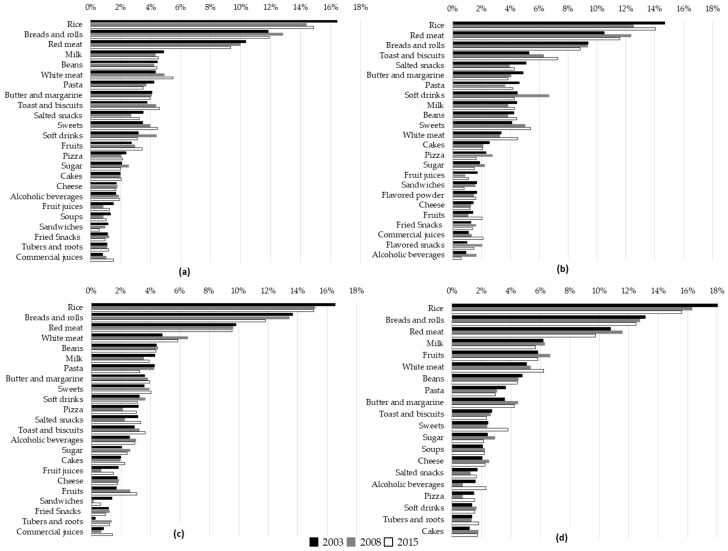
Although changes in Brazilian diet have occurred over the last decades, there is no evidence about differences in food portion sizes (FPS) over time. Therefore, we aimed to evaluate the association of FPS with excess body weight (EBW), and to monitor differences in the population from São Paulo, Brazil, from 2003 to 2015. Data came from three cross-sectional population-based studies with 5270 individuals aged ≥12 years in 2003, 2008, and 2015. Dietary data were obtained from 24-h recalls. Logistic regression models were used to evaluate the association between FPS and EBW. Over the years, there was a diverse variation in FPS, with an increase in some groups (white meat, salted snacks, coffee/tea, eggs) and decrease in others (rice, red meat, sweets, pasta, sandwiches, cold cuts). The percentage of people reporting the intake of six food groupings (rice, white meat, sweets, fruits, commercial juices, toasts/biscuits) increased in the period. In this population, EBW was associated with larger FPS of 11 of the 30 food groupings investigated (cold cuts, fried snacks, fruit and commercial juices, pizza, red meat, rice, salted snacks, soft drinks, soups, sugar). These findings could support future interventions and policies for optimal food intake in Brazil.
尽管巴西饮食在过去几十年发生了变化,但目前尚无关于食物份量(FPS)随时间变化的证据。因此,我们旨在评估 FPS 与超重(EBW)的关联,并监测 2003 年至 2015 年期间巴西圣保罗人口的差异。数据来自 2003 年、2008 年和 2015 年进行的三项基于人群的横断面研究,共涉及 5270 名年龄≥12 岁的个体。饮食数据来自 24 小时回忆。使用逻辑回归模型评估 FPS 与 EBW 之间的关联。多年来,FPS 呈现出多样化的变化,一些群体(白肉、咸零食、咖啡/茶、鸡蛋)的 FPS 增加,而另一些群体(大米、红肉、糖果、意大利面、三明治、冷切)的 FPS 减少。在这一时期,报告摄入 6 种食物组(大米、白肉、糖果、水果、商业果汁、吐司/饼干)的人群比例增加。在该人群中,超重与 30 种食物组中的 11 种 FPS 较大有关(冷切、油炸零食、水果和商业果汁、披萨、红肉、大米、咸零食、软饮料、汤、糖)。这些发现可能为巴西未来的最佳食物摄入量干预和政策提供支持。