Institute of Inflammation and Ageing, University of Birmingham, Birmingham, UK.
Mediators Inflamm. 2018 Apr 11;2018:4065362. doi: 10.1155/2018/4065362. eCollection 2018.
Neutrophil dysfunction in sepsis has been implicated in the pathogenesis of multiorgan failure; however, the role of neutrophil extracellular traps (NETs) remains uncertain. We aimed to determine the sequential changes in ex vivo NETosis and its relationship with mortality in patients with sepsis and severe sepsis.
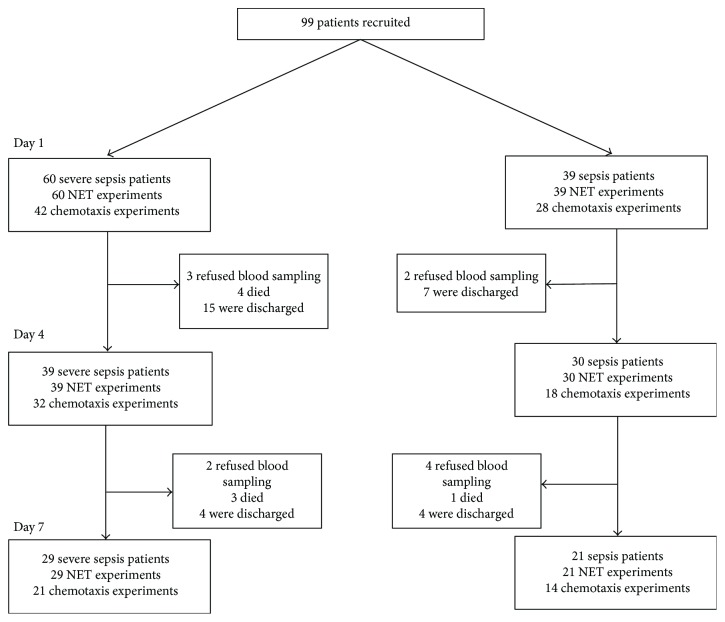
This was a prospective observational cohort study enrolling 21 healthy age-matched controls and 39 sepsis and 60 severe sepsis patients from acute admissions to two UK hospitals. Patients had sequential bloods for the ex vivo assessment of NETosis in response to phorbol-myristate acetate (PMA) using a fluorometric technique and chemotaxis using time-lapse video microscopy. Continuous data was tested for normality, with appropriate parametric and nonparametric tests, whilst categorical data was analysed using a chi-squared test. Correlations were performed using Spearman's rho.
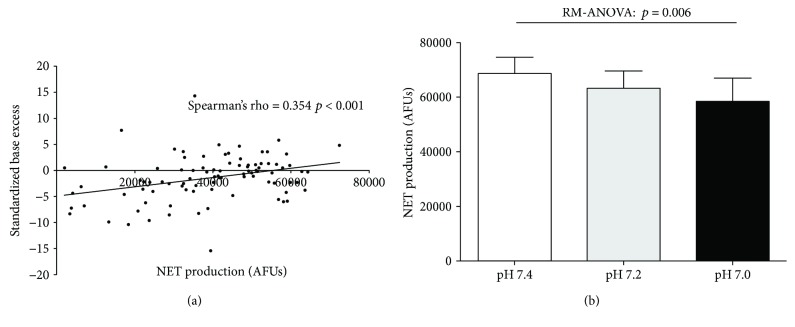
Ex vivo NETosis was reduced in patients with severe sepsis, compared to patients with sepsis and controls ( = 0.002). PMA NETosis from patients with septic shock was reduced further ( < 0.001) compared to controls. The degree of metabolic acidosis correlated with reduced NETosis ( < 0.001), and this was replicated when neutrophils from healthy donors were incubated in acidotic media. Reduced NETosis at baseline was associated with an increased 30-day ( = 0.002) and 90-day mortality ( = 0.014) in sepsis patients. These findings were accompanied by defects in neutrophil migration and delayed apoptosis. Resolution of sepsis was not associated with the return to baseline levels of NETosis or migration.
Sepsis induces significant changes in neutrophil function with the degree of dysfunction corresponding to the severity of the septic insult which persists beyond physiological recovery from sepsis. The changes induced lead to the failure to effectively contain and eliminate the invading pathogens and contribute to sepsis-induced immunosuppression. For the first time, we demonstrate that reduced ex vivo NETosis is associated with poorer outcomes from sepsis.
脓毒症中中性粒细胞功能障碍与多器官衰竭的发病机制有关;然而,中性粒细胞胞外诱捕网(NETs)的作用仍不确定。我们旨在确定脓毒症和严重脓毒症患者体外 NET 形成的序贯变化及其与死亡率的关系。
这是一项前瞻性观察队列研究,纳入了来自英国两家医院急性入院的 21 名健康年龄匹配的对照者和 39 名脓毒症患者和 60 名严重脓毒症患者。使用荧光技术和延时视频显微镜对趋化性进行体外评估,检测到患者对佛波醇肉豆蔻酸酯(PMA)的 NET 形成的序贯血液。对连续数据进行正态性检验,使用适当的参数和非参数检验,而分类数据使用卡方检验进行分析。使用 Spearman's rho 进行相关性分析。
与脓毒症患者和对照组相比,严重脓毒症患者的体外 NET 形成减少( = 0.002)。与对照组相比,脓毒性休克患者的 PMA NET 形成进一步减少( < 0.001)。代谢性酸中毒的严重程度与 NET 形成减少相关( < 0.001),当健康供体的中性粒细胞在酸性介质中孵育时,可复制这种情况。基线时 NET 形成减少与脓毒症患者 30 天( = 0.002)和 90 天死亡率增加相关( = 0.014)。这些发现伴随着中性粒细胞迁移和延迟凋亡的缺陷。脓毒症的缓解与 NET 形成或迁移恢复到基线水平无关。
脓毒症会引起中性粒细胞功能的显著变化,功能障碍的程度与脓毒症的严重程度相对应,并且这种变化持续存在,超过了从脓毒症中生理恢复的程度。诱导的变化导致无法有效控制和消除入侵的病原体,并导致脓毒症引起的免疫抑制。我们首次证明,体外 NET 形成减少与脓毒症的预后较差有关。