Biological Sciences, University of Southampton, Southampton, UK.
School of Medicine, University of St Andrews, St Andrews, UK.
Neural Plast. 2018 Apr 18;2018:2952386. doi: 10.1155/2018/2952386. eCollection 2018.
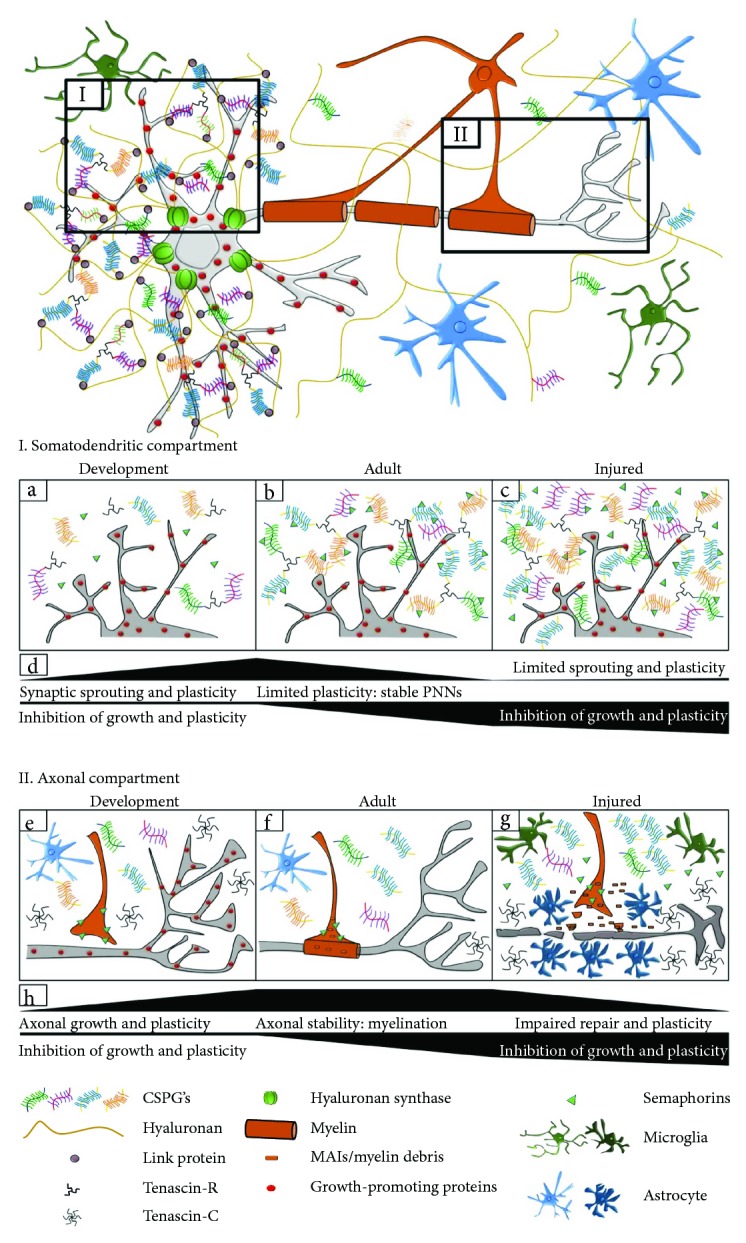
The extracellular environment of the central nervous system (CNS) becomes highly structured and organized as the nervous system matures. The extracellular space of the CNS along with its subdomains plays a crucial role in the function and stability of the CNS. In this review, we have focused on two components of the neuronal extracellular environment, which are important in regulating CNS plasticity including the extracellular matrix (ECM) and myelin. The ECM consists of chondroitin sulfate proteoglycans (CSPGs) and tenascins, which are organized into unique structures called perineuronal nets (PNNs). PNNs associate with the neuronal cell body and proximal dendrites of predominantly parvalbumin-positive interneurons, forming a robust lattice-like structure. These developmentally regulated structures are maintained in the adult CNS and enhance synaptic stability. After injury, however, CSPGs and tenascins contribute to the structure of the inhibitory glial scar, which actively prevents axonal regeneration. Myelin sheaths and mature adult oligodendrocytes, despite their important role in signal conduction in mature CNS axons, contribute to the inhibitory environment existing after injury. As such, unlike the peripheral nervous system, the CNS is unable to revert to a "developmental state" to aid neuronal repair. Modulation of these external factors, however, has been shown to promote growth, regeneration, and functional plasticity after injury. This review will highlight some of the factors that contribute to or prevent plasticity, sprouting, and axonal regeneration after spinal cord injury.
中枢神经系统(CNS)的细胞外环境在神经系统成熟过程中变得高度结构化和组织化。CNS 的细胞外空间及其子域在 CNS 的功能和稳定性中发挥着关键作用。在这篇综述中,我们集中讨论了神经元细胞外环境的两个重要组成部分,它们在调节 CNS 可塑性方面起着重要作用,包括细胞外基质(ECM)和髓鞘。ECM 由软骨素硫酸盐蛋白聚糖(CSPGs)和 tenascin 组成,它们组织成称为神经周围网(PNNs)的独特结构。PNNs 与神经元细胞体和主要表达 parvalbumin 的中间神经元的近端树突相关联,形成坚固的晶格状结构。这些发育调节的结构在成年 CNS 中得以维持,并增强突触稳定性。然而,在损伤后,CSPGs 和 tenascin 有助于形成抑制性神经胶质瘢痕的结构,该结构积极阻止轴突再生。髓鞘和成熟的少突胶质细胞,尽管它们在成熟 CNS 轴突中的信号传导中起着重要作用,但在损伤后也会形成抑制性环境。因此,与周围神经系统不同,CNS 无法恢复到“发育状态”以帮助神经元修复。然而,这些外部因素的调节已被证明可以促进损伤后生长、再生和功能可塑性。这篇综述将重点介绍一些有助于或阻止脊髓损伤后可塑性、发芽和轴突再生的因素。