CeMM Research Center for Molecular Medicine of the Austrian Academy of Sciences , 1090 Vienna , Austria.
Center for Physiology and Pharmacology , Medical University of Vienna , 1090 Vienna , Austria.
ACS Chem Biol. 2018 Jun 15;13(6):1480-1486. doi: 10.1021/acschembio.8b00270. Epub 2018 Jun 6.
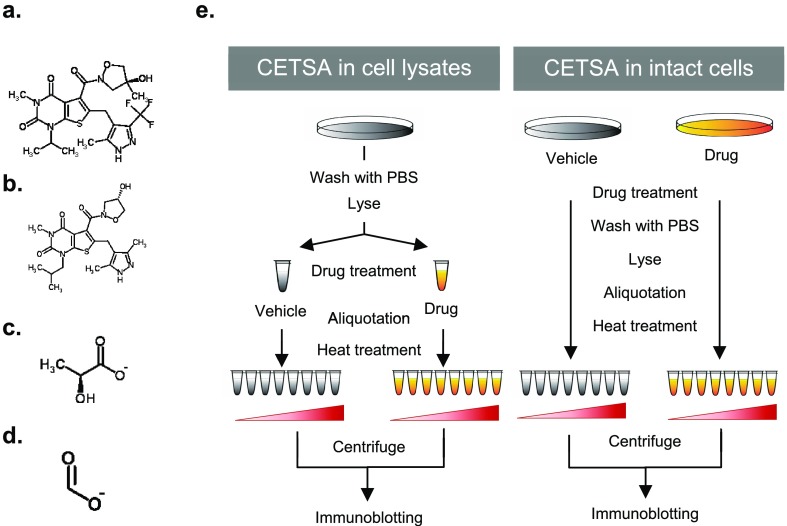
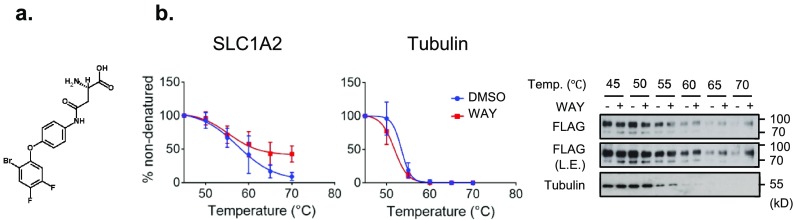
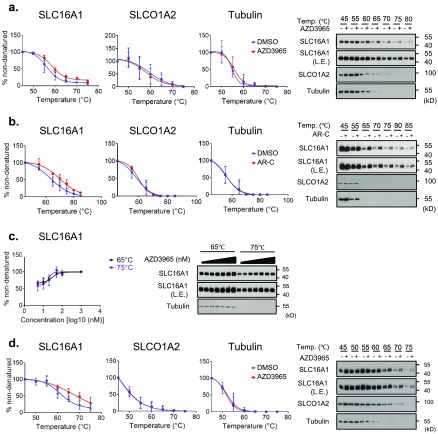
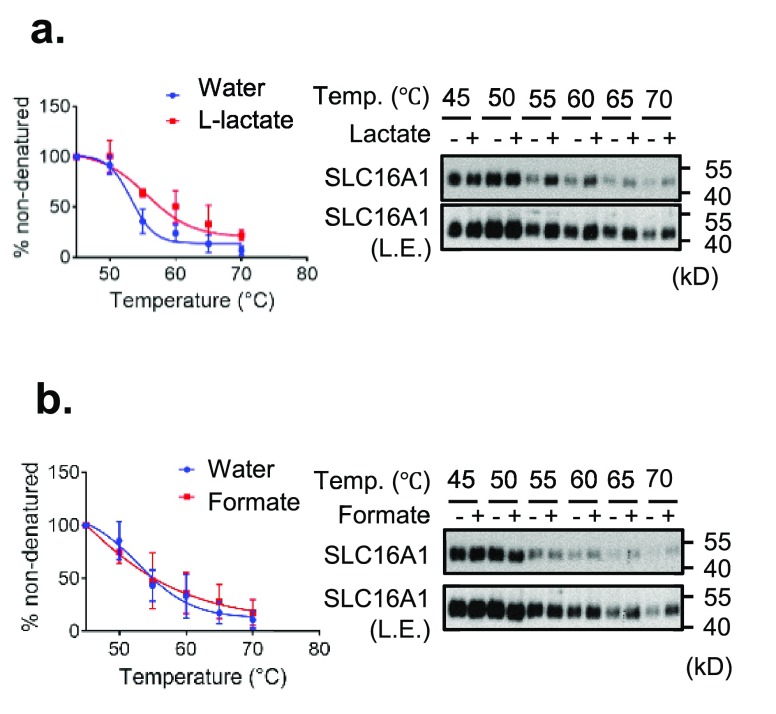
Solute carriers (SLCs) are transmembrane proteins that transport various nutrients, metabolites, and drugs across cellular membranes. Despite the relevance of SLCs to cell homeostasis, metabolism, and disease states, for the majority of SLCs we lack experimental evidence regarding the nature of the cognate ligands, whether endobiotic or xenobiotic. Moreover, even for the roughly 20 SLCs for which inhibitors have been characterized, engagement assays in cells are limited to the accessibility of radiolabeled or fluorescent probes. The cellular thermal shift assay (CETSA) has been introduced as a powerful method to assess target engagement by monitoring ligand-induced changes in the thermal stability of cellular proteins. We addressed the question of whether CETSA could be modified to become routinely applicable to membrane transporters such as SLCs. We used SLC16A1 (MCT1) and SLC1A2 (EAAT2) as targets to establish robust conditions by which chemical engagement of SLCs can be detected. Using immunoblotting, we demonstrate that treatment with the SLC16A1 inhibitors AZD3965 and AR-C155858 stabilized endogenous SLC16A1 in HEK293 cell lysates as well as intact cells. In addition, the high-affinity ligand of SLC16A1, l-lactate, and the low-affinity ligand, formate, resulted in strong and weak stabilization of SLC16A1, respectively. Moreover, we observed stabilization of SLC1A2 upon treatment with the selective inhibitor WAY-213613. We propose that the experimental approach presented here should be generally and easily applicable for monitoring the engagement of chemical ligands by SLCs in cellular settings and thus assisting in their deorphanization.
溶质载体 (SLCs) 是跨膜蛋白,可将各种营养物质、代谢物和药物运输穿过细胞膜。尽管 SLCs 与细胞内稳态、代谢和疾病状态有关,但对于大多数 SLCs,我们缺乏关于其同源配体性质的实验证据,无论是内源性的还是外源性的。此外,即使对于大约 20 种已经确定了抑制剂的 SLCs,细胞中的结合测定也仅限于放射性标记或荧光探针的可及性。细胞热转移测定 (CETSA) 已被引入作为一种强大的方法来评估配体与靶标的结合,方法是监测配体诱导的细胞蛋白热稳定性变化。我们提出了一个问题,即 CETSA 是否可以被修改,以便常规适用于膜转运体,如 SLCs。我们使用 SLC16A1(MCT1)和 SLC1A2(EAAT2)作为靶点,通过建立可靠的条件来检测 SLCs 的化学结合。通过免疫印迹,我们证明用 SLC16A1 抑制剂 AZD3965 和 AR-C155858 处理可稳定 HEK293 细胞裂解物和完整细胞中的内源性 SLC16A1。此外,SLC16A1 的高亲和力配体 l-乳酸和低亲和力配体甲酸盐分别导致 SLC16A1 的强和弱稳定。此外,我们观察到选择性抑制剂 WAY-213613 处理后 SLC1A2 的稳定化。我们提出,这里提出的实验方法应该普遍且易于适用于监测化学配体与 SLCs 在细胞环境中的结合,从而有助于它们的去孤儿化。