Early Clinical Trials Development Program, Developmental Therapeutics Clinic, Division of Cancer Treatment and Diagnosis, National Cancer Institute, Bethesda, Maryland, USA.
Division of Cancer Treatment and Diagnosis, National Cancer Institute, Bethesda, Maryland, USA.
Oncologist. 2018 Nov;23(11):1269-e125. doi: 10.1634/theoncologist.2018-0203. Epub 2018 May 31.
The combination of the antiangiogenic agent ziv-aflibercept and the heat shock protein 90 inhibitor ganetespib was associated with several serious and unexpected adverse events and was not tolerable on the dosing schedule tested.Studies such as these emphasize the importance of considering overlapping toxicities when designing novel treatment combination regimens.
Although inhibition of angiogenesis is an effective strategy for cancer treatment, acquired resistance to antiangiogenic therapy is common. Heat shock protein 90 (Hsp90) is a molecular chaperone that regulates various oncogenic signaling pathways involved in acquired resistance and has been shown to play a role in angiogenesis. Combining an antiangiogenic agent with an Hsp90 inhibitor has therefore been proposed as a strategy for preventing resistance and improving antitumor activity. We conducted a single-arm phase I study evaluating the combination of ziv-aflibercept, an antiangiogenic drug, with the Hsp90 inhibitor ganetespib.
Adult patients were eligible if they had recurrent or metastatic gastrointestinal carcinomas, nonsquamous non-small cell lung carcinomas, urothelial carcinomas, or sarcomas that had progressed after at least one line of standard therapy. Ziv-aflibercept was administered intravenously on days 1 and 15, and ganetespib was administered intravenously on days 1, 8, and 15, of each 28-day cycle.
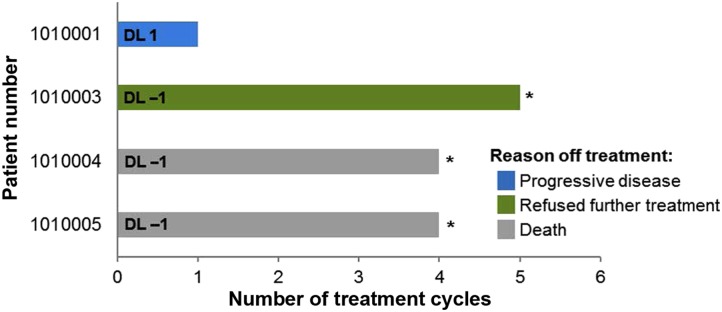
Five patients were treated with the combination. Although three patients achieved stable disease, study treatment was associated with several serious and unexpected adverse events.
The dose escalation phase of this study was not completed, but the limited data obtained suggest that this combination may be too toxic when administered on this dosing schedule.
抗血管生成剂 ziv-aflibercept 与热休克蛋白 90 抑制剂 ganetespib 的联合应用与多种严重且意外的不良事件相关,且在测试的给药方案下无法耐受。此类研究强调了当设计新的治疗联合方案时,考虑重叠毒性的重要性。
尽管抑制血管生成是癌症治疗的有效策略,但对抗血管生成治疗的获得性耐药很常见。热休克蛋白 90(Hsp90)是一种分子伴侣,可调节多种参与获得性耐药的致癌信号通路,并且已被证明在血管生成中起作用。因此,联合使用抗血管生成药物和 Hsp90 抑制剂已被提议作为一种预防耐药和提高抗肿瘤活性的策略。我们进行了一项单臂 I 期研究,评估了抗血管生成药物 ziv-aflibercept 与 Hsp90 抑制剂 ganetespib 的联合应用。
符合条件的成年患者为患有复发性或转移性胃肠道癌、非鳞状非小细胞肺癌、尿路上皮癌或肉瘤,且在至少一线标准治疗后进展。ziv-aflibercept 于每个 28 天周期的第 1 天和第 15 天静脉给药,ganetespib 于第 1、8 和 15 天静脉给药。
共有 5 名患者接受了联合治疗。尽管 3 名患者疾病稳定,但研究治疗与多种严重且意外的不良事件相关。
尽管该研究的剂量递增阶段尚未完成,但获得的有限数据表明,按照该给药方案,该联合用药可能毒性太大。