The Clinical Hospital of Chengdu Brain Science Institute, MOE Key Lab for Neuroinformation, University of Electronic Science and Technology of China, Chengdu, China.
Department of Psychiatry, Chengdu Mental Health Centre, The Four People's Hospital of Chengdu, Chengdu 610036, China.
Neural Plast. 2018 May 2;2018:2821832. doi: 10.1155/2018/2821832. eCollection 2018.
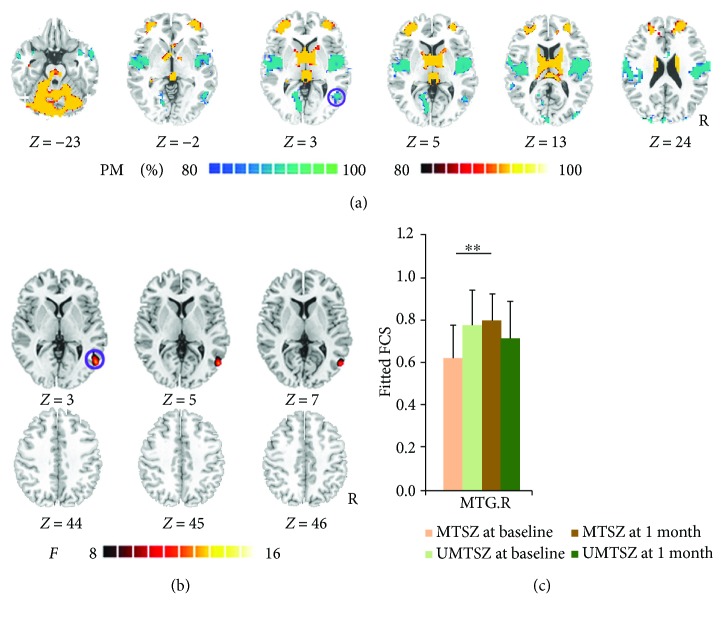
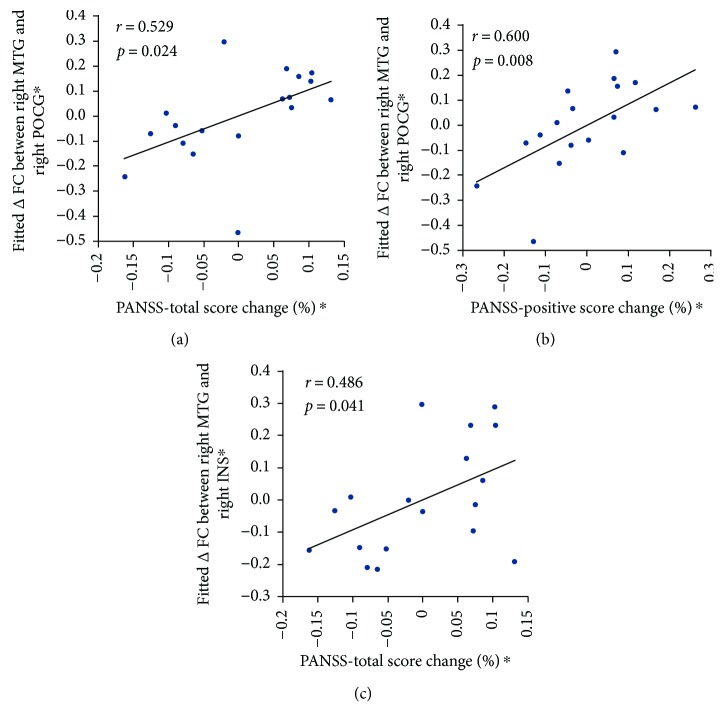
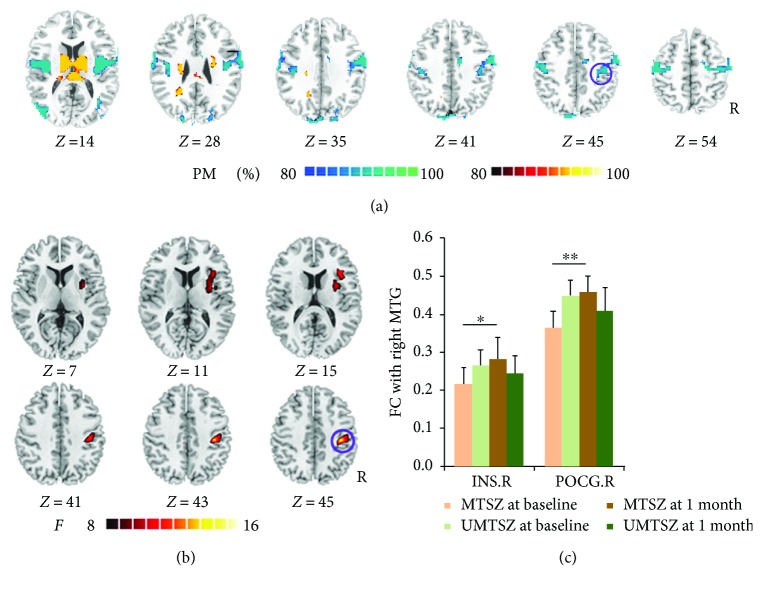
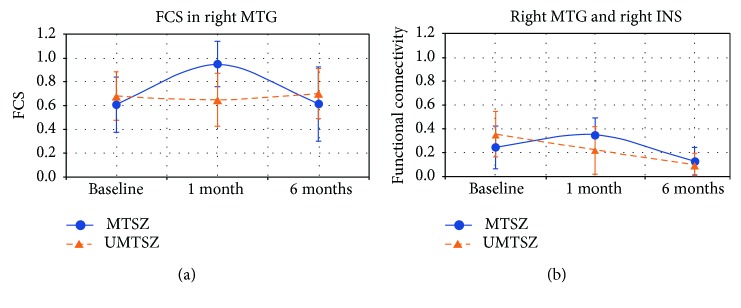
Schizophrenia is often associated with behavior abnormality in the cognitive and affective domain. Music intervention is used as a complementary treatment for improving symptoms in patients with schizophrenia. However, the neurophysiological correlates of these remissions remain poorly understood. Here, we investigated the effects of music intervention in neural circuits through functional magnetic resonance imaging (fMRI) study in schizophrenic subjects. Under the standard care, patients were randomly assigned to music and non-music interventions (MTSZ, UMTSZ) for 1 month. Resting-state fMRI were acquired over three time points (baseline, 1 month, and 6 months later) in patients and analyzed using functional connectivity strength (FCS) and seed-based functional connection (FC) approaches. At baseline, compared with healthy controls, decreased FCS in the right middle temporal gyrus (MTG) was observed in patients. However, after music intervention, the functional circuitry of the right MTG, which was related with the function of emotion and sensorimotor, was improved in MTSZ. Furthermore, the FC increments were significantly correlated with the improvement of symptoms, while vanishing 6 months later. Together, these findings provided evidence that music intervention might positively modulate the functional connectivity of MTG in patients with schizophrenia; such changes might be associated with the observed therapeutic effects of music intervention on neurocognitive function. This trial is registered with ChiCTR-OPC-14005339.
精神分裂症常伴有认知和情感领域的行为异常。音乐干预被用作改善精神分裂症患者症状的辅助治疗方法。然而,这些缓解的神经生理相关性仍知之甚少。在这里,我们通过对精神分裂症患者的功能磁共振成像(fMRI)研究,研究了音乐干预对神经回路的影响。在标准护理下,患者被随机分配到音乐和非音乐干预组(MTSZ、UMTSZ)进行 1 个月的治疗。在患者中采集了三个时间点(基线、1 个月和 6 个月后)的静息态 fMRI,并使用功能连接强度(FCS)和基于种子的功能连接(FC)方法进行分析。在基线时,与健康对照组相比,患者的右侧颞中回(MTG)的 FCS 降低。然而,在音乐干预后,与情绪和感觉运动功能相关的右侧 MTG 的功能回路在 MTSZ 中得到了改善。此外,FC 的增加与症状的改善显著相关,而 6 个月后则消失。总之,这些发现提供了证据表明,音乐干预可能会积极调节精神分裂症患者 MTG 的功能连接;这些变化可能与音乐干预对神经认知功能的观察到的治疗效果有关。该试验在中国临床试验注册中心注册,注册号为 ChiCTR-OPC-14005339。