Department of Pathobiology and Medical Biotechnologies, University of Palermo, Palermo, Italy.
Unit of Cardiac Surgery, Department of Surgery and Oncology, University of Palermo, Palermo, Italy.
Oxid Med Cell Longev. 2018 Apr 5;2018:5879281. doi: 10.1155/2018/5879281. eCollection 2018.
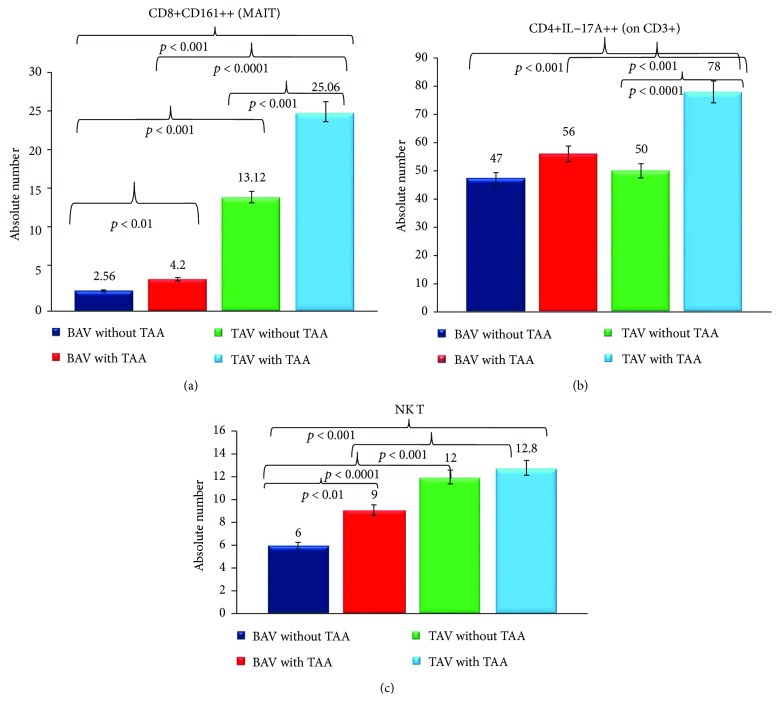
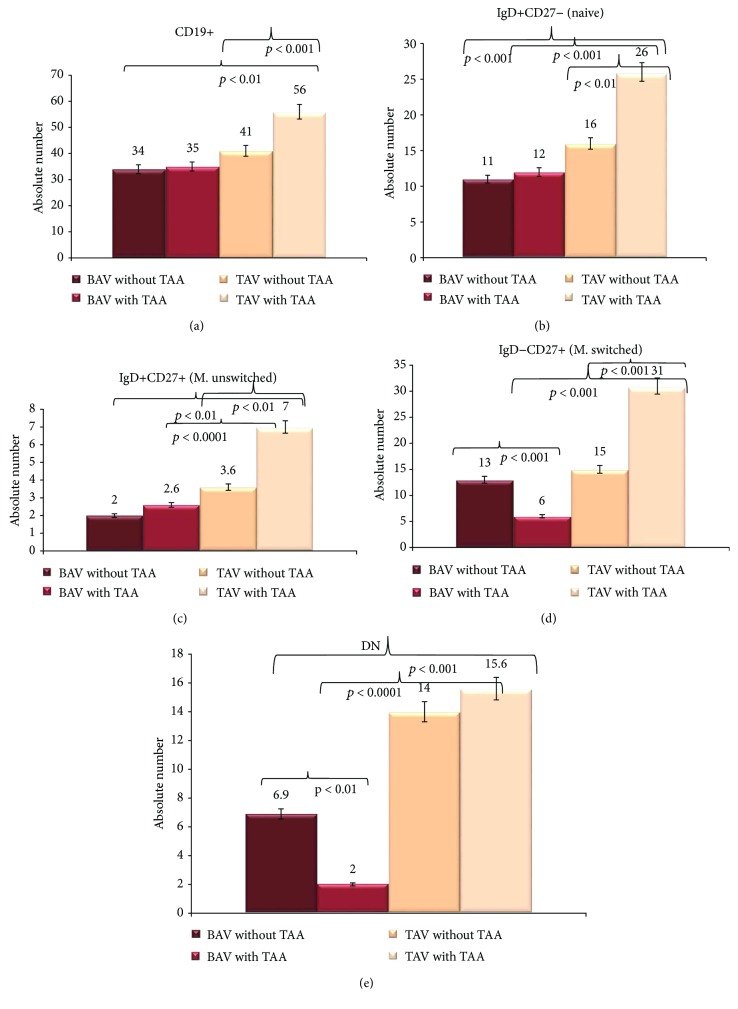
Bicuspid valve disease is associated with the development of thoracic aortic aneurysm. The molecular mechanisms underlying this association still need to be clarified. Here, we evaluated the circulating levels of T and B lymphocyte subsets associated with the development of vascular diseases in patients with bicuspid aortic valve or tricuspid aortic valve with and without thoracic aortic aneurysm. We unveiled that the circulating levels of the MAIT, CD4+IL-17A+, and NKT T cell subsets were significantly reduced in bicuspid valve disease cases, when compared to tricuspid aortic valve cases in either the presence or the absence of thoracic aortic aneurysm. Among patients with tricuspid aortic valve, these cells were higher in those also affected by thoracic aortic aneurysm. Similar data were obtained by examining CD19+ B cells, naïve B cells (IgD+CD27-), memory unswitched B cells (IgD+CD27+), memory switched B cells (IgD-CD27+), and double-negative B cells (DN) (IgD-CD27-). These cells resulted to be lower in subjects with bicuspid valve disease with respect to patients with tricuspid aortic valve. In whole, our data indicate that patients with bicuspid valve disease show a quantitative reduction of T and B lymphocyte cell subsets. Future studies are encouraged to understand the molecular mechanisms underlying this observation and its pathophysiological significance.
二叶式主动脉瓣病变与胸主动脉瘤的发展有关。这种关联的分子机制仍需阐明。在这里,我们评估了与二叶式主动脉瓣或三叶式主动脉瓣伴或不伴胸主动脉瘤患者血管疾病发展相关的 T 和 B 淋巴细胞亚群的循环水平。我们发现,与三叶式主动脉瓣病例相比,二叶式主动脉瓣病例中 MAIT、CD4+IL-17A+和 NKT T 细胞亚群的循环水平显著降低,无论胸主动脉瘤是否存在。在三叶式主动脉瓣患者中,这些细胞在同时受胸主动脉瘤影响的患者中更高。通过检查 CD19+B 细胞、幼稚 B 细胞(IgD+CD27-)、未转换记忆 B 细胞(IgD+CD27+)、转换记忆 B 细胞(IgD-CD27+)和双阴性 B 细胞(DN)(IgD-CD27-),也获得了类似的数据。与三叶式主动脉瓣患者相比,二叶式主动脉瓣疾病患者的这些细胞数量较低。总的来说,我们的数据表明,二叶式主动脉瓣疾病患者的 T 和 B 淋巴细胞亚群数量减少。鼓励未来的研究来理解这一观察结果及其病理生理学意义的分子机制。