Amoah Padmore Adusei
Division of Graduate Studies and Asia Pacific Institute of Ageing Studies, Lingnan University, 8 Castle Peak Rd, Tuen Mun, Hong Kong (SAR).
SSM Popul Health. 2018 Mar 9;4:263-270. doi: 10.1016/j.ssmph.2018.02.005. eCollection 2018 Apr.
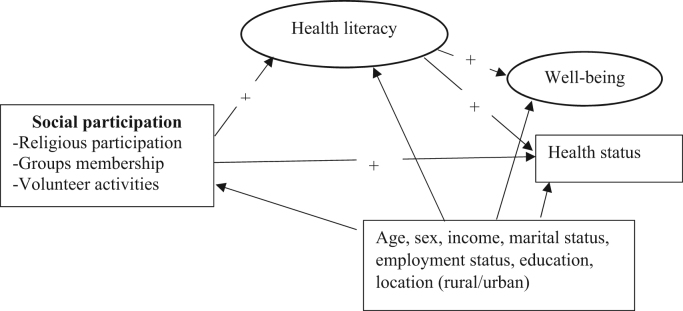
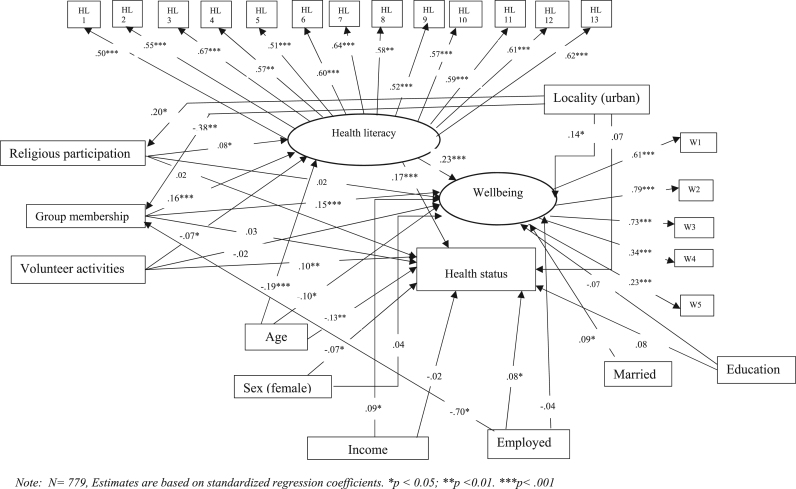
Numerous studies attest to the salubriousness of social participation across contexts. Factors such as health-related behaviour, health risk aversion, and psychosocial traits partly explain this association. While a study of these factors contributes to an understanding of the role that social participation plays in health-related outcomes, significant gaps still exist in this field of investigation. In particular, existing studies have not explored the relationship between social participation and health literacy and how it affects health and well-being adequately. This paper addresses this gap by examining the responses of some 779 rural and urban residents in Ashanti Region in Ghana. The study used path analyses within structural equation modelling (SEM) to assess the mediational role of health literacy in the association between social participation (religious participation, volunteer activities and group membership), and health status and subjective well-being. All the proxies of social participation significantly predicted health literacy. It was also evident that social participation influences health and well-being substantially. After controlling for socio-demographic variables, religious participation and group membership indirectly predicted well-being and health status through health literacy. Volunteer activities showed a negative indirect effect; thus, social participation does not always have a favourable effect on health and well-being. However, the findings suggest that overall, enhancing social participation may be promising for effective health promotion.
众多研究证实了不同背景下社会参与的有益性。与健康相关的行为、健康风险规避以及心理社会特征等因素部分解释了这种关联。虽然对这些因素的研究有助于理解社会参与在健康相关结果中所起的作用,但在这一研究领域仍存在重大差距。特别是,现有研究尚未充分探讨社会参与与健康素养之间的关系以及它如何影响健康和幸福。本文通过考察加纳阿散蒂地区约779名城乡居民的回答来填补这一差距。该研究在结构方程模型(SEM)中使用路径分析来评估健康素养在社会参与(宗教参与、志愿活动和团体成员身份)与健康状况及主观幸福感之间的关联中的中介作用。社会参与的所有指标都显著预测了健康素养。同样明显的是,社会参与对健康和幸福有重大影响。在控制了社会人口统计学变量后,宗教参与和团体成员身份通过健康素养间接预测了幸福感和健康状况。志愿活动显示出负面的间接影响;因此,社会参与并非总是对健康和幸福有积极影响。然而,研究结果表明,总体而言,增强社会参与可能对有效的健康促进具有前景。