National Oceanic and Atmospheric Administration, Southwest Fisheries Science Center, Monterey, CA 93940, USA.
Institute of Marine Sciences, University of California, Santa Cruz, Santa Cruz, CA 95064, USA.
Sci Adv. 2018 May 30;4(5):eaar3001. doi: 10.1126/sciadv.aar3001. eCollection 2018 May.
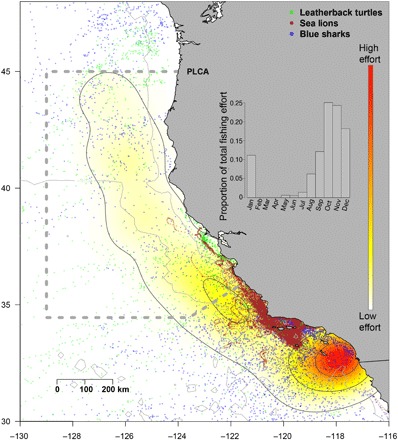
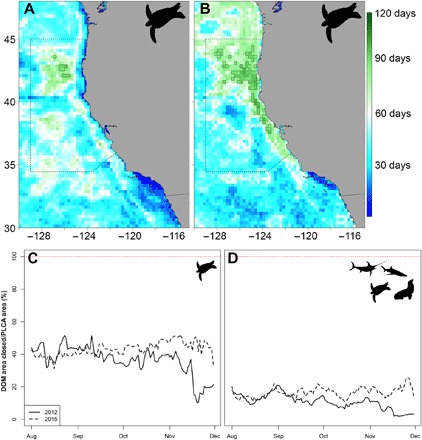
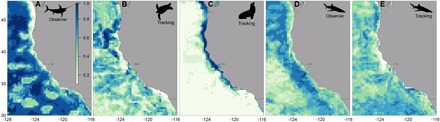
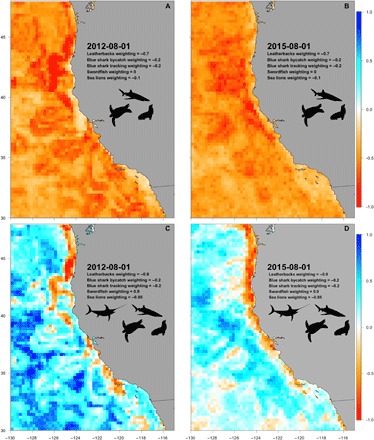
Seafood is an essential source of protein for more than 3 billion people worldwide, yet bycatch of threatened species in capture fisheries remains a major impediment to fisheries sustainability. Management measures designed to reduce bycatch often result in significant economic losses and even fisheries closures. Static spatial management approaches can also be rendered ineffective by environmental variability and climate change, as productive habitats shift and introduce new interactions between human activities and protected species. We introduce a new multispecies and dynamic approach that uses daily satellite data to track ocean features and aligns scales of management, species movement, and fisheries. To accomplish this, we create species distribution models for one target species and three bycatch-sensitive species using both satellite telemetry and fisheries observer data. We then integrate species-specific probabilities of occurrence into a single predictive surface, weighing the contribution of each species by management concern. We find that dynamic closures could be 2 to 10 times smaller than existing static closures while still providing adequate protection of endangered nontarget species. Our results highlight the opportunity to implement near real-time management strategies that would both support economically viable fisheries and meet mandated conservation objectives in the face of changing ocean conditions. With recent advances in eco-informatics, dynamic management provides a new climate-ready approach to support sustainable fisheries.
海鲜是全球超过 30 亿人蛋白质的重要来源,但在捕捞渔业中,受威胁物种的兼捕仍然是渔业可持续性的主要障碍。旨在减少兼捕的管理措施往往会导致重大经济损失,甚至渔业关闭。静态空间管理方法也可能因环境变异性和气候变化而失效,因为生产性生境发生变化,并在人类活动和受保护物种之间引入新的相互作用。我们引入了一种新的多物种和动态方法,该方法使用每日卫星数据来跟踪海洋特征,并调整管理、物种移动和渔业的规模。为此,我们使用卫星遥测和渔业观察员数据为一个目标物种和三个兼捕敏感物种创建物种分布模型。然后,我们将特定物种出现的概率集成到一个单一的预测表面中,根据管理关注程度权衡每个物种的贡献。我们发现,动态关闭的面积可能比现有的静态关闭小 2 到 10 倍,同时仍能为濒危非目标物种提供充分的保护。我们的结果强调了实施近实时管理策略的机会,这些策略既能支持经济上可行的渔业,又能在不断变化的海洋条件下实现规定的保护目标。随着生态信息学的最新进展,动态管理为支持可持续渔业提供了一种新的适应气候变化的方法。