Centre for Epidemiology and Microbiology, National Institute of Public Health, Prague, Czech Republic.
Department of Clinical Microbiology, Faculty of Medicine and University Hospital, Charles University, Hradec Kralove, Czech Republic.
J Med Microbiol. 2018 Jul;67(7):1003-1011. doi: 10.1099/jmm.0.000765.
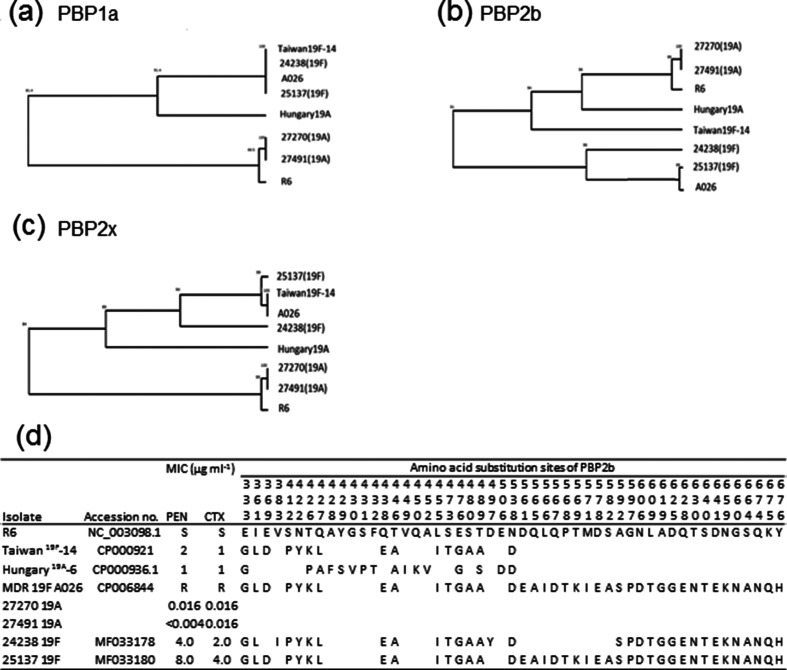
The aim of this study was to characterize serogroup 19 isolates resistant to macrolides and/or penicillin found among pneumococci recovered from cases of invasive and respiratory tract disease in the Czech Republic in 2014. Pneumococcal isolates of serotypes 19A (=26) and 19F (=10) that were non-susceptible to penicillin and/or macrolides and had been collected in 2014 were analysed using multi-locus sequence typing (MLST). Four isolates representing the major clones were subjected to whole-genome sequencing (WGS). The penicillin-susceptible macrolide-resistant isolates of serotype 19A were mainly associated with sequence type (ST) 416 belonging to clonal complex (CC) 199, and the penicillin-resistant isolates were of serotype 19F belonging to ST1464 (CC 320). WGS revealed the presence of pilus 1, in association with pilus 2, in serotype19F isolates belonging to CC 320. Another adhesin, pneumococcal serine-rich protein (PsrP), was only present in serotype 19A isolates of ST416. Analysis of the penicillin-binding proteins (PBPs) of serotype 19F penicillin-resistant isolates (ST1464 and ST271) performed on PBP1a, 2b and 2x identified a large number of mutations in comparison to the reference strain, R6. Both isolates contained a unique PBP profile; however, they were highly similar to PBP sequences of the Taiwan-14 reference strain. The sequences of both 19F isolates showed the lowest similarity to those of the Taiwan-14 strain (91 % similarity), while they were also found to be distantly related to each other (94 % similarity). WGS revealed specific virulence factors in antibiotic-resistant pneumococcal clones that spread rapidly in the post-vaccine era in the Czech Republic.
本研究旨在描述 2014 年在捷克共和国从侵袭性和呼吸道疾病病例中分离出的对大环内酯类和/或青霉素耐药的 19 型血清群分离株的特征。对 2014 年分离的非青霉素和/或大环内酯类药物敏感的 19A 型(=26)和 19F 型(=10)血清型肺炎球菌分离株进行多位点序列分型(MLST)分析。对 4 个代表主要克隆的分离株进行全基因组测序(WGS)。青霉素敏感、大环内酯类耐药的 19A 型分离株主要与属于 CC199 的克隆复合体(CC)199 的序列型(ST)416 相关,而青霉素耐药的分离株为 19F 型,属于 ST1464(CC320)。WGS 显示,在属于 CC320 的 19F 型分离株中存在与 2 型菌毛相关的 1 型菌毛。另一种黏附素,肺炎球菌丝氨酸丰富蛋白(PsrP),仅存在于 ST416 的 19A 型分离株中。对青霉素耐药的 19F 型分离株(ST1464 和 ST271)的青霉素结合蛋白(PBP)进行分析,与 R6 参考株相比,在 PBP1a、2b 和 2x 上发现了大量突变。两个分离株都有独特的 PBP 图谱,但与台湾 14 参考株的 PBP 序列高度相似。这两个 19F 型分离株的 序列与台湾 14 株的相似性最低(91%相似性),但彼此之间的相似性也较远(94%相似性)。WGS 揭示了在捷克共和国疫苗接种后时代快速传播的抗生素耐药肺炎球菌克隆中的特定毒力因子。