State Key Laboratory of Microbial Resources, Institute of Microbiology, Chinese Academy of Sciences, Beijing, China.
College of Life Science, University of Chinese Academy of Sciences, Beijing, China.
Genome Med. 2023 Jul 4;15(1):46. doi: 10.1186/s13073-023-01200-8.
Streptococcus pneumoniae is a gram-positive opportunistic pathogen, and infection risks of S. pneumoniae can be profoundly augmented by its acquired multidrug-resistance (MDR). The rapid development of MDR in S. pneumoniae was attributed to the international dissemination of a small number of multidrug-resistant "clones." Clonal complex (CC) 271 is a prevalent MDR CC in the world and the most prevalent CC in China. However, the evolutionary trajectories of multidrug-resistant S. pneumoniae CC271 in China still are largely unknown.
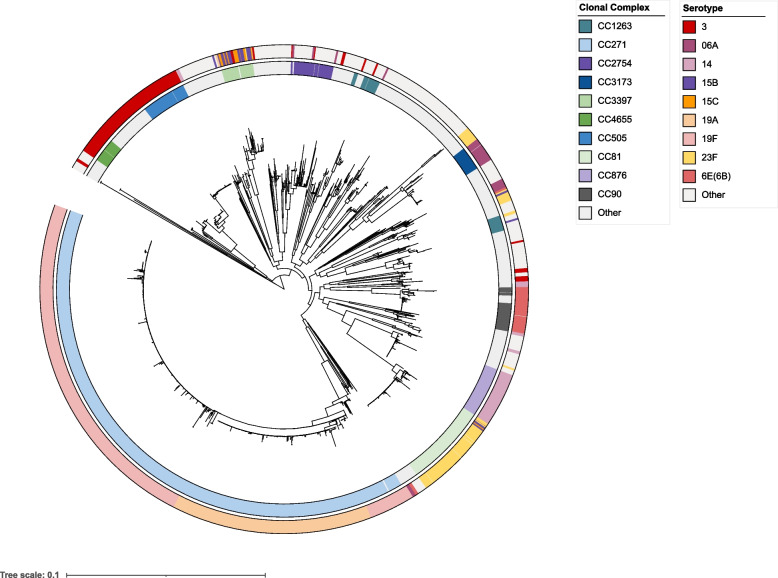
We investigated a collection of 1312 S. pneumoniae isolates collected from 28 tertiary hospitals in China from 2007 to 2020. Recombination prediction and recombination-masked phylogenetic analysis were combined to determine the population structure and mode of evolution of CC271. Data from the Global Pneumococcal Sequencing program (GPS) were combined to understand the global distribution of clones identified in this study. Bayesian analysis were recruited to analysis the evolutionary dynamics of dominant clones within CC271 in China.
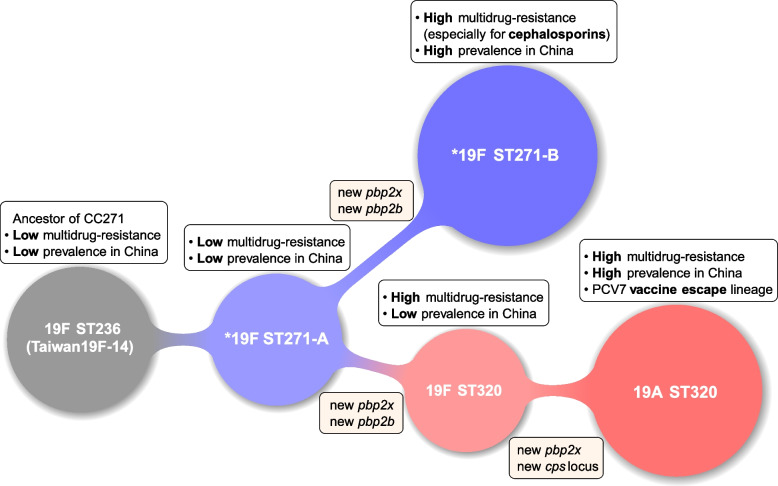
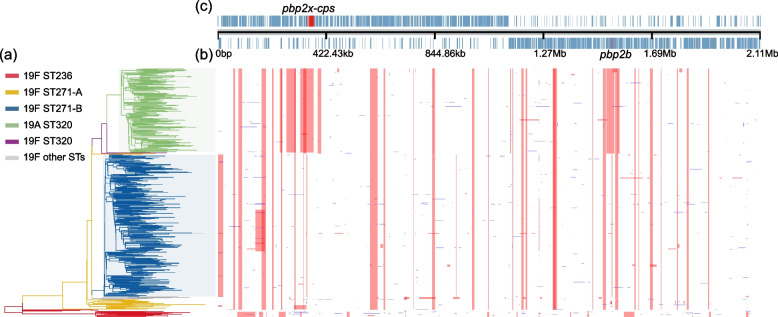
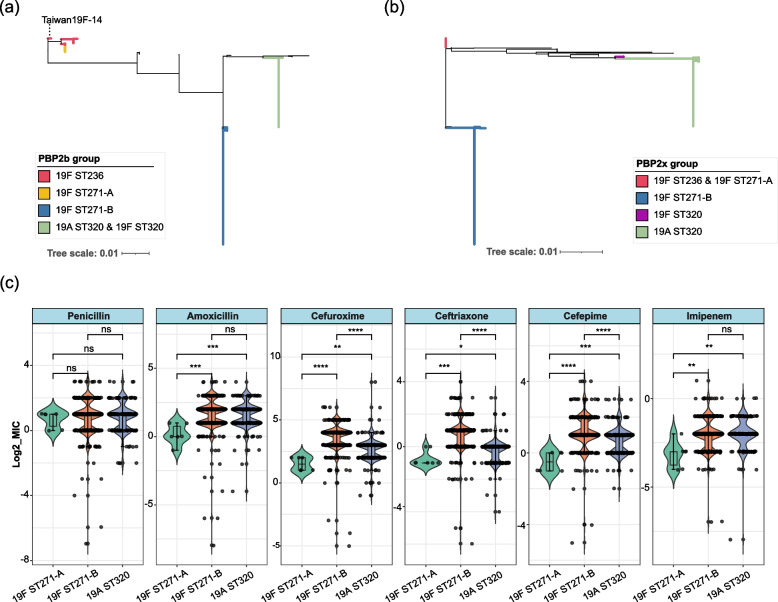
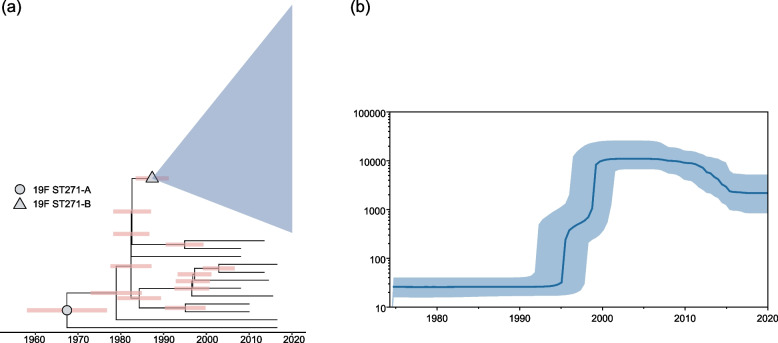
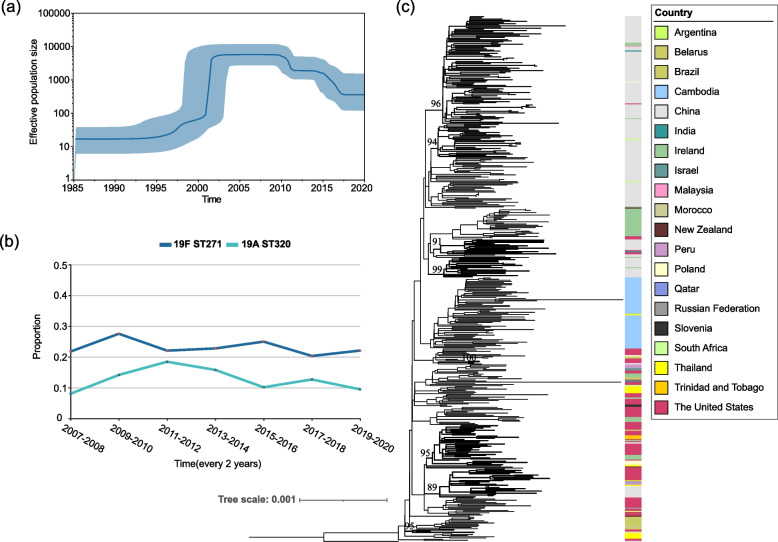
The phylogenomic analysis resulted in the discovery of two globally distributed clones, ST271-A and ST271-B. ST271-A was a derivative of ST236 and an ancestor of ST271-B and ST320, refining the internal phylogenetic relationship of CC271. ST271-B was the most dominant clone in China, with higher β-lactam resistance especially for cephalosporins comparing to other MDR clones. Bayesian skyline plot showed a rapid expansion of 19F ST271-B from 1995 to 2000, which correlates with the widespread use of cephalosporins in the 1990s in China. 19A ST320, a vaccine-escape clone, is the second largest population in China. The Bayesian skyline plot showed that the 19A ST320 began to expand rapidly around 2001, which appeared to coincide with the prevalence of 19A after application of PCV7 in 2000 in the USA. We also observed frequent transmission of 19A ST320 between countries. It suggests that mass vaccination in some countries could affect the prevalence of clones in unvaccinated countries in the context of high-frequency international transmission.
Our results refined the internal phylogenetic relationship of CC271, showing that the 19F ST271-B and 19A ST320 evolved independently from ST271-A, with different histories and driving forces for their evolution and dissemination in China.
肺炎链球菌是一种革兰氏阳性机会性病原体,其获得性多药耐药(MDR)可显著增加感染风险。肺炎链球菌 MDR 的快速发展归因于少数多药耐药“克隆”的国际传播。克隆复合体(CC)271 是世界上流行的 MDR CC,也是中国最流行的 CC。然而,中国多药耐药性肺炎链球菌 CC271 的进化轨迹在很大程度上仍然未知。
我们调查了来自 2007 年至 2020 年中国 28 家三级医院的 1312 株肺炎链球菌分离株。结合重组预测和重组掩蔽系统发育分析,确定 CC271 的种群结构和进化模式。结合全球肺炎球菌测序计划(GPS)的数据,了解本研究中鉴定的克隆在全球的分布情况。贝叶斯分析用于分析中国 CC271 内优势克隆的进化动态。
基因组分析发现了两个在全球分布的克隆,ST271-A 和 ST271-B。ST271-A 是 ST236 的衍生物,是 ST271-B 和 ST320 的祖先,从而完善了 CC271 的内部系统发育关系。ST271-B 是中国最主要的克隆,与其他 MDR 克隆相比,β-内酰胺类药物(特别是头孢菌素)耐药性更高。贝叶斯天空图显示,19F ST271-B 从 1995 年到 2000 年快速扩张,这与 20 世纪 90 年代中国头孢菌素的广泛使用有关。19A ST320 是一种逃避疫苗的克隆,是中国第二大种群。贝叶斯天空图显示,19A ST320 大约在 2001 年开始迅速扩张,这似乎与 2000 年美国应用 PCV7 后 19A 的流行相一致。我们还观察到 19A ST320 在国家间频繁传播。这表明,在高频率的国际传播背景下,一些国家的大规模疫苗接种可能会影响未接种国家的克隆流行。
我们的研究结果完善了 CC271 的内部系统发育关系,表明 19F ST271-B 和 19A ST320 分别独立于 ST271-A 进化,在中国的进化和传播具有不同的历史和驱动力。