Department of Population Medicine, Ontario Veterinary College, University of Guelph, Guelph, Ontario, Canada.
Centre for Public Health and Zoonoses, University of Guelph, Guelph, Ontario, Canada.
PLoS One. 2018 Jun 1;13(6):e0198209. doi: 10.1371/journal.pone.0198209. eCollection 2018.
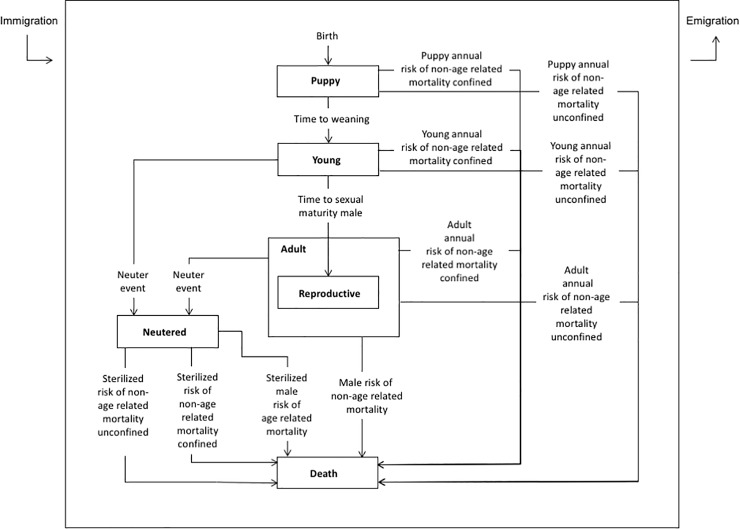
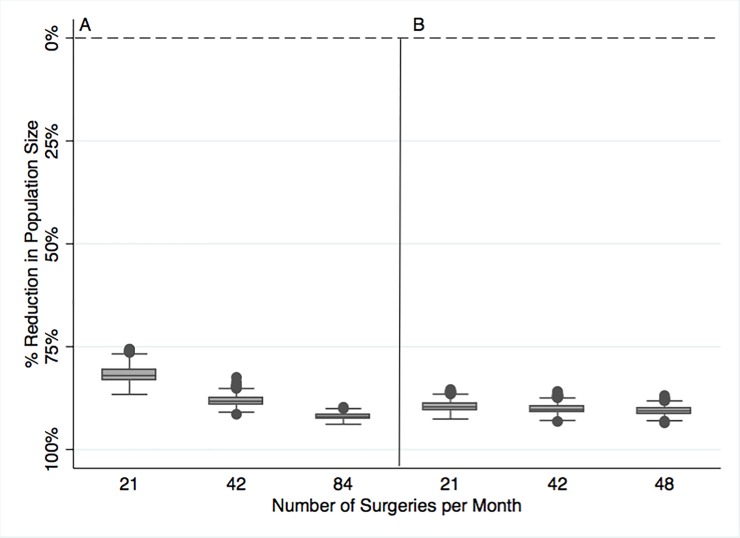
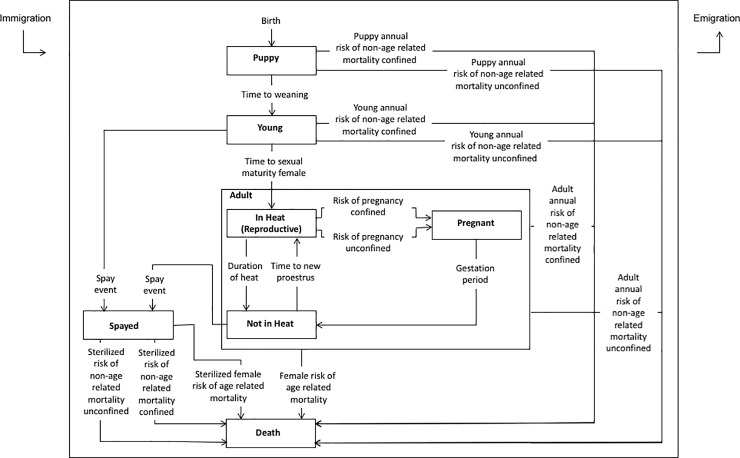
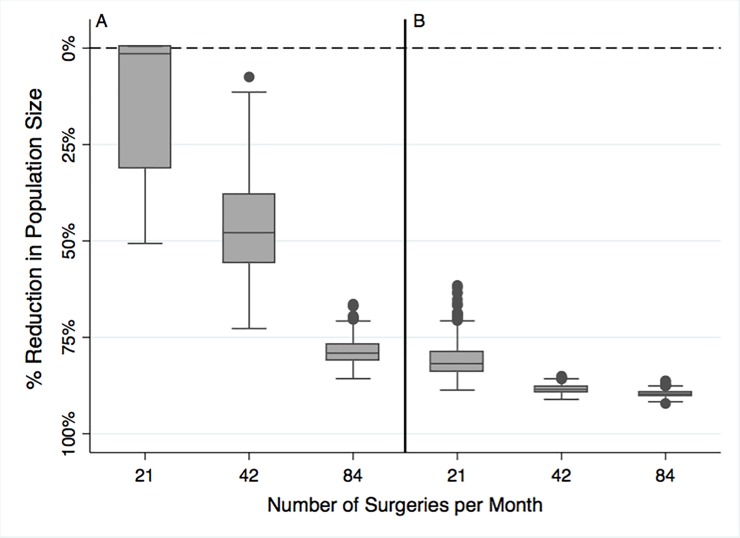
Surgical sterilization programs for dogs have been proposed as interventions to control dog population size. Models can be used to help identify the long-term impact of reproduction control interventions for dogs. The objective of this study was to determine the projected impact of surgical sterilization interventions on the owned dog population size in Villa de Tezontepec, Hidalgo, Mexico. A stochastic, individual-based simulation model was constructed and parameterized using a combination of empirical data collected on the demographics of owned dogs in Villa de Tezontepec and data available from the peer-reviewed literature. Model outcomes were assessed using a 20-year time horizon. The model was used to examine: the effect of surgical sterilization strategies focused on: 1) dogs of any age and sex, 2) female dogs of any age, 3) young dogs (i.e., not yet reached sexual maturity) of any sex, and 4) young, female dogs. Model outcomes suggested that as surgical capacity increases from 21 to 84 surgeries/month, (8.6% to 34.5% annual sterilization) for dogs of any age, the mean dog population size after 20 years was reduced between 14% and 79% compared to the base case scenario (i.e. in the absence of intervention). Surgical sterilization interventions focused only on young dogs of any sex yielded greater reductions (81% - 90%) in the mean population size, depending on the level of surgical capacity. More focused sterilization targeted at female dogs of any age, resulted in reductions that were similar to focusing on mixed sex sterilization of only young dogs (82% - 92%). The greatest mean reduction in population size (90% - 91%) was associated with sterilization of only young, female dogs. Our model suggests that targeting sterilization to young females could enhance the efficacy of existing surgical dog population control interventions in this location, without investing extra resources.
已经提出了针对犬类的外科绝育计划,作为控制犬类种群数量的干预措施。模型可以用于帮助确定犬类繁殖控制干预措施的长期影响。本研究的目的是确定在墨西哥伊达尔戈州特松特佩克村实施外科绝育干预对犬类拥有量的预计影响。使用基于个体的随机模拟模型,并结合在特松特佩克村收集的有关犬类人口统计学数据和来自同行评审文献的数据对其进行参数化。使用 20 年的时间范围评估模型结果。该模型用于检查:1)任何年龄和性别的犬只,2)任何年龄的雌性犬只,3)任何性别的幼龄犬只(即尚未达到性成熟),和 4)幼龄雌性犬只的绝育策略的效果。模型结果表明,随着手术能力从每月 21 例增加到 84 例(8.6%至 34.5%的年绝育率),任何年龄的犬只的平均犬只数量在 20 年后减少了 14%至 79%,与基线情景相比(即无干预)。仅针对任何性别的幼龄犬只进行的外科绝育干预产生了更大的减少(81%至 90%),具体取决于手术能力水平。针对任何年龄的雌性犬只进行更有针对性的绝育,导致的减少与仅对幼龄混合性别犬只进行绝育相似(82%至 92%)。种群数量的最大平均减少(90%至 91%)与仅对幼龄雌性犬只进行绝育有关。我们的模型表明,针对年轻雌性犬只进行绝育可以提高该地区现有外科犬类种群控制干预措施的效果,而无需投入额外资源。