School of Civil Engineering, Chang'an University, Xi'an 710061, China.
State Key Laboratory of Environmental Criteria and Risk Assessment, Chinese Research Academy of Environmental Sciences, No. 8 Da Yang Fang, Anwai, Chaoyang District, Beijing 100012, China.
Int J Environ Res Public Health. 2018 May 27;15(6):1081. doi: 10.3390/ijerph15061081.
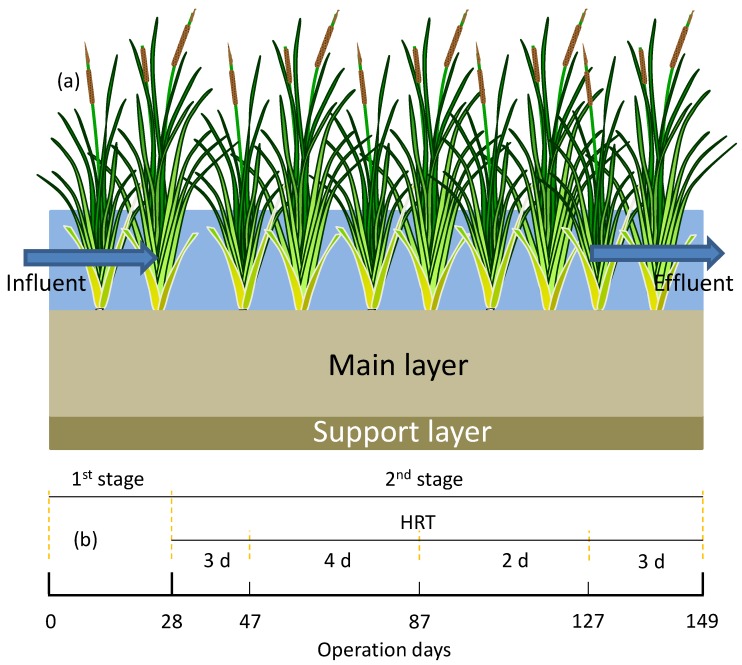
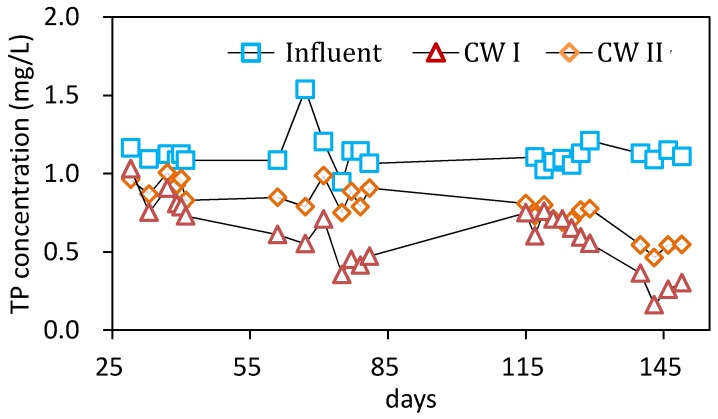
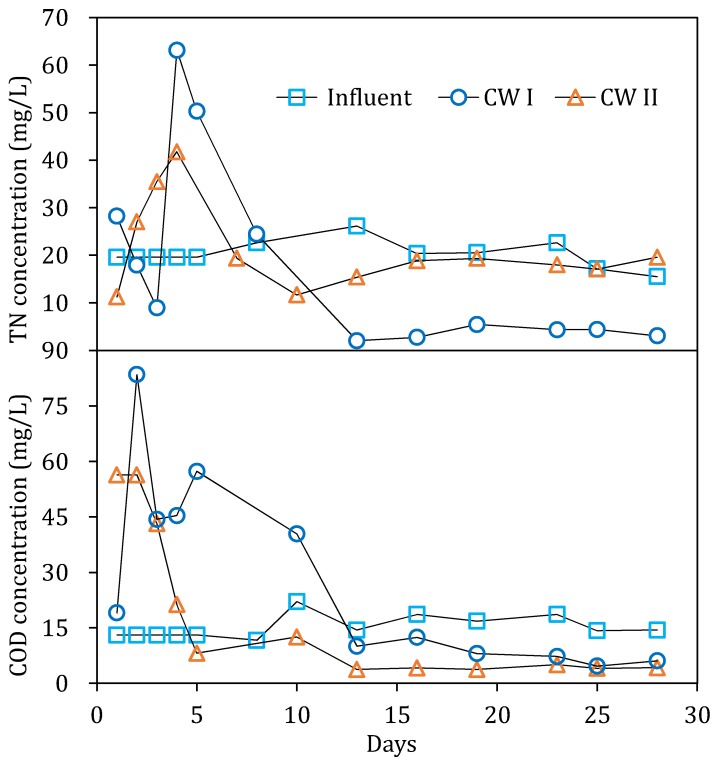
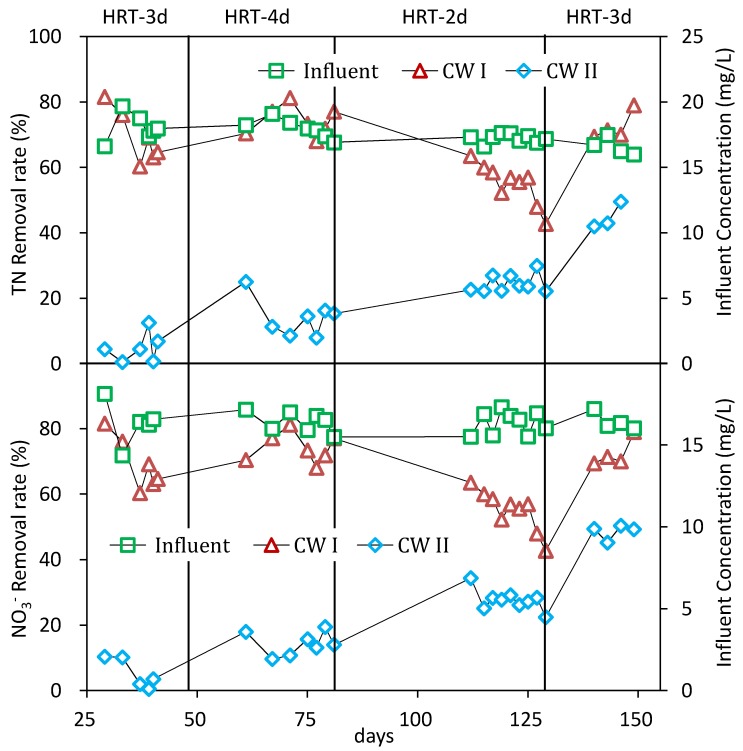
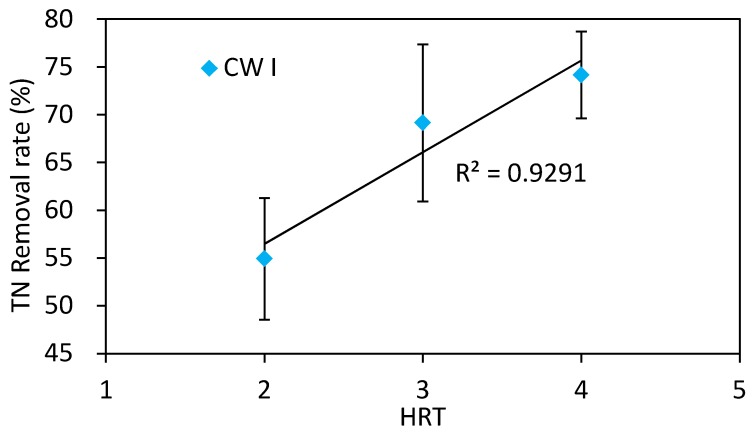
The low carbon/nitrogen (C/N) ratio and high nitrate content characteristics of agricultural runoff restricted the nitrogen removal in constructed wetlands (CWs). To resolve such problems, the economically- and easily-obtained (reeds) litters were applied and packed in the surface layer of a surface flow CW as external carbon sources. The results demonstrated that the introduction of the reeds straw increased the C concentration as a result of their decomposition during the CW operation, which will help the denitrification in the ensuing operation of an entire 148 days. The total nitrogen (TN) and Chemical Oxygen Demand (COD) () in the effluent reached the peak level of 63.2 mg/L and 83 mg/L at the fourth and the second day, respectively. Subsequently, the pollutants in the CW that were filled with straw decreased rapidly and achieved a stable removal after 13 days of operation. Moreover, the present study showed that the N removal efficiency increased with the increase of the hydraulic retention time (HRT). Under the HRT of four days, the CW presented 74.1 ± 6%, 87.4 ± 6% and 56.0 ± 6% removal for TN, NO₃⁻, and TP, respectively.
农业径流的低碳/氮(C/N)比和高硝酸盐含量特征限制了人工湿地(CWs)中的氮去除。为了解决这些问题,经济实惠且易于获得的(芦苇)秸秆被用作外部碳源应用于表面流 CW 的表层。结果表明,芦苇秸秆的引入增加了 C 浓度,因为它们在 CW 运行期间分解,这将有助于随后整个 148 天的反硝化作用。在第四天和第二天,出水的总氮(TN)和化学需氧量(COD)分别达到 63.2 毫克/升和 83 毫克/升的峰值水平。随后,填充秸秆的 CW 中的污染物迅速减少,并在运行 13 天后达到稳定去除。此外,本研究表明,氮去除效率随水力停留时间(HRT)的增加而增加。在 HRT 为四天的情况下,CW 对 TN、NO₃⁻和 TP 的去除率分别为 74.1±6%、87.4±6%和 56.0±6%。