Hody James W, Kays Roland
North Carolina State University, Department of Forestry and Environmental Resources, 2800 Faucette Drive, Raleigh, NC, USA 27607.
North Carolina Museum of Natural Sciences, Nature Research Center, 9 West Jones Street, Raleigh, NC, USA 27601.
Zookeys. 2018 May 22(759):81-97. doi: 10.3897/zookeys.759.15149. eCollection 2018.
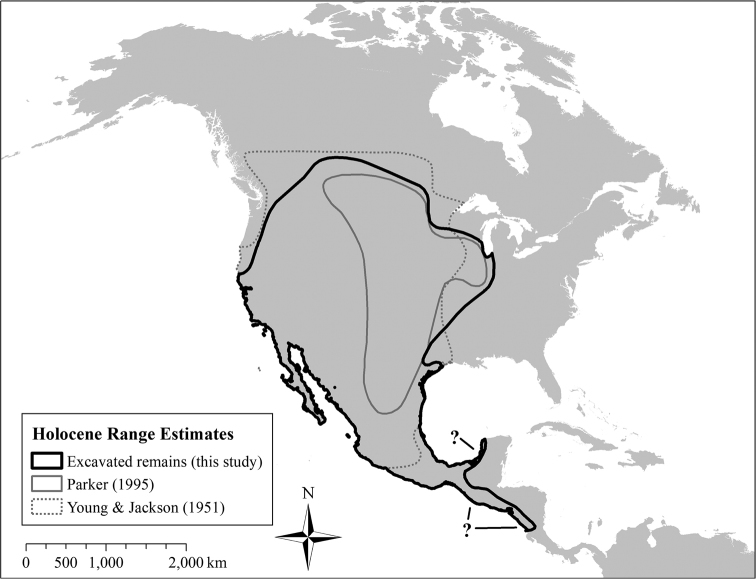
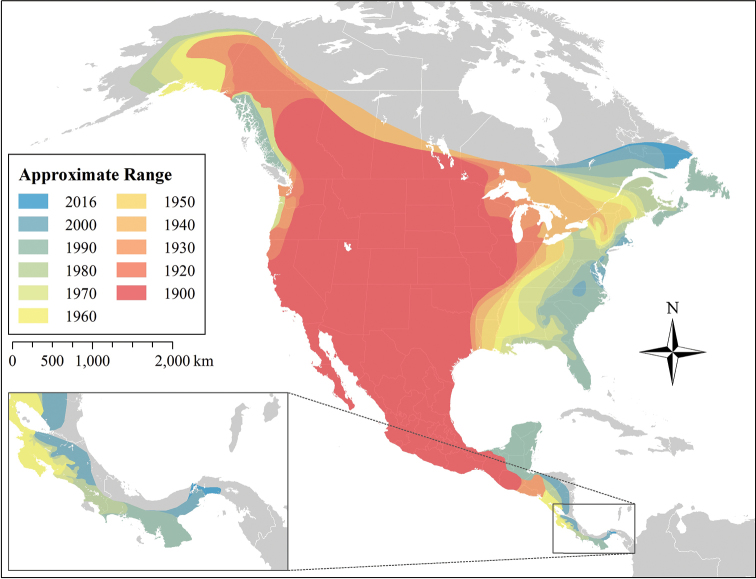
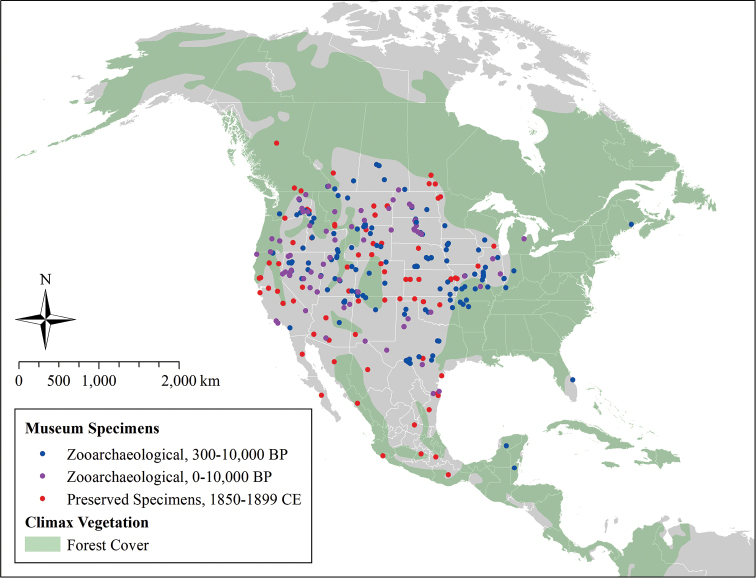
The geographic distribution of coyotes () has dramatically expanded since 1900, spreading across much of North America in a period when most other mammal species have been declining. Although this considerable expansion has been well documented at the state/provincial scale, continent-wide descriptions of coyote spread have portrayed conflicting distributions for coyotes prior to the 1900s, with popularly referenced anecdotal accounts showing them restricted to the great plains, and more obscure, but data-rich accounts suggesting they ranged across the arid west. To provide a scientifically credible map of the coyote's historical range (10,000-300 BP) and describe their range expansion from 1900 to 2016, we synthesized archaeological and fossil records, museum specimens, peer-reviewed reports, and records from wildlife management agencies. Museum specimens confirm that coyotes have been present in the arid west and California throughout the Holocene, well before European colonization. Their range in the late 1800s was undistinguishable from earlier periods, and matched the distribution of non-forest habitat in the region. Coyote expansion began around 1900 as they moved north into taiga forests, east into deciduous forests, west into costal temperate rain forests, and south into tropical rainforests. Forest fragmentation and the extirpation of larger predators probably enabled these expansions. In addition, hybridization with wolves (, , and/or ) and/or domestic dogs has been documented in the east, and suspected in the south. Our detailed account of the original range of coyotes and their subsequent expansion provides the core description of a large scale ecological experiment that can help us better understand the predator-prey interactions, as well as evolution through hybridization.
自1900年以来,郊狼()的地理分布范围急剧扩大,在大多数其他哺乳动物物种数量一直在减少的时期内,蔓延至北美大部分地区。尽管这种显著的扩张在州/省层面已有充分记录,但关于20世纪之前郊狼在整个大陆范围的分布描述却相互矛盾,普遍引用的轶事记载表明它们局限于大平原地区,而一些不太为人所知但数据丰富的记载则显示它们分布于干旱的西部地区。为了绘制出科学可信的郊狼历史分布范围图(公元前10000年至公元300年),并描述它们在1900年至2016年期间的分布范围扩张情况,我们综合了考古和化石记录、博物馆标本、同行评审报告以及野生动物管理机构的记录。博物馆标本证实,在全新世期间,即远早于欧洲殖民之前,郊狼就已存在于干旱的西部地区和加利福尼亚州。它们在19世纪后期的分布范围与早期并无差异,且与该地区非森林栖息地的分布相匹配。郊狼的扩张始于1900年左右,它们向北进入泰加林,向东进入落叶林,向西进入沿海温带雨林,向南进入热带雨林。森林碎片化以及大型食肉动物的灭绝可能促成了这些扩张。此外,在东部有记录表明郊狼与狼(、和/或)和/或家犬发生了杂交,在南部也存在这种怀疑。我们对郊狼原始分布范围及其后续扩张的详细描述,为一项大规模生态实验提供了核心描述,这有助于我们更好地理解捕食者与猎物之间的相互作用,以及杂交导致的进化。