Hövelmann F, Gaspar I, Chamiolo J, Kasper M, Steffen J, Ephrussi A, Seitz O
Department of Chemistry , Humboldt University Berlin , Brook-Taylor-Str. 2 , D-12489 Berlin , Germany . Email:
European Molecular Biology Laboratory (EMBL) Heidelberg , Meyerhofstr. 1 , 69117 Heidelberg , Germany.
Chem Sci. 2016 Jan 1;7(1):128-135. doi: 10.1039/c5sc03053f. Epub 2015 Nov 2.
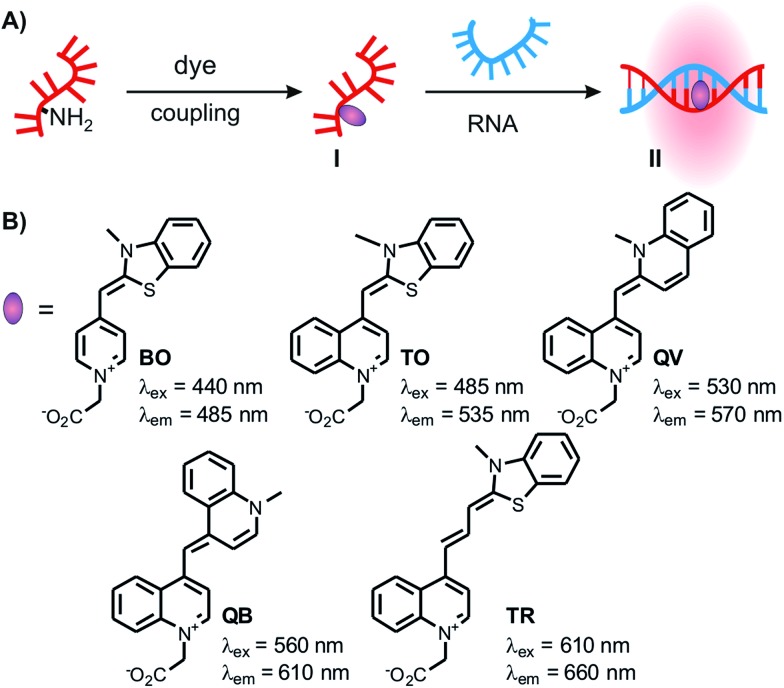
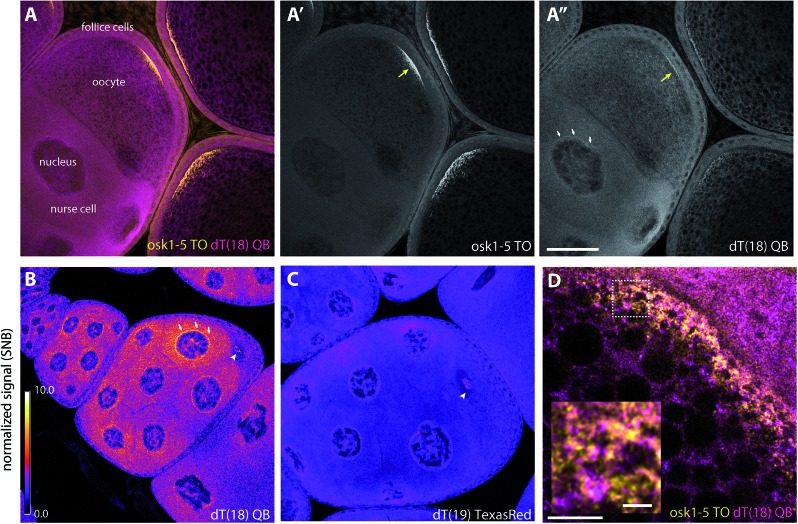
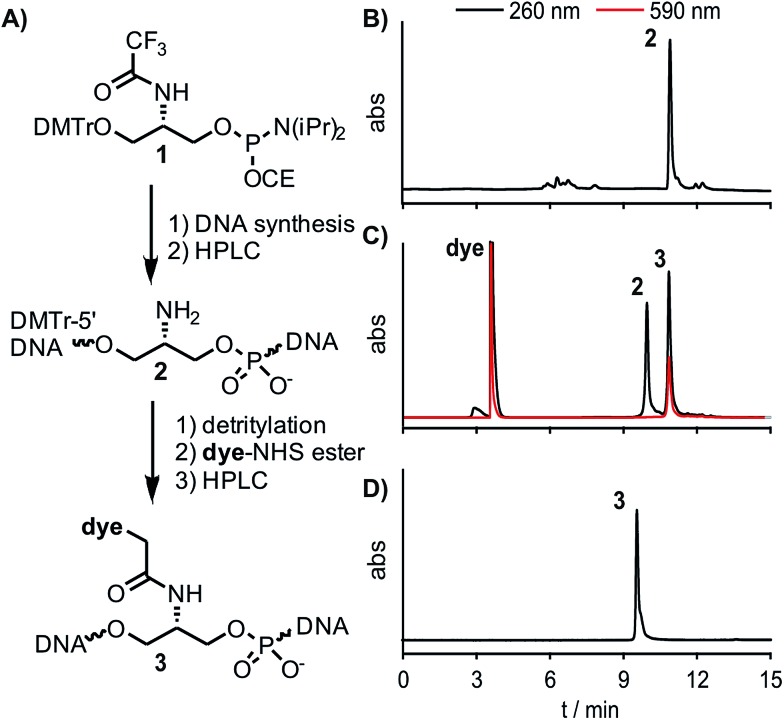
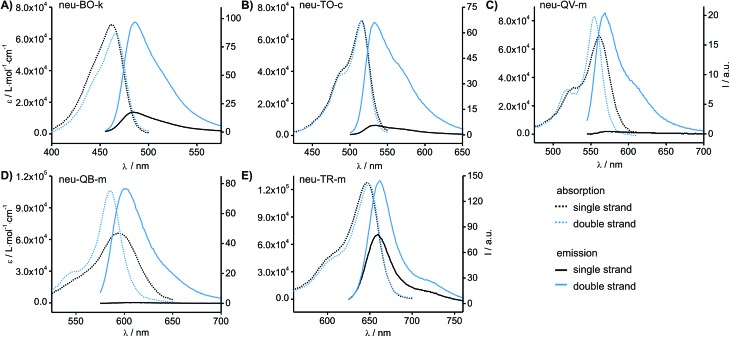
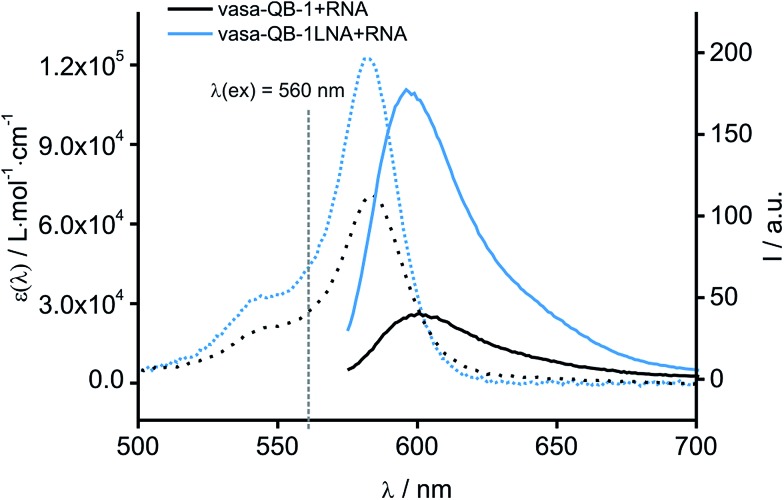
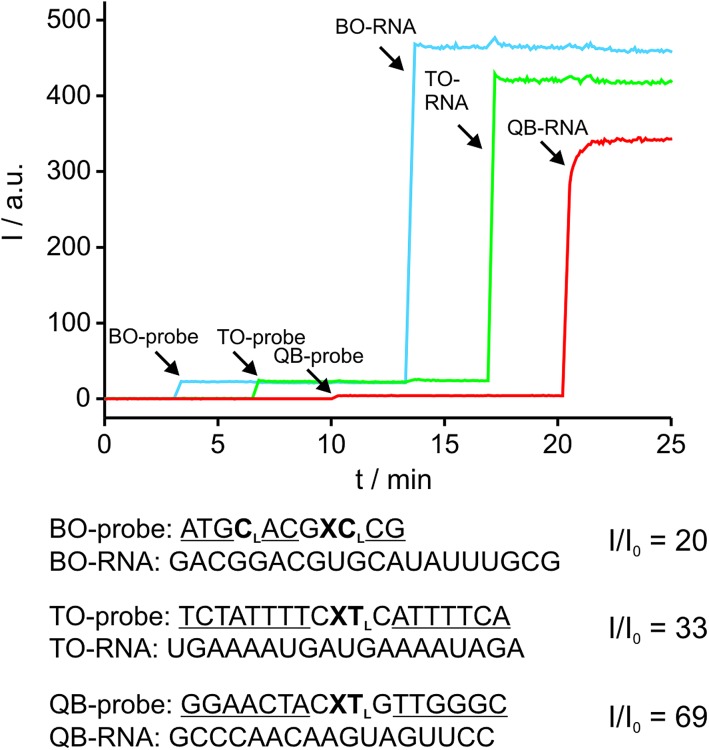
The simultaneous imaging of different RNA molecules in homogeneous solution is a challenge and requires optimisation to enable unambiguous staining of intracellular RNA targets. Our approach relies on single dye forced intercalation (FIT) probes, in which a visco-sensitive reporter of the thiazole orange (TO) family serves as a surrogate nucleobase and provides enhancements of fluorescence upon hybridisation. Previous FIT probes spanned the cyan and green emission range. Herein, we report for the first time chromophores for FIT probes that emit in the red range (above 600 nm). Such probes are valuable to overcome cellular auto-fluorescent background and enable multiplexed detection. In order to find suitable chromophores, we developed a submonomer approach that facilitated the rapid analysis of different TO family dyes in varied sequence positions. A carboxymethylated 4,4'-methine linked cyanine, which we named quinoline blue (QB), provided exceptional response characteristics at the 605 nm emission maximum. Exceeding previously reported base surrogates, the emission of the QB nucleotide intensified by up to 195-fold upon binding of complementary RNA. Owing to large extinction coefficients and quantum yields (up to = 129.000 L mol cm and = 0.47, respectively) QB-FIT probes enable imaging of intracellular mRNA. A mixture of BO-, TO- and QB-containing FIT probes allowed the simultaneous detection of three different RNA targets in homogenous solution. TO- and QB-FIT probes were used to localize mRNA and other polyadenylated mRNA molecules in developing oocytes from by means of wash-free fluorescent hybridisation and super resolution microscopy (STED).
在均匀溶液中对不同RNA分子进行同步成像具有挑战性,需要进行优化以实现对细胞内RNA靶标的明确染色。我们的方法依赖于单染料强制插入(FIT)探针,其中噻唑橙(TO)家族的粘滞敏感报告基团作为替代核碱基,并在杂交时增强荧光。先前的FIT探针涵盖了青色和绿色发射范围。在此,我们首次报道了发射红色范围(600 nm以上)荧光的FIT探针发色团。这类探针对于克服细胞自发荧光背景和实现多重检测非常有价值。为了找到合适的发色团,我们开发了一种亚单体方法,便于快速分析不同序列位置的不同TO家族染料。一种羧甲基化的4,4'-次甲基连接花青,我们将其命名为喹啉蓝(QB),在605 nm最大发射波长处具有出色的响应特性。与先前报道的碱基替代物相比,当与互补RNA结合时,QB核苷酸的发射增强了高达195倍。由于具有较大的消光系数和量子产率(分别高达 = 129,000 L mol cm和 = 0.47),QB-FIT探针能够对细胞内mRNA进行成像。含有BO、TO和QB的FIT探针混合物能够在均匀溶液中同时检测三种不同的RNA靶标。通过免洗荧光原位杂交和超分辨率显微镜(STED),使用TO-和QB-FIT探针在发育中的卵母细胞中定位mRNA和其他多聚腺苷酸化mRNA分子。