Bachmann C, Probst B, Oberholzer M, Fox T, Alberto R
Department of Chemistry , University of Zürich , Winterthurerstr. 190 , CH-8057 Zürich , Switzerland . Email:
Chem Sci. 2016 Jan 1;7(1):436-445. doi: 10.1039/c5sc02124c. Epub 2015 Oct 8.
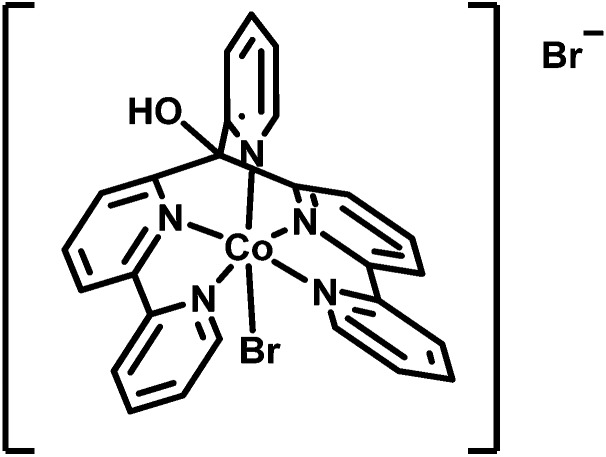
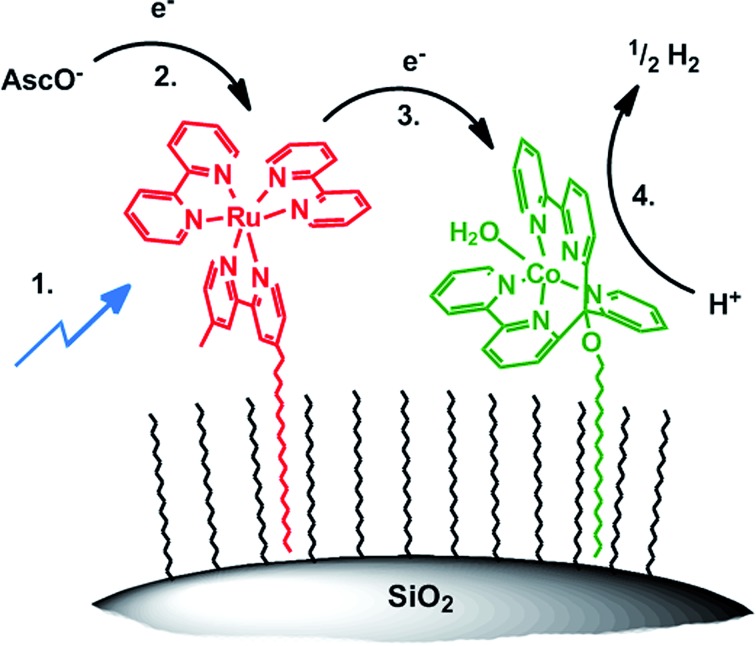
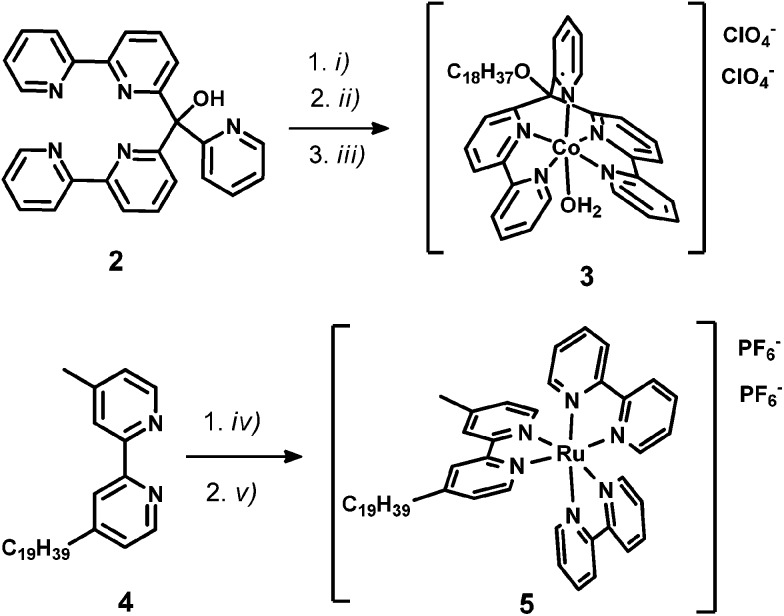
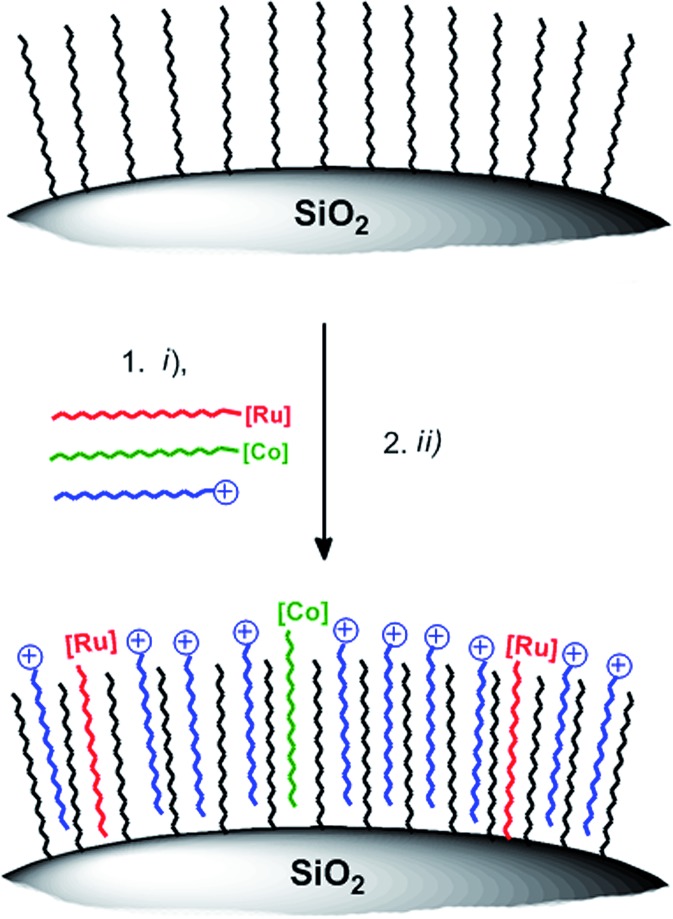
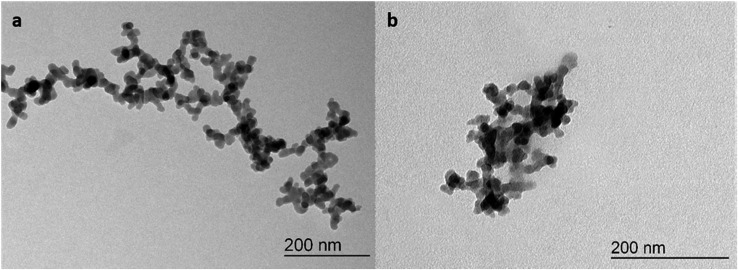
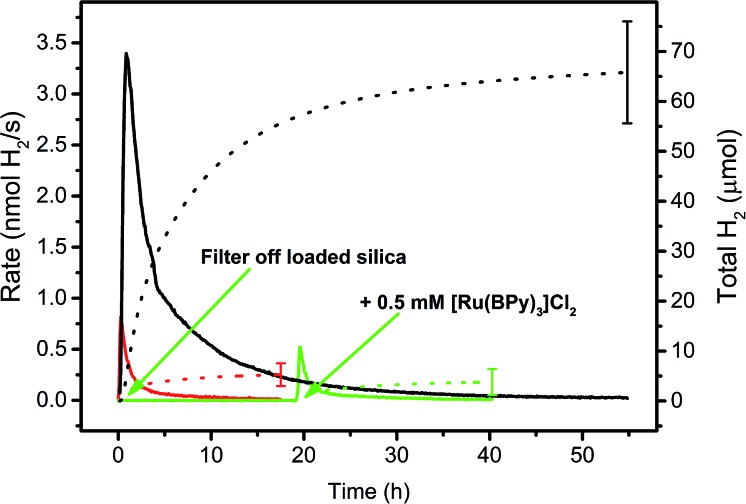
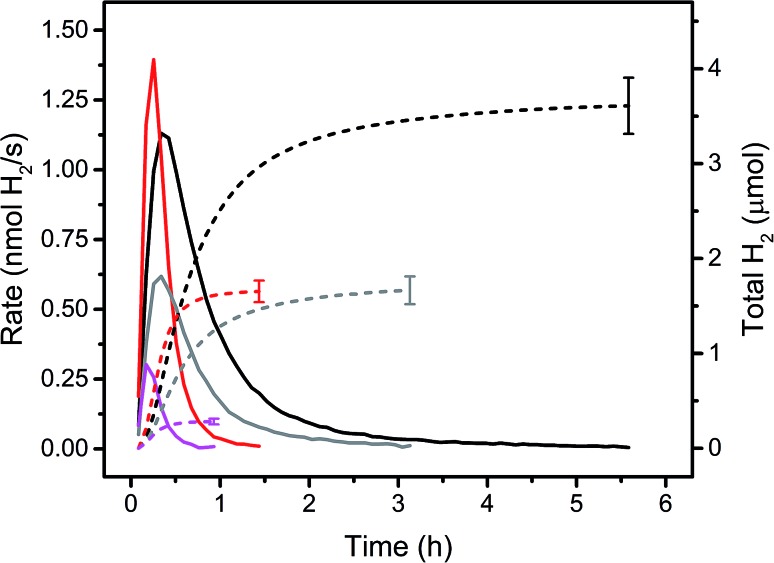
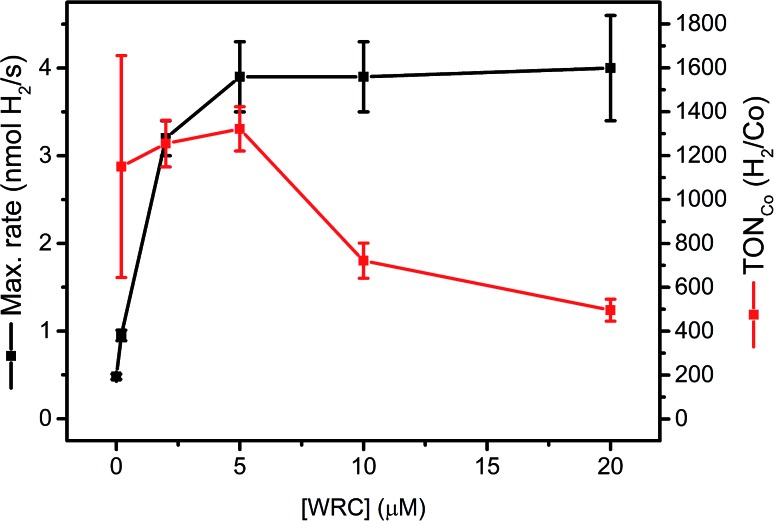
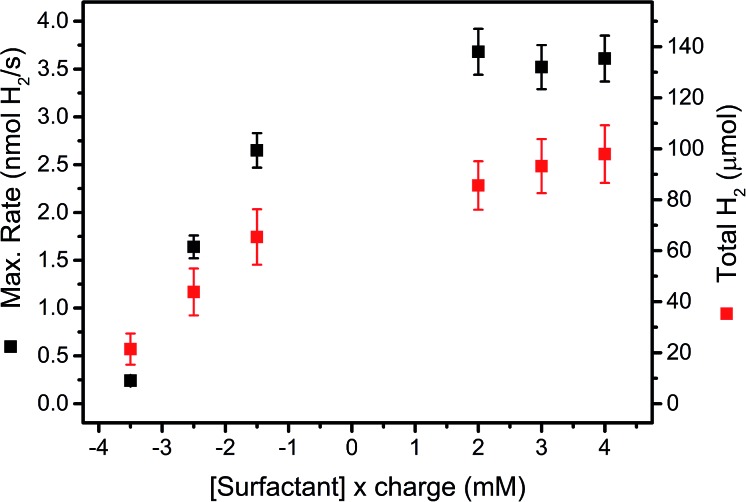
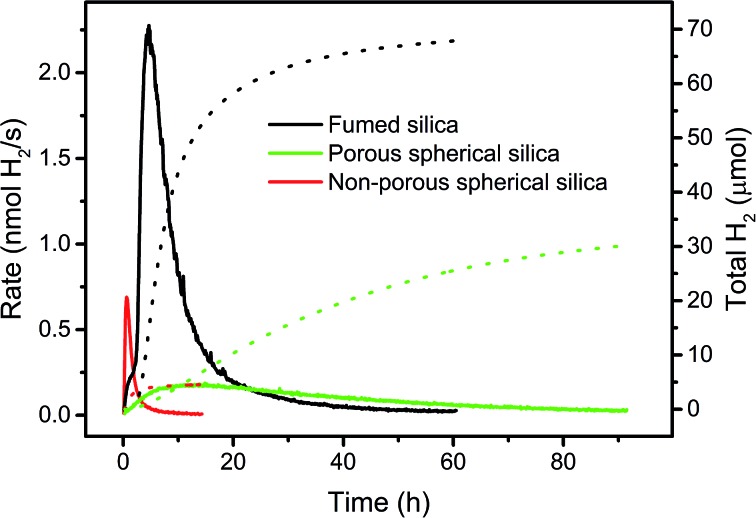
Heterogeneous photocatalytic hydrogen production with a non-covalently immobilized molecular ruthenium based photosensitizer (PS) and a cobalt polypyridyl based water reducing catalyst (WRC) is reported. PS and WRC were derivatized with C-alkyl chains and immobilized by adsorption on hydrophobic fumed silica. The resulting loaded support was suspended in water with anionic or cationic surfactants and subjected to heterogeneous photocatalytic H production with ascorbate as sacrificial electron donor (SED). No leaching was observed under catalytic conditions, thus catalysis was truly heterogeneous. The catalytic performance of immobilized PS and WRC clearly exceeded that of homogeneous catalysis at low concentrations. At high concentration, diffusion and light limitation lead to lower reaction rates, but the same stability as for homogeneous reactions was still achieved. WRC concentration variations indicated a relatively high stability (up to 1300 H/Co) and mobility of amphiphilic catalysts on the hydrophobic silica surface. Comparison of fumed silica with porous and non-porous silica showed, that a high BET surface area along with a good accessibility from the reaction media are crucial for catalytic performance. Mechanistic investigations by transient absorption spectroscopy displayed reductive quenching of excited PS by ascorbate followed by on particle electron transfer to WRC as reaction pathway. Particles with additional cationic surfactants exhibited a significantly higher catalytic performance as compared to anionic surfactants. Non-covalent anchoring of correspondingly derivatized WRCs or PSs to reversed-phase silica offers a rapid and versatile transition from homogeneous to heterogeneous molecular proton reduction.
报道了一种使用非共价固定的基于分子钌的光敏剂(PS)和基于钴多吡啶的水还原催化剂(WRC)的多相光催化制氢方法。PS和WRC用C-烷基链进行衍生化,并通过吸附固定在疏水性气相二氧化硅上。将所得负载载体与阴离子或阳离子表面活性剂一起悬浮在水中,并以抗坏血酸作为牺牲电子供体(SED)进行多相光催化制氢。在催化条件下未观察到浸出,因此催化是真正的多相催化。在低浓度下,固定化PS和WRC的催化性能明显超过均相催化。在高浓度下,扩散和光限制导致反应速率降低,但仍实现了与均相反应相同的稳定性。WRC浓度变化表明两亲性催化剂在疏水二氧化硅表面具有相对较高的稳定性(高达1300 H/Co)和迁移率。气相二氧化硅与多孔和无孔二氧化硅的比较表明,高BET表面积以及从反应介质的良好可及性对于催化性能至关重要。通过瞬态吸收光谱进行的机理研究表明,抗坏血酸对激发态PS进行还原猝灭,随后在颗粒上发生电子转移至WRC作为反应途径。与阴离子表面活性剂相比,含有额外阳离子表面活性剂的颗粒表现出明显更高的催化性能。将相应衍生化的WRC或PS非共价锚定到反相二氧化硅上,提供了从均相分子质子还原到多相分子质子还原的快速且通用的转变。