Guang'anmen Hospital, China Academy of Chinese Medical Sciences, Beijing 100700, China.
Beijing University of Chinese Medicine, Beijing 100029, China.
Biomed Res Int. 2018 May 16;2018:2785636. doi: 10.1155/2018/2785636. eCollection 2018.
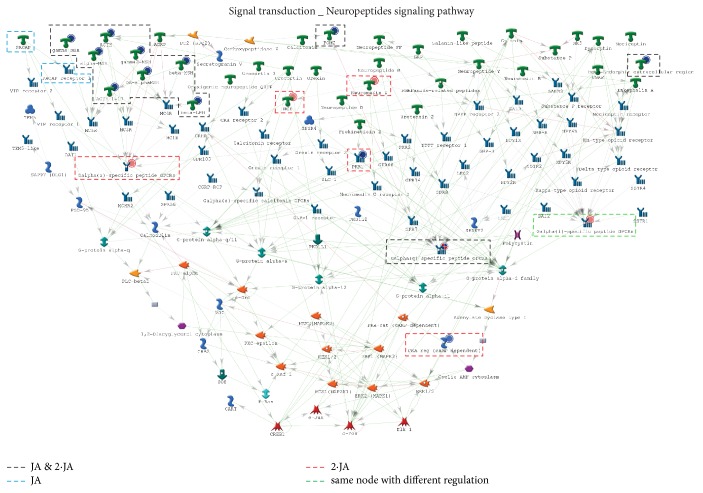
Recent evidence demonstrates that a double dose of Jasminoidin (2·JA) is more effective than Jasminoidin (JA) in cerebral ischemia therapy, but its dosage-effect mechanisms are unclear. In this study, the software GeneGo MetaCore was used to perform pathway analysis of the differentially expressed genes obtained in microarrays of mice belonging to four groups (Sham, Vehicle, JA, and 2·JA), aiming to elucidate differences in JA and 2·JA's dose-dependent pharmacological mechanism from a system's perspective. The top 10 enriched pathways in the 2·JA condition were mainly involved in neuroprotection (70% of the pathways), apoptosis and survival (40%), and anti-inflammation (20%), while JA induced pathways were mainly involved in apoptosis and survival (60%), anti-inflammation (20%), and lipid metabolism (20%). Regarding shared pathways and processes, 3, 1, and 3 pathways overlapped between the Vehicle and JA, Vehicle and 2·JA, and JA and 2·JA conditions, respectively; for the top ten overlapped processes these numbers were 3, 0, and 4, respectively. The common pathways and processes in the 2·JA condition included differentially expressed genes significantly different from those in JA. Seven representative pathways were only activated by 2·JA, such as Process network comparison indicated that significant nodes, such as , , , and , were involved in the pharmacological mechanism of 2·JA. Function distribution was different between JA and 2·JA groups, indicating a dosage additive mechanism in cerebral ischemia treatment. Such systemic approach based on whole-genome multiple pathways and networks may provide an effective and alternative approach to identify alterations underlining dosage-dependent therapeutic benefits of pharmacological compounds on complex disease processes.
近期证据表明,双剂量栀子苷(2·JA)在脑缺血治疗中的效果优于栀子苷(JA),但其剂量效应机制尚不清楚。本研究利用 GeneGo MetaCore 软件对四组(假手术、载体、JA 和 2·JA)小鼠微阵列中差异表达基因进行通路分析,旨在从系统角度阐明 JA 和 2·JA 剂量依赖性药理机制的差异。2·JA 条件下富集的前 10 条通路主要涉及神经保护(70%的通路)、凋亡和存活(40%)以及抗炎(20%),而 JA 诱导的通路主要涉及凋亡和存活(60%)、抗炎(20%)和脂质代谢(20%)。关于共有通路和过程,载体和 JA、载体和 2·JA 以及 JA 和 2·JA 条件之间分别有 3、1 和 3 条通路重叠;对于前 10 个重叠过程,这些数字分别为 3、0 和 4。2·JA 条件下的共同通路和过程包括与 JA 差异表达基因明显不同的基因。仅 2·JA 激活了七个有代表性的通路,如 Process network comparison indicated that significant nodes, such as,,, and, were involved in the pharmacological mechanism of 2·JA. Function distribution was different between JA and 2·JA groups, indicating a dosage additive mechanism in cerebral ischemia treatment. Such systemic approach based on whole-genome multiple pathways and networks may provide an effective and alternative approach to identify alterations underlining dosage-dependent therapeutic benefits of pharmacological compounds on complex disease processes.
网络对比表明,如 等显著节点参与了 2·JA 的药理机制。JA 和 2·JA 组之间的功能分布不同,表明在脑缺血治疗中存在剂量相加机制。这种基于全基因组多途径和网络的系统方法可能为识别药物化合物对复杂疾病过程的剂量依赖性治疗益处提供一种有效和替代的方法。