
糖酵解酶在卵巢癌中的表达及糖酵解途径作为卵巢癌治疗策略的评估。
Expression of glycolytic enzymes in ovarian cancers and evaluation of the glycolytic pathway as a strategy for ovarian cancer treatment.
机构信息
Cancer Research UK Edinburgh Centre and Division of Pathology Laboratory, Institute of Genetics and Molecular Medicine, University of Edinburgh, Edinburgh, EH4 2XU, UK.
The Royal (Dick) School of Veterinary Studies and Roslin Institute, Easter Bush, Roslin, Midlothian, EH25 9RG, UK.
出版信息
BMC Cancer. 2018 Jun 5;18(1):636. doi: 10.1186/s12885-018-4521-4.
BACKGROUND
Novel therapeutic approaches are required to treat ovarian cancer and dependency on glycolysis may provide new targets for treatment. This study sought to investigate the variation of expression of molecular components (GLUT1, HKII, PKM2, LDHA) of the glycolytic pathway in ovarian cancers and the effectiveness of targeting this pathway in ovarian cancer cell lines with inhibitors.
METHODS
Expression of GLUT1, HKII, PKM2, LDHA were analysed by quantitative immunofluorescence in a tissue microarray (TMA) analysis of 380 ovarian cancers and associations with clinicopathological features were sought. The effect of glycolysis pathway inhibitors on the growth of a panel of ovarian cancer cell lines was assessed by use of the SRB proliferation assay. Combination studies were undertaken combining these inhibitors with cytotoxic agents.
RESULTS
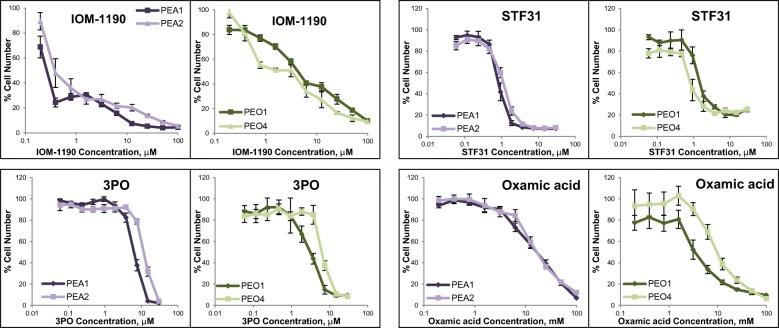
Mean expression levels of GLUT1 and HKII were higher in high grade serous ovarian cancer (HGSOC), the most frequently occurring subtype, than in non-HGSOC. GLUT1 expression was also significantly higher in advanced stage (III/IV) ovarian cancer than early stage (I/II) disease. Growth dependency of ovarian cancer cells on glucose was demonstrated in a panel of ovarian cancer cell lines. Inhibitors of the glycolytic pathway (STF31, IOM-1190, 3PO and oxamic acid) attenuated cell proliferation in platinum-sensitive and platinum-resistant HGSOC cell line models in a concentration dependent manner. In combination with either cisplatin or paclitaxel, 3PO (a novel PFKFB3 inhibitor) enhanced the cytotoxic effect in both platinum sensitive and platinum resistant ovarian cancer cells. Furthermore, synergy was identified between STF31 (a novel GLUT1 inhibitor) or oxamic acid (an LDH inhibitor) when combined with metformin, an inhibitor of oxidative phosphorylation, resulting in marked inhibition of ovarian cancer cell growth.
CONCLUSIONS
The findings of this study provide further support for targeting the glycolytic pathway in ovarian cancer and several useful combinations were identified.
背景
需要新的治疗方法来治疗卵巢癌,而对糖酵解的依赖性可能为治疗提供新的靶点。本研究旨在探讨糖酵解途径中分子成分(GLUT1、HKII、PKM2、LDHA)在卵巢癌中的表达变化,以及用抑制剂靶向该途径对卵巢癌细胞系的有效性。
方法
通过对 380 例卵巢癌组织微阵列(TMA)分析进行定量免疫荧光分析,检测 GLUT1、HKII、PKM2、LDHA 的表达,并探讨其与临床病理特征的关系。采用 SRB 增殖测定法评估糖酵解途径抑制剂对一组卵巢癌细胞系生长的影响。进行组合研究,将这些抑制剂与细胞毒性药物联合使用。
结果
在最常见的高级别浆液性卵巢癌(HGSOC)亚型中,GLUT1 和 HKII 的平均表达水平高于非 HGSOC。在晚期(III/IV 期)卵巢癌中,GLUT1 的表达也明显高于早期(I/II 期)疾病。在一组卵巢癌细胞系中证明了卵巢癌细胞对葡萄糖的生长依赖性。糖酵解途径抑制剂(STF31、IOM-1190、3PO 和 oxamic acid)以浓度依赖性方式减弱了铂敏感和铂耐药 HGSOC 细胞系模型中的细胞增殖。与顺铂或紫杉醇联合使用时,3PO(一种新型 PFKFB3 抑制剂)增强了对铂敏感和铂耐药卵巢癌细胞的细胞毒性作用。此外,当与二甲双胍(一种氧化磷酸化抑制剂)联合使用时,STF31(一种新型 GLUT1 抑制剂)或 oxamic acid(一种 LDH 抑制剂)之间发现了协同作用,导致卵巢癌细胞生长明显抑制。
结论
本研究的结果为在卵巢癌中靶向糖酵解途径提供了进一步的支持,并确定了几种有用的组合。


 Zotero 插件