Smith John K
Departments of Academic Affairs and Biomedical Science, James H. Quillen College of Medicine, East Tennessee State University, Johnson City, TN, United States.
Front Physiol. 2018 May 17;9:574. doi: 10.3389/fphys.2018.00574. eCollection 2018.
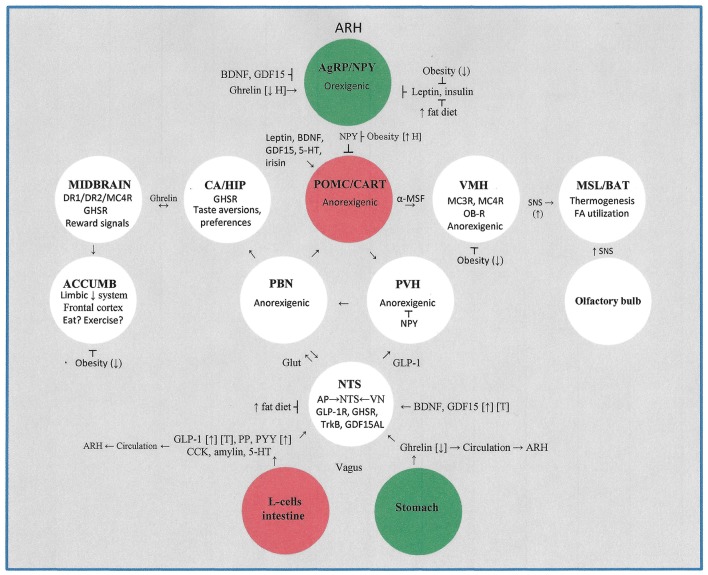
This review details the manner in which the central nervous system regulates metabolic homeostasis in normal weight and obese rodents and humans. It includes a review of the homeostatic contributions of neurons located in the hypothalamus, the midbrain and limbic structures, the pons and the medullary area postrema, nucleus tractus solitarius, and vagus nucleus, and details how these brain regions respond to circulating levels of orexigenic hormones, such as ghrelin, and anorexigenic hormones, such as glucagon-like peptide 1 and leptin. It provides an insight as to how high intensity exercise may improve homeostatic control in overweight and obese subjects. Finally, it provides suggestions as to how further progress can be made in controlling the current pandemic of obesity and diabetes.
本综述详细阐述了中枢神经系统调节正常体重及肥胖啮齿动物和人类代谢稳态的方式。其中包括对位于下丘脑、中脑和边缘结构、脑桥以及延髓最后区、孤束核和迷走神经核的神经元在稳态调节中的作用的综述,并详细说明了这些脑区如何对促食欲激素(如胃饥饿素)和抑食欲激素(如胰高血糖素样肽1和瘦素)的循环水平作出反应。它深入探讨了高强度运动如何改善超重和肥胖受试者的稳态控制。最后,它就如何在控制当前肥胖和糖尿病大流行方面取得进一步进展提出了建议。