Research Laboratory for Archaeology & the History of Art, University of Oxford, Oxford, United Kingdom.
Naturalis Biodiversity Center, Leiden, The Netherlands.
PLoS One. 2018 Jun 5;13(6):e0198333. doi: 10.1371/journal.pone.0198333. eCollection 2018.
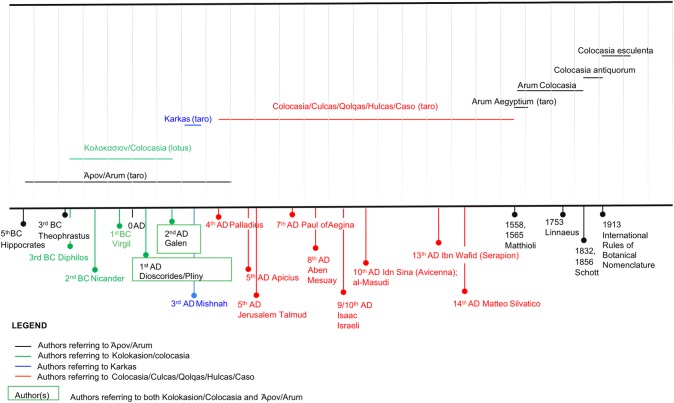
Taro, Colocasia esculenta (L.) Schott, is a vegetable and starchy root crop cultivated in Asia, Oceania, the Americas, Africa, and the Mediterranean. Very little is known about its early history in the Mediterranean, which previous authors have sought to trace through Classical (Greek and Latin) texts that record the name colocasia (including cognates) from the 3rd century BC onwards. In ancient literature, however, this name also refers to the sacred lotus, Nelumbo nucifera Gaertn. and its edible rhizome. Like taro, lotus is an alien introduction to the Mediterranean, and there has been considerable confusion regarding the true identity of plants referred to as colocasia in ancient literature. Another early name used to indicate taro was arum, a name already attested from the 4th century BC. Today, this name refers to Arum, an aroid genus native to West Asia, Europe, and the Mediterranean. Our aim is to explore historical references to taro in order to clarify when and through which routes this plant reached the Mediterranean. To investigate Greek and Latin texts, we performed a search using the Thesaurus Linguae Graecae (TLG) and the Thesaurus Linguae Latinae (TLL), plus commentaries and English and French translations of original texts. Results show that while in the early Greek and Latin literature the name kolokasia (Greek κολοκάσια) and its Latin equivalent colocasia refer to Nelumbo nucifera Gaertn., after the 4th century AD a poorly understood linguistic shift occurs, and colocasia becomes the name for taro. We also found that aron (Greek ἄρον) and its Latin equivalent arum are names used to indicate taro from the 3rd century BC and possibly earlier.
芋头,又称芋艿,天南星科芋属植物,原产于亚洲、大洋洲、美洲、非洲和地中海地区。关于芋头在地中海地区的早期历史,人们知之甚少,此前的学者曾试图通过记录公元前 3 世纪以来科洛卡西亚(包括同源词)名称的古典(希腊语和拉丁语)文本追溯其历史。然而,在古代文献中,这个名字也指的是神圣的莲花,即莲(Nelumbo nucifera Gaertn.)及其可食用的根茎。与芋头一样,莲花也是地中海地区的外来植物,因此关于古代文献中被称为科洛卡西亚的植物的真正身份存在相当大的混淆。另一个早期用来表示芋头的名称是蒟蒻(arum),这个名称早在公元前 4 世纪就已被证实。如今,这个名称指的是蒟蒻,一种原产于西亚、欧洲和地中海地区的天南星科植物。我们的目的是探讨芋头在历史文献中的记载,以厘清这种植物何时以及通过何种途径到达地中海地区。为了研究希腊语和拉丁语的文本,我们使用了 Thesaurus Linguae Graecae(TLG)和 Thesaurus Linguae Latinae(TLL)进行搜索,此外还查阅了原始文本的评注以及英、法译文。结果表明,在早期的希腊语和拉丁语文献中,科洛卡西亚(希腊语:κολοκάσια)及其拉丁语等价词 colocasia 指的是莲(Nelumbo nucifera Gaertn.),但在公元 4 世纪后,发生了一次人们对语言理解不够充分的转变,colocasia 成为了芋头的名称。我们还发现,蒟蒻(希腊语: ἄρον)及其拉丁语等价词 arum 是从公元前 3 世纪开始,甚至更早,就用来表示芋头的名称。