Lanzo Ambra, Safratowich Bryan D, Kudumala Sirisha R, Gallotta Ivan, Zampi Giuseppina, Di Schiavi Elia, Carvelli Lucia
Institute of Biosciences and Bioresources, National Research Council (CNR), Naples, Italy.
Department of Biomedical Sciences, University of North Dakota, Grand Forks, ND, United States.
Front Physiol. 2018 May 22;9:576. doi: 10.3389/fphys.2018.00576. eCollection 2018.
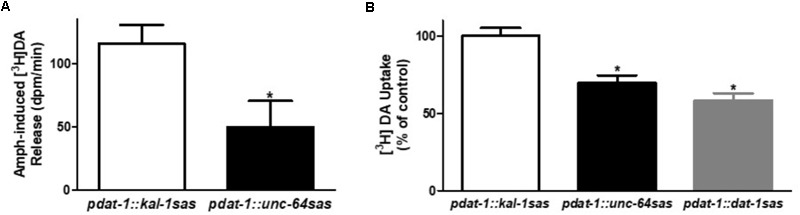
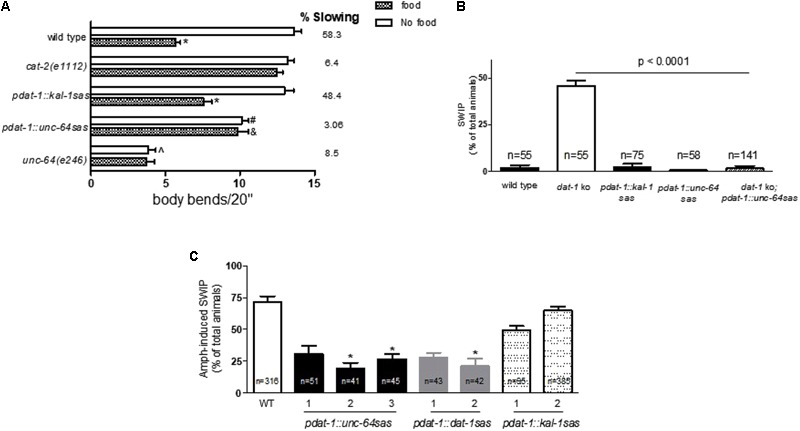
The dopamine transporter (DAT) is a cell membrane protein whose main function is to reuptake the dopamine (DA) released in the synaptic cleft back into the dopaminergic neurons. Previous studies suggested that the activity of DAT is regulated by allosteric proteins such as Syntaxin-1A and is altered by drugs of abuse such as amphetamine (Amph). Because expresses both DAT (DAT-1) and Syntaxin-1A (UNC-64), we used this model system to investigate the functional and behavioral effects caused by lack of expression of in cultured dopaminergic neurons and in living animals. Using an inheritable RNA silencing technique, we were able to knockdown specifically in the dopaminergic neurons. This cell-specific knockdown approach avoids the pleiotropic phenotypes caused by knockout mutations of and ensures the transmission of dopaminergic specific silencing to the progeny. We found that, similarly to knockouts and silenced lines, animals with reduced expression in the dopaminergic neurons did not respond to Amph treatment when tested for locomotor behaviors. Our data demonstrated that in neuronal cultures derived from animals silenced for , the DA uptake was reduced by 30% when compared to controls, and this reduction was similar to that measured in neurons isolated from animals silenced for (40%). Moreover, reduced expression of in the dopaminergic neurons significantly reduced the DA release elicited by Amph. Because in DAT-1 is the only protein capable to reuptake DA, these data show that reduced expression of in the dopaminergic neurons decreases the capability of DAT in re-accumulating synaptic DA. Moreover, these results demonstrate that decreased expression of in the dopaminergic neurons abrogates the locomotor behavior induced by Amph. Taken together these data suggest that Syntaxin-1A plays an important role in both functional and behavioral effects caused by Amph.
多巴胺转运体(DAT)是一种细胞膜蛋白,其主要功能是将突触间隙中释放的多巴胺(DA)重新摄取回多巴胺能神经元。先前的研究表明,DAT的活性受诸如Syntaxin-1A等变构蛋白的调节,并会被诸如苯丙胺(Amph)等滥用药物改变。由于[具体实验对象]同时表达DAT(DAT-1)和Syntaxin-1A(UNC-64),我们使用这个模型系统来研究在培养的多巴胺能神经元和活体动物中缺乏[具体实验对象]表达所引起的功能和行为影响。使用一种可遗传的RNA沉默技术,我们能够特异性地在多巴胺能神经元中敲低[具体实验对象]。这种细胞特异性的敲低方法避免了因[具体实验对象]基因敲除突变导致的多效性表型,并确保多巴胺能特异性[具体实验对象]沉默传递给后代。我们发现,与[具体实验对象]基因敲除和[具体实验对象]沉默品系类似,多巴胺能神经元中[具体实验对象]表达降低的动物在进行运动行为测试时对Amph处理无反应。我们的[具体实验对象]数据表明,在源自[具体实验对象]沉默动物的神经元培养物中,与对照组相比,DA摄取减少了30%,这种减少与从[具体实验对象]沉默动物分离的神经元中测得的减少(40%)相似。此外,多巴胺能神经元中[具体实验对象]表达的降低显著减少了Amph引起的DA释放。因为在[具体实验对象]中DAT-1是唯一能够重新摄取DA的蛋白,这些数据表明多巴胺能神经元中[具体实验对象]表达的降低会降低DAT重新积累突触DA的能力。此外,这些结果表明多巴胺能神经元中[具体实验对象]表达的降低消除了Amph诱导的运动行为。综上所述,这些数据表明Syntaxin-1A在Amph引起的功能和行为影响中都起着重要作用。