Kudumala Sirisha, Sossi Serena, Carvelli Lucia
Harriet Wilkes Honors College, Florida Atlantic University, John D MacArthur Campus.
Integrative Biology and Neuroscience program, College of Science, Florida Atlantic University.
J Vis Exp. 2019 Apr 3(146). doi: 10.3791/59243.
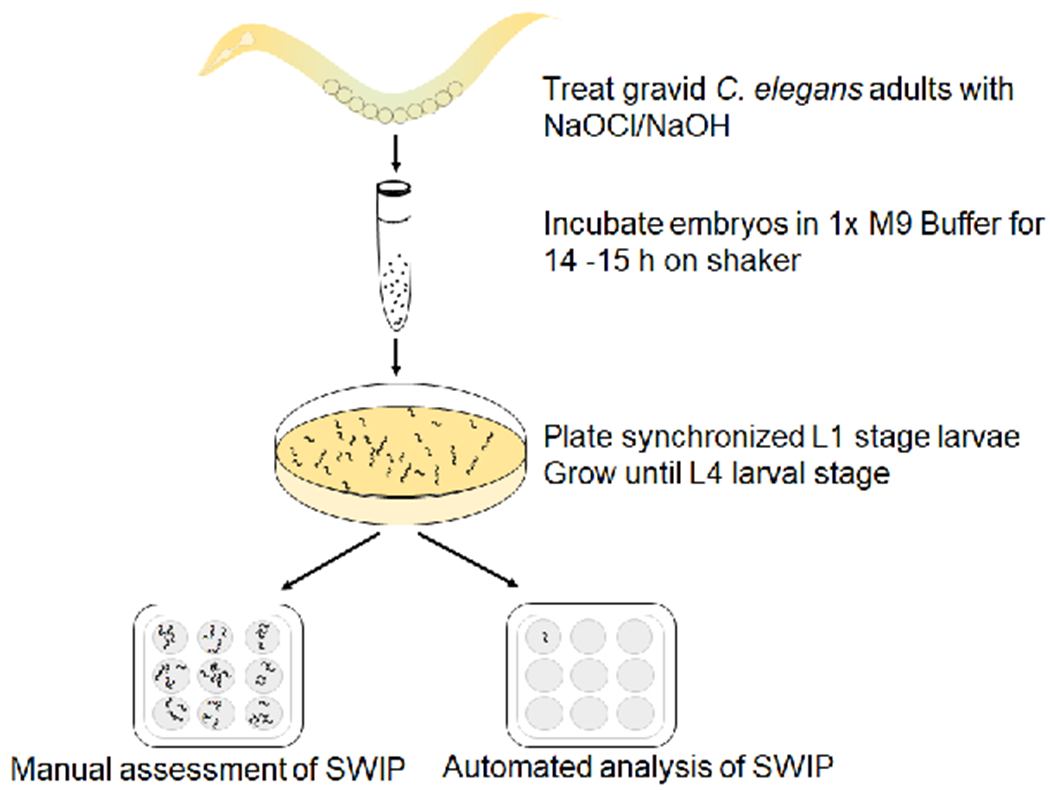
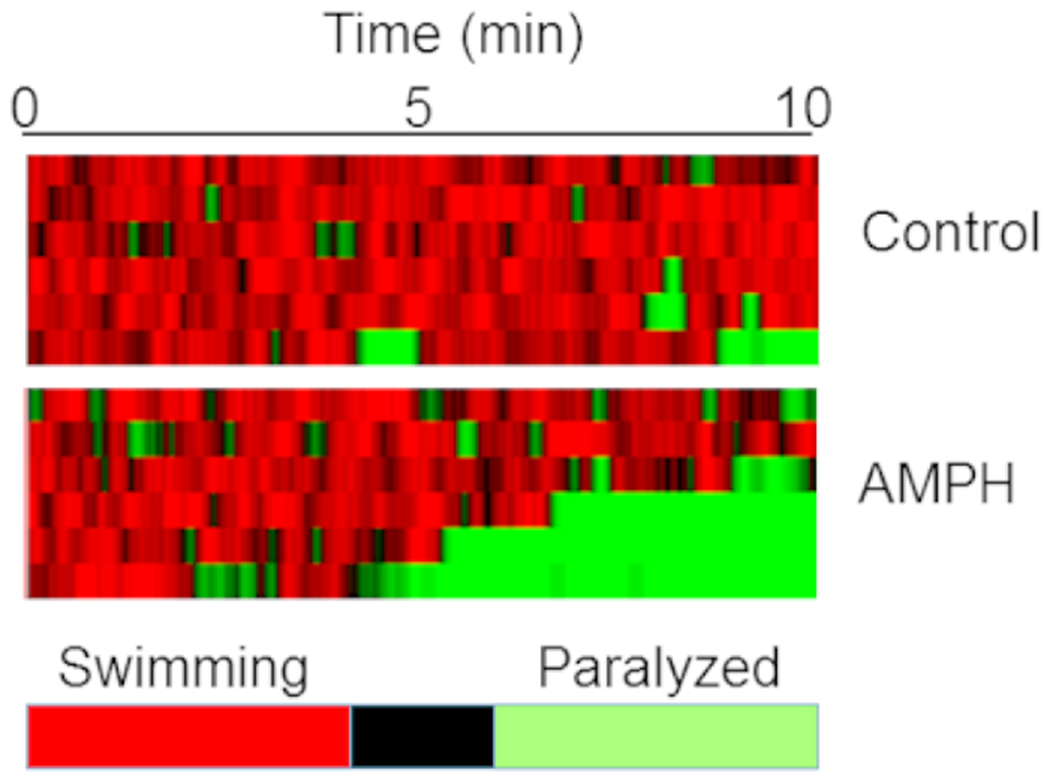
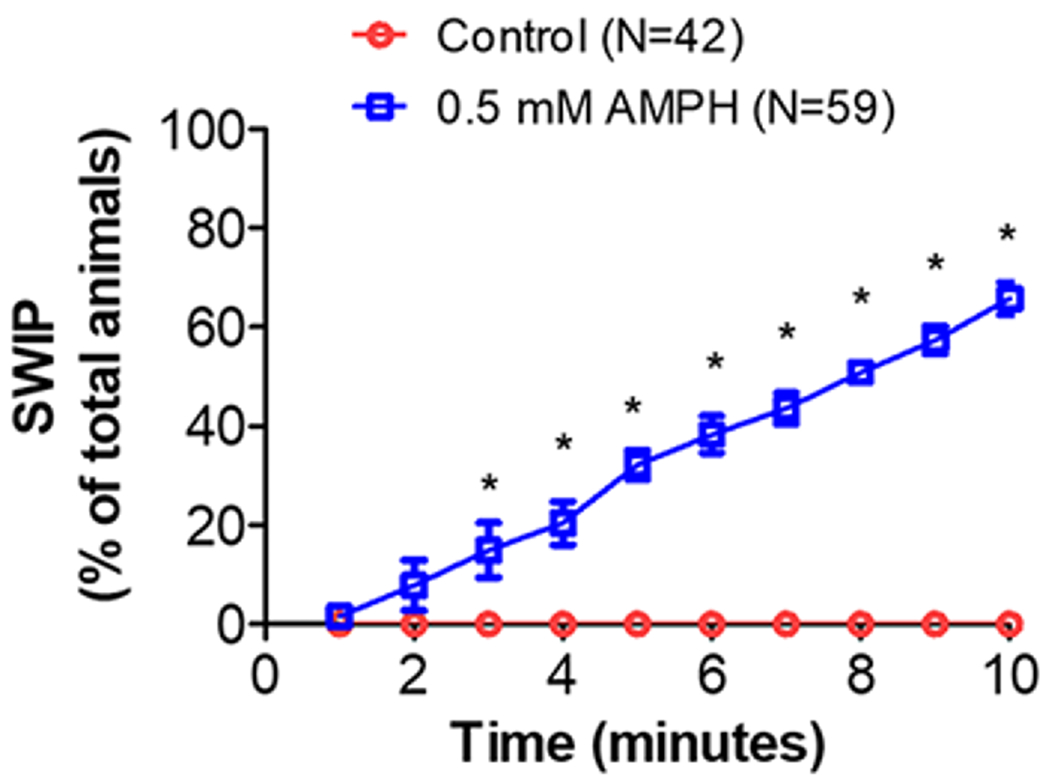
The swimming assay described in this protocol is a valid tool to identify proteins regulating the dopaminergic synapses. Similar to mammals, dopamine (DA) controls several functions in C. elegans including learning and motor activity. Conditions that stimulate DA release (e.g., amphetamine (AMPH) treatments) or that prevent DA clearance (e.g., animals lacking the DA transporter (dat-1) which are incapable of reaccumulating DA into the neurons) generate an excess of extracellular DA ultimately resulting in inhibited locomotion. This behavior is particularly evident when animals swim in water. In fact, while wild-type animals continue to swim for an extended period, dat-1 null mutants and wild-type treated with AMPH or inhibitors of the DA transporter sink to the bottom of the well and do not move. This behavior is termed "Swimming Induced Paralysis" (SWIP). Although the SWIP assay is well established, a detailed description of the method is lacking. Here, we describe a step-by-step guide to perform SWIP. To perform the assay, late larval stage-4 animals are placed in a glass spot plate containing control sucrose solution with or without AMPH. Animals are scored for their swimming behavior either manually by visualization under a stereoscope or automatically by recording with a camera mounted on the stereoscope. Videos are then analyzed using a tracking software, which yields a visual representation of thrashing frequency and paralysis in the form of heat maps. Both the manual and automated systems guarantee an easily quantifiable readout of the animals' swimming ability and thus facilitate screening for animals bearing mutations within the dopaminergic system or for auxiliary genes. In addition, SWIP can be used to elucidate the mechanism of action of drugs of abuse such as AMPH.
本实验方案中描述的游泳试验是鉴定调节多巴胺能突触蛋白的有效工具。与哺乳动物类似,多巴胺(DA)控制着秀丽隐杆线虫的多种功能,包括学习和运动活动。刺激DA释放的条件(如苯丙胺(AMPH)处理)或阻止DA清除的条件(如缺乏DA转运体(dat-1)的动物,其无法将DA重新积累到神经元中)会产生过量的细胞外DA,最终导致运动受到抑制。当动物在水中游泳时,这种行为尤为明显。事实上,野生型动物会持续游泳较长时间,而dat-1基因敲除突变体以及用AMPH或DA转运体抑制剂处理的野生型动物会沉到孔底且不再移动。这种行为被称为“游泳诱导麻痹”(SWIP)。尽管SWIP试验已得到广泛应用,但缺乏对该方法的详细描述。在此,我们描述了进行SWIP试验的详细步骤指南。为进行该试验,将四龄晚期幼虫置于含有对照蔗糖溶液(添加或不添加AMPH)的玻璃点滴板中。通过在体视显微镜下目视观察或通过安装在体视显微镜上的相机自动记录来对动物的游泳行为进行评分。然后使用跟踪软件对视频进行分析,该软件以热图的形式呈现甩动频率和麻痹的直观表示。手动和自动系统都能保证轻松量化动物的游泳能力读数,从而便于筛选多巴胺能系统内携带突变的动物或辅助基因。此外,SWIP可用于阐明诸如AMPH等滥用药物的作用机制。