Parolin Micol, Miscioscia Marina, De Carli Pietro, Cristofalo Patrizia, Gatta Michela, Simonelli Alessandra
Department of Developmental Psychology and Socialization, University of Padua, Padua, Italy.
Department of Women's and Children's Health, University of Padua, Padua, Italy.
Front Psychol. 2018 May 22;9:645. doi: 10.3389/fpsyg.2018.00645. eCollection 2018.
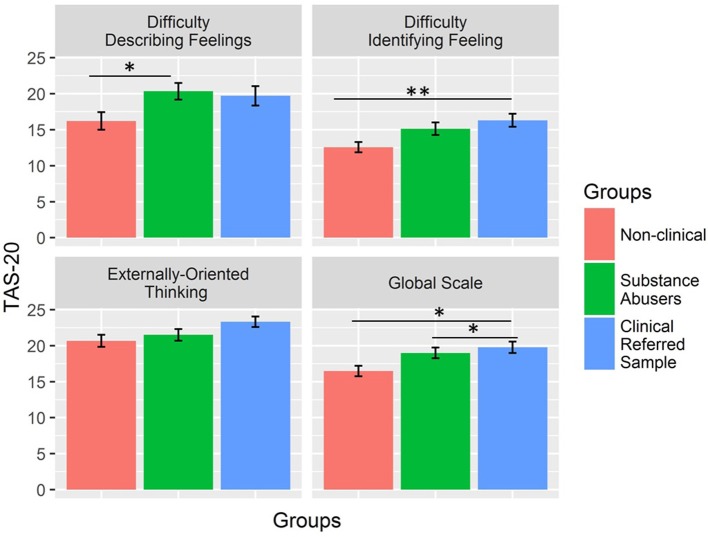
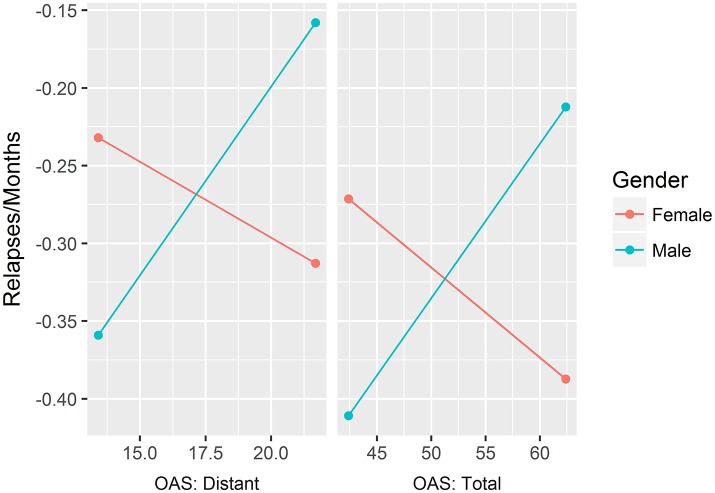
Several studies have reported high rates of alexithymia in drug-dependent individuals, but supporting evidence attests association between alexithymia and a variety of psychiatric disorders, raising doubts about its specificity. Moreover, controversies are emerging about alexithymia assessment: self-report measures present shortcomings with respect to discriminant validity and reliability. As regards treatment for substance use disorders (SUDs), alexithymia has been linked to poorer outcomes, but the results are inconsistent. The aim of the present study is to investigate alexithymia in substance-dependent young adults by examining: (a) the specificity of alexithymia in drug-dependent inpatients, compared to healthy individuals and patients with psychiatric disorders (behavioral and emotional disorders) and (b) the predictivity of alexithymia in determining treatment outcomes in terms of relapses, drop-outs from treatment and the rate of relapse per month of treatment. Two studies were conducted to fulfill these aims: Study 1 and Study 2. Study 1 involved 90 late adolescents, aged 17-21. To fulfill the first aim, 30 inpatients diagnosed with SUD were compared with 30 healthy controls and 30 individuals referred to an outpatient neuropsychiatric unit (a). The participants completed the Toronto Alexithymia Scale-20 (TAS-20) and the Symptom Checklist-90-Revised (SCL-90-R). The results indicated that both clinical groups reported higher TAS-20 scores than the non-clinical subjects, but they did not differ from each other (a); moreover, a large correlation was detected between alexithymia and depressive symptoms, as assessed by the SCL-90-R. Study 2 involved 55 inpatients with SUD recruited in a therapeutic community. The participants completed the TAS-20, and clinicians filled out the Observer Alexithymia Scale (OAS). No association was found between self-report and observational measures. Neither self-reported nor observed alexithymia predicted the number of relapses, drop-out from treatment, or the rate of relapses per month of treatment (b). When the interaction with gender was explored, the global score of alexithymia and the "Distant" OAS subscale predicted the number rate relapses only in males. The TAS-20 did not discriminate between the clinical groups. The limited ability of both observed and self-reported measures in predicting treatment outcome raises questions on the specificity of alexithymia among the substance-dependent inpatient population.
多项研究报告称,药物依赖个体的述情障碍发生率较高,但有支持证据证明述情障碍与多种精神疾病之间存在关联,这引发了对其特异性的质疑。此外,关于述情障碍评估的争议也在不断涌现:自我报告测量在区分效度和信度方面存在缺陷。至于物质使用障碍(SUDs)的治疗,述情障碍与较差的治疗结果有关,但结果并不一致。本研究的目的是通过检查以下方面来调查物质依赖青年成人的述情障碍:(a)与健康个体以及患有精神疾病(行为和情绪障碍)的患者相比,药物依赖住院患者中述情障碍的特异性;(b)述情障碍在确定治疗结果方面的预测性,包括复发情况、治疗退出情况以及每月治疗的复发率。为实现这些目标进行了两项研究:研究1和研究2。研究1涉及90名年龄在17至21岁之间的青少年晚期。为实现第一个目标,将30名被诊断为SUD的住院患者与30名健康对照者以及30名转至门诊神经精神科的个体进行了比较(a)。参与者完成了多伦多述情障碍量表-20(TAS-20)和症状自评量表-90修订版(SCL-90-R)。结果表明,两个临床组的TAS-20得分均高于非临床受试者,但两组之间没有差异(a);此外,通过SCL-90-R评估发现,述情障碍与抑郁症状之间存在高度相关性。研究2涉及在一个治疗社区招募的55名患有SUD的住院患者。参与者完成了TAS-20,临床医生填写了观察者述情障碍量表(OAS)。未发现自我报告测量与观察测量之间存在关联。自我报告的述情障碍和观察到的述情障碍均未预测复发次数、治疗退出情况或每月治疗的复发率(b)。在探讨与性别的相互作用时,述情障碍总分和“疏离”OAS子量表仅在男性中预测了复发率。TAS-20无法区分临床组。观察测量和自我报告测量在预测治疗结果方面的能力有限,这引发了关于述情障碍在物质依赖住院患者群体中的特异性的疑问。