Leng Qixin, Lin Yanli, Zhan Min, Jiang Feng
Department of Pathology, University of Maryland School of Medicine, Baltimore, MD 21201, USA.
Department of Epidemiology & Public Health, University of Maryland School of Medicine, Baltimore, MD 21201, USA.
Oncotarget. 2018 May 15;9(37):24684-24692. doi: 10.18632/oncotarget.25227.
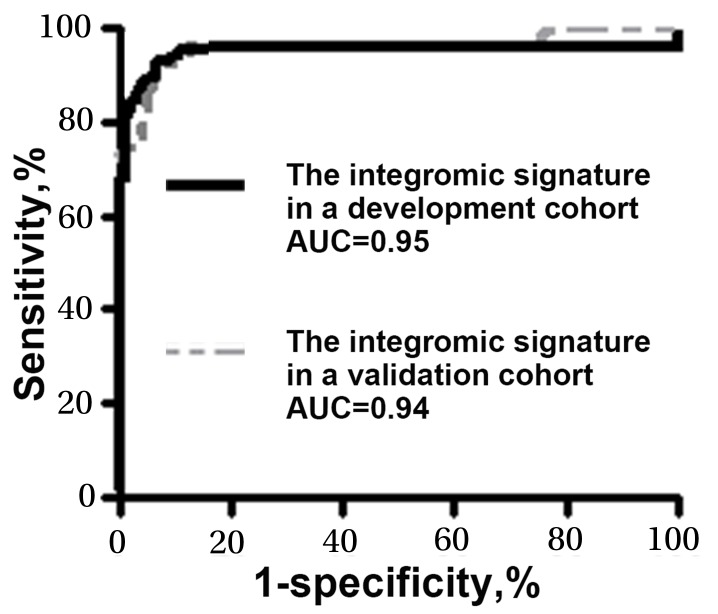
We previously developed three microRNAs (miRs-21, 210, and 486-5p), two long noncoding RNAs (lncRNAs) (SNHG1 and RMRP), and two fucosyltransferase (FUT) genes (FUT8 and POFUT1) as potential plasma biomarkers for lung cancer. However, the diagnostic performance of the individual panels is not sufficient to be used in the clinics. Given the heterogeneity of lung tumors developed from multifactorial molecular aberrations, we determine whether integrating the different classes of molecular biomarkers can improve diagnosis of lung cancer. By using droplet digital PCR, we analyze expression of the seven genes in plasma of a development cohort of 64 lung cancer patients and 33 cancer-free individuals. The panels of three miRNAs (miRs-21, 210, and 486-5p), two lncRNAs (SNHG1 and RMRP), and two FUTs (FUT8 and POFUT1) have a sensitivity of 81-86% and a specificity of 84-87% for diagnosis of lung cancer. From the seven genes, an integromic plasma signature comprising miR-210, SNHG1, and FUT8 is developed that produces higher sensitivity (95.45%) and specificity (96.97%) compared with the individual biomarker panels (all p<0.05). The diagnostic value of the signature was confirmed in a validation cohort of 40 lung cancer patients and 29 controls, independent of stage and histological type of lung tumor, and patients' age, sex, and smoking status (all p>0.05). The integration of the different categories of biomarkers might improve diagnosis of lung cancer.
我们之前开发了三种微小RNA(miR-21、miR-210和miR-486-5p)、两种长链非编码RNA(lncRNA)(SNHG1和RMRP)以及两种岩藻糖基转移酶(FUT)基因(FUT8和POFUT1)作为肺癌潜在的血浆生物标志物。然而,单个检测指标的诊断性能不足以用于临床。鉴于肺癌由多因素分子异常导致的异质性,我们决定探究整合不同类别的分子生物标志物是否能改善肺癌的诊断。通过液滴数字PCR,我们分析了64例肺癌患者和33例无癌个体的血浆中这七个基因的表达。由三种微小RNA(miR-21、miR-210和miR-486-5p)、两种lncRNA(SNHG1和RMRP)以及两种FUT(FUT8和POFUT1)组成的检测指标对肺癌诊断的敏感性为81%-86%,特异性为84%-87%。从这七个基因中,开发出一种包含miR-210、SNHG1和FUT8的整合血浆标志物,与单个生物标志物检测指标相比,其敏感性(95.45%)和特异性(96.97%)更高(所有p<0.05)。该标志物的诊断价值在一个由40例肺癌患者和29例对照组成的验证队列中得到证实,与肺癌的分期、组织学类型以及患者的年龄、性别和吸烟状况无关(所有p>0.05)。整合不同类别的生物标志物可能会改善肺癌的诊断。