Lin Yanli, Leng Qixin, Zhan Min, Jiang Feng
Department of Cell Engineering, Beijing Institute of Biotechnology, No. 20 Dongdajie Street, Fengtai District, Beijing 100071, China; Department of Pathology, University of Maryland School of Medicine, 10 S. Pine St. Baltimore, MD 21201, USA.
Department of Cell Engineering, Beijing Institute of Biotechnology, No. 20 Dongdajie Street, Fengtai District, Beijing 100071, China.
Transl Oncol. 2018 Oct;11(5):1225-1231. doi: 10.1016/j.tranon.2018.07.016. Epub 2018 Aug 8.
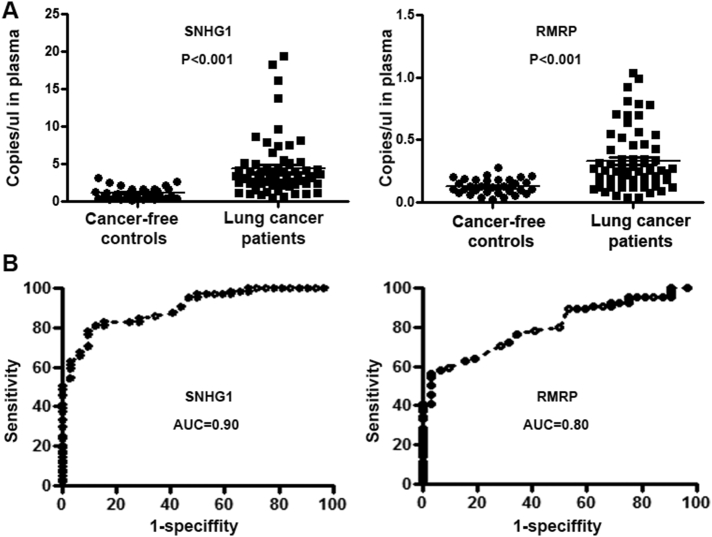
The early detection of lung cancer is a major clinical challenge. Long noncoding RNAs (lncRNAs) have important functions in tumorigenesis. Plasma lncRNAs directly released from primary tumors or the circulating cancer cells might provide cell-free cancer biomarkers. The objective of this study was to investigate whether the lncRNAs could be used as plasma biomarkers for early-stage lung cancer. By using droplet digital polymerase chain reaction, we determined the diagnostic performance of 26 lung cancer-associated lncRNAs in plasma of a development cohort of 63 lung cancer patients and 33 cancer-free individuals, and a validation cohort of 39 lung cancer patients and 28 controls. In the development cohort, 7 of the 26 lncRNAs were reliably measured in plasma. Two (SNHG1 and RMRP) displayed a considerably high plasma level in lung cancer patients vs. cancer-free controls (all P < .001). Combined use of the plasma lncRNAs as a biomarker signature produced 84.13% sensitivity and 87.88% specificity for diagnosis of lung cancer, independent of stage and histological type of lung tumor, and patients' age and sex (all P > .05). The diagnostic value of the plasma lncRNA signature for lung cancer early detection was confirmed in the validation cohort. The plasma lncRNA signature may provide a potential blood-based assay for diagnosing lung cancer at the early stage. Nevertheless, a prospective study is warranted to validate its clinical value.
肺癌的早期检测是一项重大的临床挑战。长链非编码RNA(lncRNAs)在肿瘤发生过程中具有重要功能。从原发性肿瘤或循环癌细胞直接释放到血浆中的lncRNAs可能提供无细胞癌症生物标志物。本研究的目的是调查lncRNAs是否可作为早期肺癌的血浆生物标志物。通过使用液滴数字聚合酶链反应,我们测定了26种与肺癌相关的lncRNAs在63例肺癌患者和33例无癌个体的血浆发育队列以及39例肺癌患者和28例对照的验证队列中的诊断性能。在发育队列中,26种lncRNAs中有7种在血浆中可可靠测量。其中两种(SNHG1和RMRP)在肺癌患者与无癌对照中的血浆水平显著升高(所有P<0.001)。联合使用血浆lncRNAs作为生物标志物特征对肺癌诊断的敏感性为84.13%,特异性为87.88%,与肺癌的分期、组织学类型以及患者的年龄和性别无关(所有P>0.05)。血浆lncRNA特征对肺癌早期检测的诊断价值在验证队列中得到证实。血浆lncRNA特征可能为早期诊断肺癌提供一种潜在的基于血液的检测方法。然而,仍需进行前瞻性研究以验证其临床价值。