Committee on Molecular Metabolism and Nutrition, The University of Chicago, Chicago, IL 60637, USA; Ben May Department for Cancer Research, The University of Chicago, Chicago, IL 60637, USA.
Ben May Department for Cancer Research, The University of Chicago, Chicago, IL 60637, USA; Committee on Molecular Pathogenesis and Molecular Medicine, The University of Chicago, Chicago, IL 60637, USA.
Cell Rep. 2018 Jun 5;23(10):3021-3030. doi: 10.1016/j.celrep.2018.05.010.
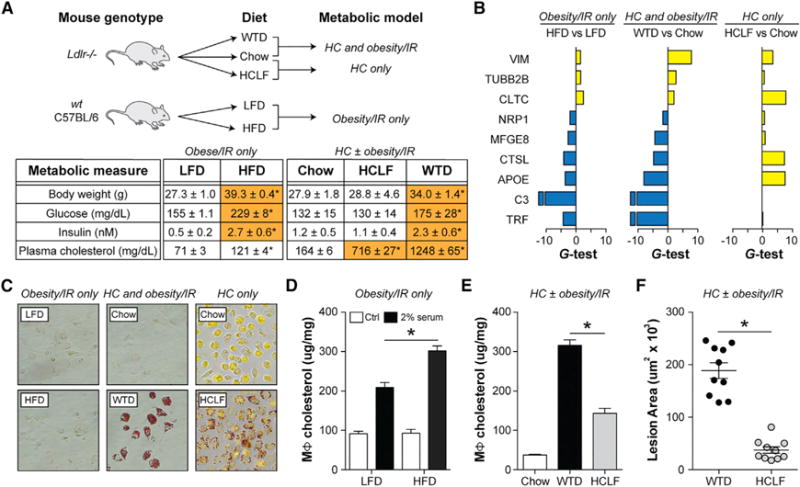
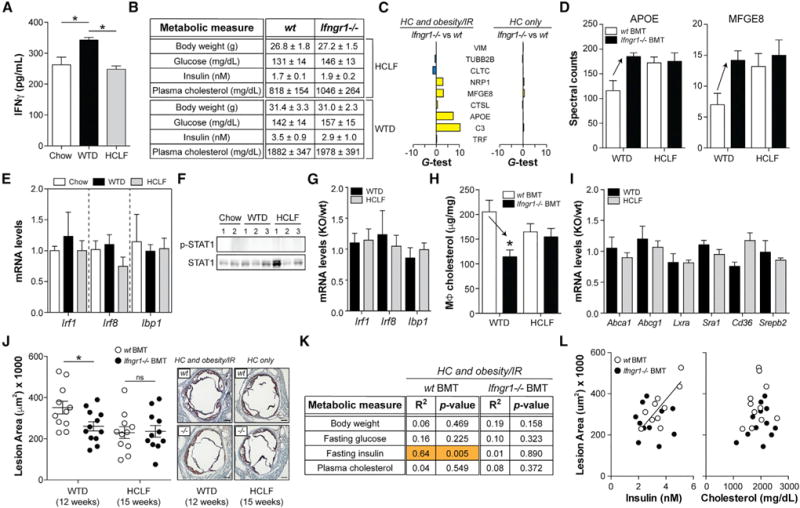
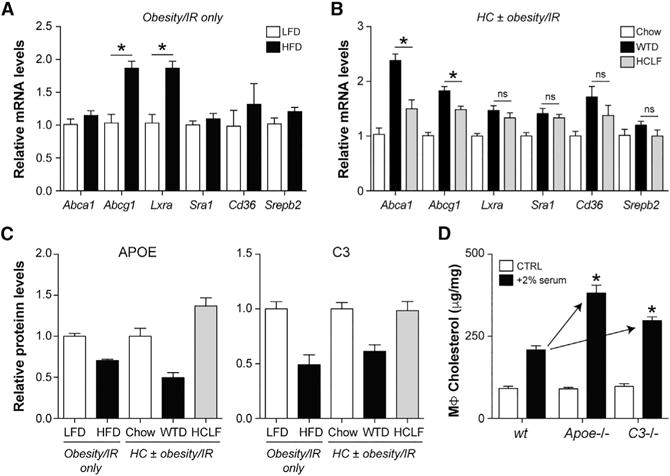
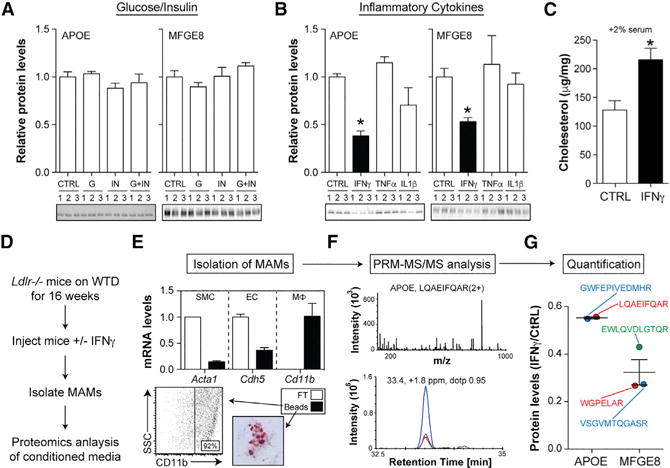
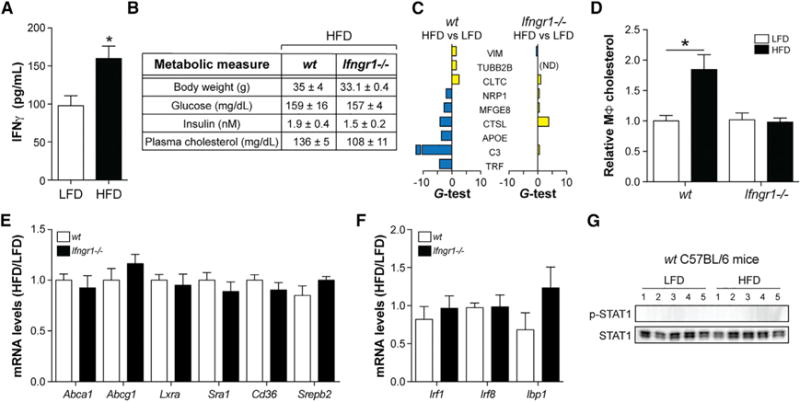
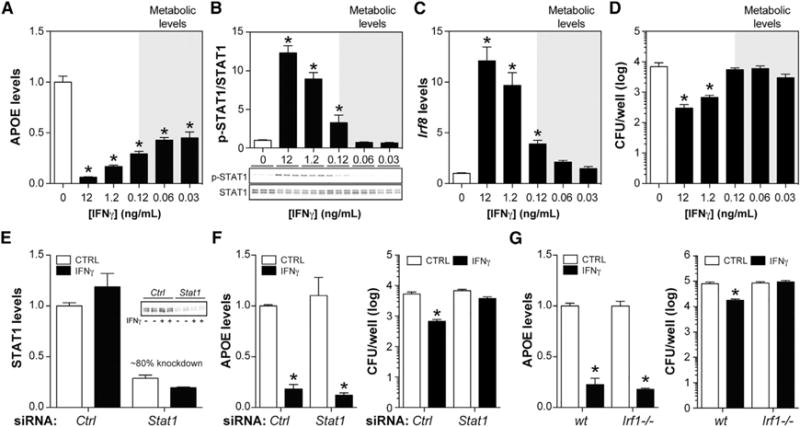
Type 2 diabetes (T2D) is associated with increased risk for atherosclerosis; however, the mechanisms underlying this relationship are poorly understood. Macrophages, which are activated in T2D and causatively linked to atherogenesis, are an attractive mechanistic link. Here, we use proteomics to show that diet-induced obesity and insulin resistance (obesity/IR) modulate a pro-atherogenic "macrophage-sterol-responsive-network" (MSRN), which, in turn, predisposes macrophages to cholesterol accumulation. We identify IFNγ as the mediator of obesity/IR-induced MSRN dysregulation and increased macrophage cholesterol accumulation and show that obesity/IR primes T cells to increase IFNγ production. Accordingly, myeloid cell-specific deletion of the IFNγ receptor (Ifngr1-/-) restores MSRN proteins, attenuates macrophage cholesterol accumulation and atherogenesis, and uncouples the strong relationship between hyperinsulinemia and aortic root lesion size in hypercholesterolemic Ldlr-/- mice with obesity/IR, but does not affect these parameters in Ldlr-/- mice without obesity/IR. Collectively, our findings identify an IFNγ-macrophage pathway as a mechanistic link between obesity/IR and accelerated atherogenesis.
2 型糖尿病(T2D)与动脉粥样硬化风险增加有关;然而,这种关系的机制尚不清楚。在 T2D 中被激活并与动脉粥样形成有因果关系的巨噬细胞是一个有吸引力的机制联系。在这里,我们使用蛋白质组学来表明,饮食诱导的肥胖和胰岛素抵抗(肥胖/IR)调节促动脉粥样硬化的“巨噬细胞固醇反应网络”(MSRN),反过来,使巨噬细胞容易发生胆固醇积累。我们确定 IFNγ 是肥胖/IR 诱导的 MSRN 失调和巨噬细胞胆固醇积累增加的介质,并表明肥胖/IR 使 T 细胞能够增加 IFNγ 的产生。相应地,髓样细胞特异性缺失 IFNγ 受体(Ifngr1-/-)恢复 MSRN 蛋白,减轻巨噬细胞胆固醇积累和动脉粥样形成,并使肥胖/IR 高脂血症 LDLR-/-小鼠中的高胰岛素血症与主动脉根部病变大小之间的强关系解耦,但在没有肥胖/IR 的 LDLR-/-小鼠中不影响这些参数。总之,我们的研究结果确定了 IFNγ-巨噬细胞途径是肥胖/IR 与加速动脉粥样形成之间的机制联系。