School of Food and Biological Engineering, Zhengzhou University of Light Industry, 5 Dongfeng Road, Zhengzhou 450002, China.
Collaborative Innovation Center for Food Production and Safety, 5 Dongfeng Road, Zhengzhou 450002, China.
Molecules. 2018 Jun 7;23(6):1376. doi: 10.3390/molecules23061376.
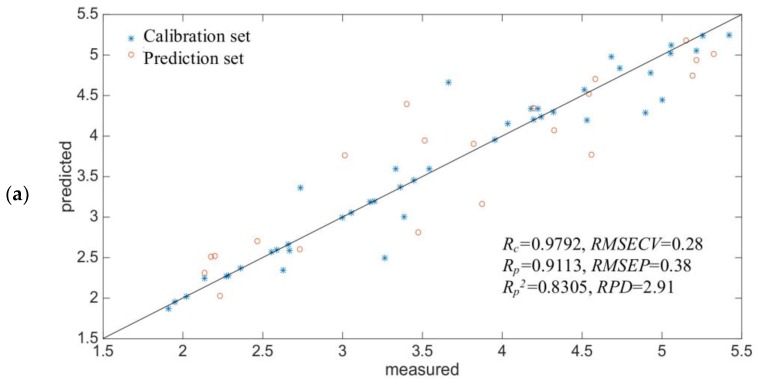
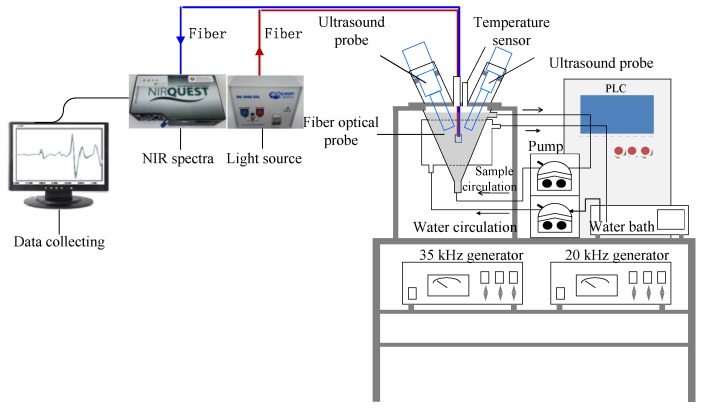
Ultrasound treatment can improve enzymolysis efficiency by changing the amounts of sulfhydryl groups (SH) and disulfide bonds (SS) in protein. This paper proposes an in-situ and real-time monitoring method for SH and SS during ultrasound application processes using a miniature near-infrared (NIR) optical fiber spectrometer and a chemometrics model to determine the endpoint of ultrasonic treatment. The results show that SH and SS contents fluctuated greatly with the extension of ultrasonic time. The optimal spectral intervals for SH content were 869⁻947, 1207⁻1284, 1458⁻1536 and 2205⁻2274 nm, the optimal spectral intervals of SS content were 933⁻992, 1388⁻1446, 2091⁻2148 and 2217⁻2274 nm. According to the optimal spectral intervals, the synergy interval partial least squares (Si-PLS) and error back propagation neural network (BP-ANN) for SH, SS contents were established. The BP-ANN model was better than the Si-PLS model. The correlation coefficient of the prediction set () and the root mean square error of prediction () for the BP-ANN model of SH were 0.9113 and 0.38 μmol/g, respectively, the ² and residual prediction deviation of SH were 0.8305 and 2.91, respectively. For the BP-ANN model of SS, the and the were 0.7523 and 6.56 μmol/g, respectively. The ² and residual prediction deviation () of SS were 0.8305 and 2.91, respectively. However, the ² and of SS was 0.5660 and 1.64, respectively. This work demonstrated that the miniature NIR combined with BP-ANN algorithms has high potential for in-situ monitoring of SH during the ultrasonic treatment process, while the spectral prediction model of SS needs to be further developed.
超声处理可以通过改变蛋白质中巯基(SH)和二硫键(SS)的数量来提高酶解效率。本文提出了一种利用微型近红外(NIR)光纤光谱仪和化学计量学模型在超声应用过程中实时原位监测 SH 和 SS 的方法,以确定超声处理的终点。结果表明,随着超声时间的延长,SH 和 SS 的含量波动较大。SH 含量的最佳光谱区间为 869-947、1207-1284、1458-1536 和 2205-2274nm,SS 含量的最佳光谱区间为 933-992、1388-1446、2091-2148 和 2217-2274nm。根据最佳光谱区间,建立了 SH、SS 含量的协同间隔偏最小二乘(Si-PLS)和误差反向传播神经网络(BP-ANN)。BP-ANN 模型优于 Si-PLS 模型。SH 的 BP-ANN 模型预测集的相关系数()和预测均方根误差()分别为 0.9113 和 0.38μmol/g,SH 的²和残差预测偏差()分别为 0.8305 和 2.91。对于 SS 的 BP-ANN 模型,和分别为 0.7523 和 6.56μmol/g。SS 的 ²和残差预测偏差()分别为 0.8305 和 2.91。然而,SS 的²和分别为 0.5660 和 1.64。本工作表明,微型近红外结合 BP-ANN 算法在超声处理过程中具有实时监测 SH 的潜力,而 SS 的光谱预测模型需要进一步开发。