Zaidi Deenaz, Huynh Hien Q, Carroll Matthew W, Baksh Shairaz, Wine Eytan
Department of Pediatrics.
Department of Medicine, Centre of Excellence for Gastrointestinal Inflammation and Immunity Research (CEGIIR).
Clin Exp Gastroenterol. 2018 May 30;11:217-231. doi: 10.2147/CEG.S148217. eCollection 2018.
A significant feature of pediatric inflammatory bowel diseases (IBD), which include Crohn disease (CD), and ulcerative colitis (UC), is failure to suppress inflammation. The inability to regulate inflammation renders a major challenge toward establishing effective treatments in IBD. Nuclear factor kappa-light-chain-enhancer of activated B-cells-induced inflammation is inhibited by A20 through interactions with TAX1BP1 (Tax1-binding protein 1) and A20-binding inhibitor of NF-κβ activation (ABIN)-1 (A20 binding and inhibitor of NF-κβ) and upon phosphorylation by inhibitor of nuclear factor kappa-β kinase subunit beta (IKKβ), which stabilizes it. We hypothesized that dysregulation of A20 is an important factor in uncontrolled inflammation in pediatric IBD.
Gene expression of , A20 protein, cytokine levels, and A20 phosphorylation was analyzed in the terminal ileum (TI) of 39 patients (14 non-IBD, 15 CD, and 10 UC). expression and protein in T-84 cells and ex vivo biopsies of patients were measured after treatment with strains or tumor necrosis factor (TNF)-α.
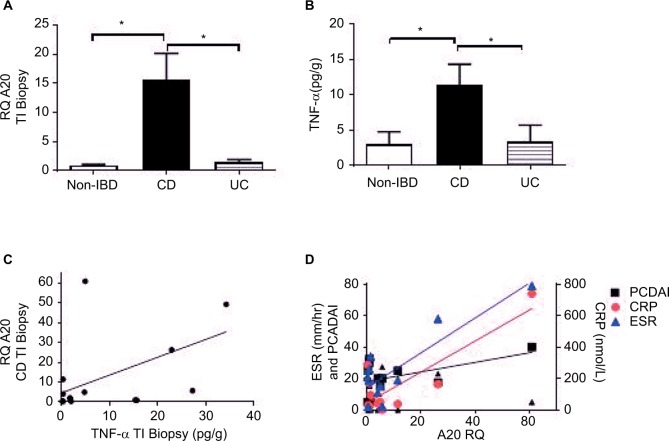
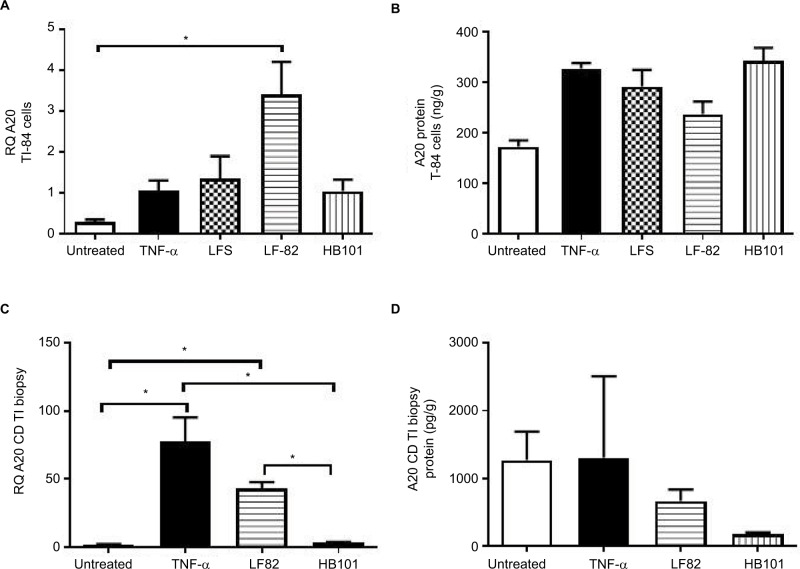
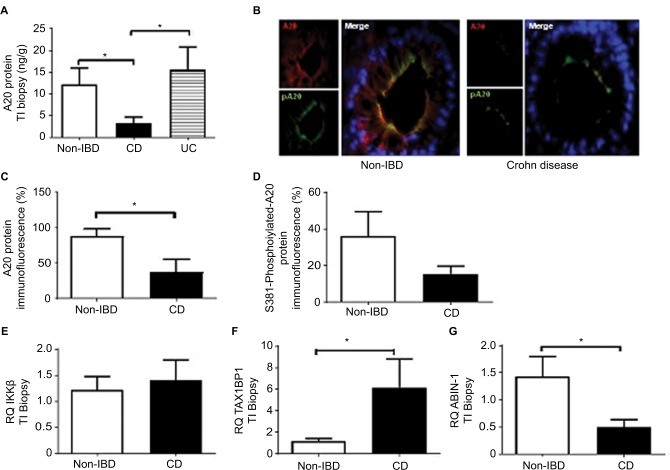
TNF-α levels and expression were increased in the TI of CD patients. A20 protein levels and expression were low, expression was high, and was unchanged. expression positively correlated with biopsy TNF-α levels and inflammatory markers in CD patients. A20 phosphorylation appeared lower in CD patients. expression in TI biopsies from CD patients and T84 cells was triggered with , strain LF82, while A20 protein levels remained unchanged.
We describe a potential mechanism related to failure of A20 to suppress inflammation in CD, characterized by high expression and low A20 protein levels. The dysregulation of A20 is potentially due to alterations in , and infection with strain LF82 could affect the function and stability of A20. Our study signifies an important finding in A20 regulation in IBD, which prevents it from suppressing inflammation.
小儿炎症性肠病(IBD)包括克罗恩病(CD)和溃疡性结肠炎(UC),其一个显著特征是无法抑制炎症。无法调节炎症给IBD有效治疗方案的制定带来了重大挑战。活化B细胞核因子κ轻链增强子诱导的炎症可被A20通过与TAX1BP1(Tax1结合蛋白1)和NF-κβ活化的A20结合抑制剂(ABIN)-1(A20结合并抑制NF-κβ)相互作用而抑制,并在被核因子κ-β激酶亚基β(IKKβ)磷酸化后得以稳定。我们推测A20失调是小儿IBD炎症失控的一个重要因素。
分析了39例患者(14例非IBD、15例CD和10例UC)回肠末端(TI)中A20的基因表达、蛋白水平、细胞因子水平及A20磷酸化情况。用菌株或肿瘤坏死因子(TNF)-α处理后,测定了T-84细胞及患者离体活检组织中的表达及蛋白水平。
CD患者TI中TNF-α水平及表达升高。A20蛋白水平及表达较低,表达较高,而未改变。CD患者中表达与活检TNF-α水平及炎症标志物呈正相关。CD患者中A20磷酸化似乎较低。用菌株LF82刺激CD患者TI活检组织及T84细胞中的表达,而A20蛋白水平保持不变。
我们描述了一种与A20在CD中无法抑制炎症相关的潜在机制,其特征为高表达和低A20蛋白水平。A20失调可能是由于的改变,而菌株LF82感染可能影响A20的功能和稳定性。我们的研究表明了IBD中A20调节方面的一项重要发现,即其无法抑制炎症。