Senek Marina, Nyholm Dag, Nielsen Elisabet I
Department of Neuroscience, Neurology, Uppsala University, Akademiska Sjukhuset/Uppsala University Hospital, 751 85, Uppsala, Sweden.
Department of Pharmaceutical Biosciences, Uppsala University, Husarg. 3, Box 591, 751 24, Uppsala, Sweden.
Eur J Clin Pharmacol. 2018 Oct;74(10):1299-1307. doi: 10.1007/s00228-018-2497-2. Epub 2018 Jun 7.
Low dose, dispersible, levodopa/carbidopa microtablets with an automatic dose dispenser have been developed to facilitate individualized levodopa treatment. The aim of this study was to characterize the pharmacokinetics (PK) of levodopa and carbidopa after microtablet administration, and evaluate the impact of potential covariates.
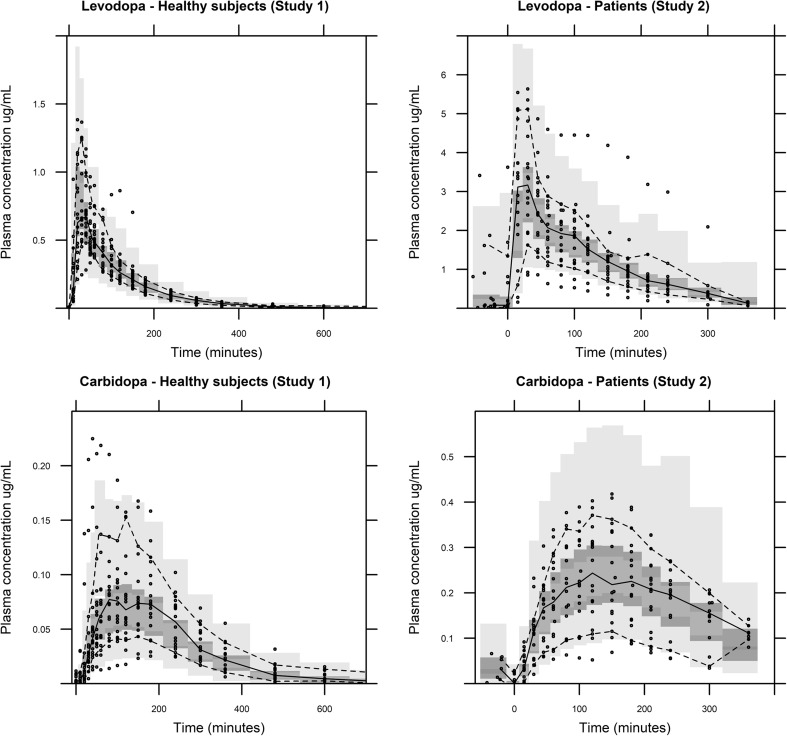
The population PK analysis involved data from 18 healthy subjects and 18 Parkinson's disease patients included in two single-dose, open-label levodopa/carbidopa microtablet studies. The analysis was carried out using non-linear mixed effects modeling. Bodyweight was included on all disposition parameters according to allometric scaling. Potential influence of additional covariates was investigated using graphical evaluation and adjusted adaptive least absolute shrinkage and selection operator.
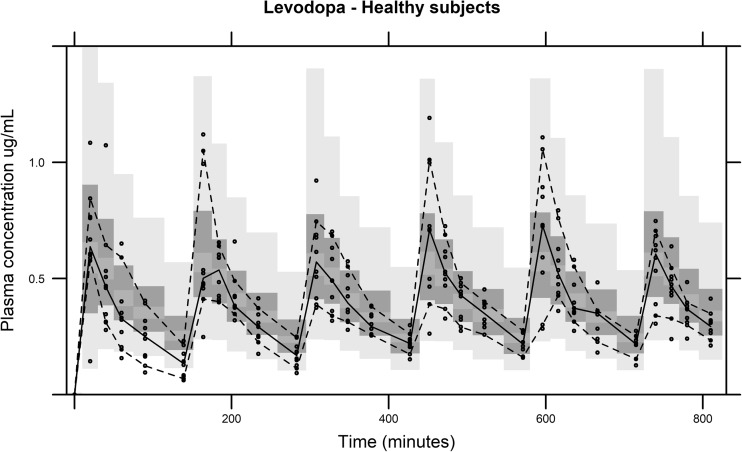
Dispositions of levodopa and carbidopa were best described by a two- and one-compartment model respectively. Double-peak profiles were described using two parallel absorption compartments. Levodopa apparent clearance was found to decrease with increasing carbidopa dose (15% lower with 75 compared to 50 mg of carbidopa) and disease stage (by 18% for Hoehn and Yahr 1 to 4). Carbidopa apparent clearance was found to decrease with age (28% between the age of 60 and 80 years). An external evaluation showed the model to be able to reasonably well predict levodopa concentrations following multiple-dose microtablet administration in healthy subjects.
The presented models adequately described the PK of levodopa and carbidopa, following microtablet administration. The developed model may in the future be combined with a pharmacokinetic-pharmacodynamic target and used for individualized dose selection, utilizing the flexibility offered by the microtablets.
已研发出低剂量、可分散的左旋多巴/卡比多巴微片及自动给药器,以促进左旋多巴个体化治疗。本研究旨在表征微片给药后左旋多巴和卡比多巴的药代动力学(PK),并评估潜在协变量的影响。
群体PK分析纳入了两项单剂量、开放标签的左旋多巴/卡比多巴微片研究中的18名健康受试者和18名帕金森病患者的数据。使用非线性混合效应模型进行分析。根据异速生长比例,将体重纳入所有处置参数。使用图形评估以及调整后的自适应最小绝对收缩和选择算子研究其他协变量的潜在影响。
左旋多巴和卡比多巴的处置分别用二室模型和一室模型能得到最佳描述。使用两个平行吸收室描述双峰曲线。发现左旋多巴的表观清除率随卡比多巴剂量增加而降低(与50mg卡比多巴相比,75mg卡比多巴时降低15%),且随疾病分期降低(Hoehn和Yahr 1期至4期降低18%)。发现卡比多巴的表观清除率随年龄降低(60至80岁之间降低28%)。外部评估表明该模型能够较好地预测健康受试者多次服用微片后左旋多巴的浓度。
所提出的模型充分描述了微片给药后左旋多巴和卡比多巴的PK。未来,利用微片提供的灵活性,所开发的模型可能与药代动力学-药效学靶点相结合,并用于个体化剂量选择。