Department of Physical Biochemistry, Max Planck Institute for Biophysical Chemistry, Göttingen, Germany.
Elife. 2018 Jun 11;7:e34252. doi: 10.7554/eLife.34252.
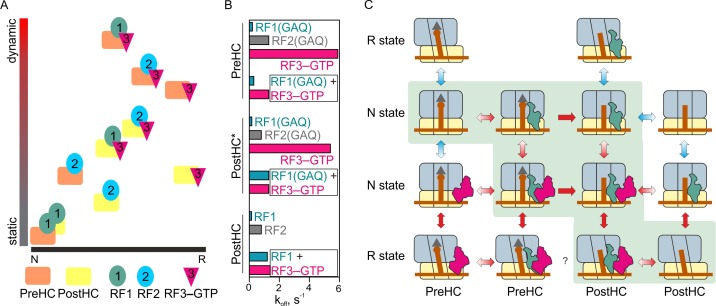
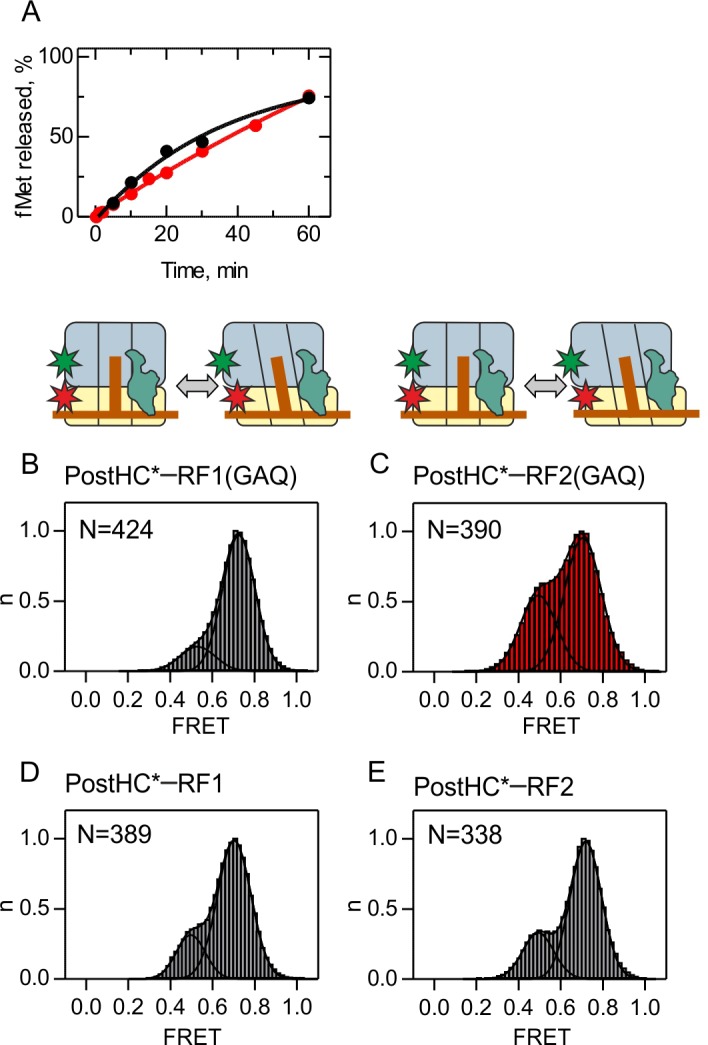
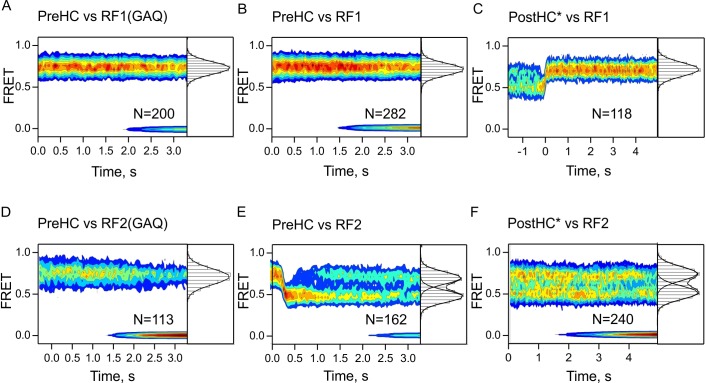
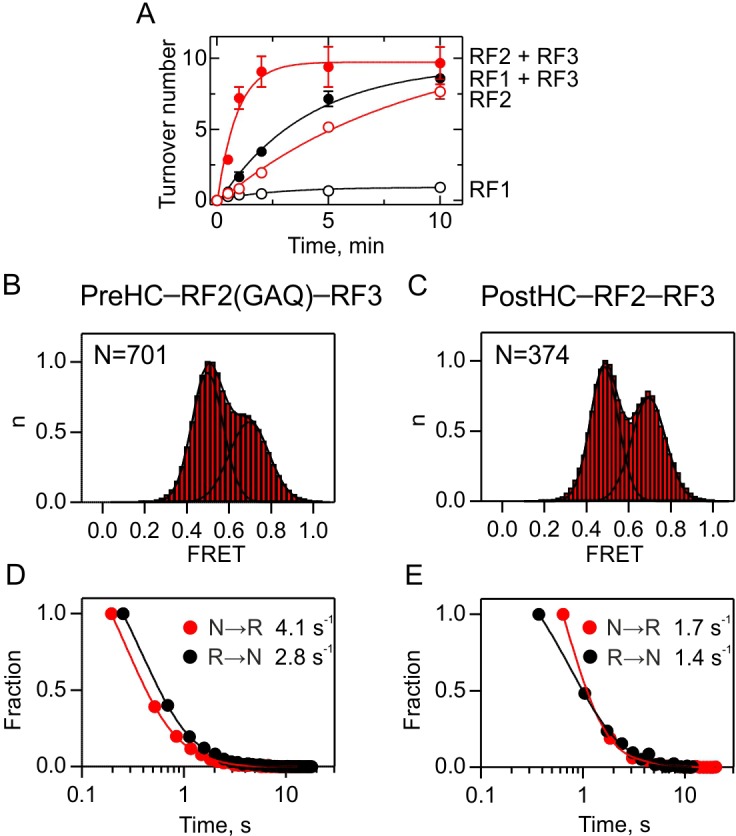
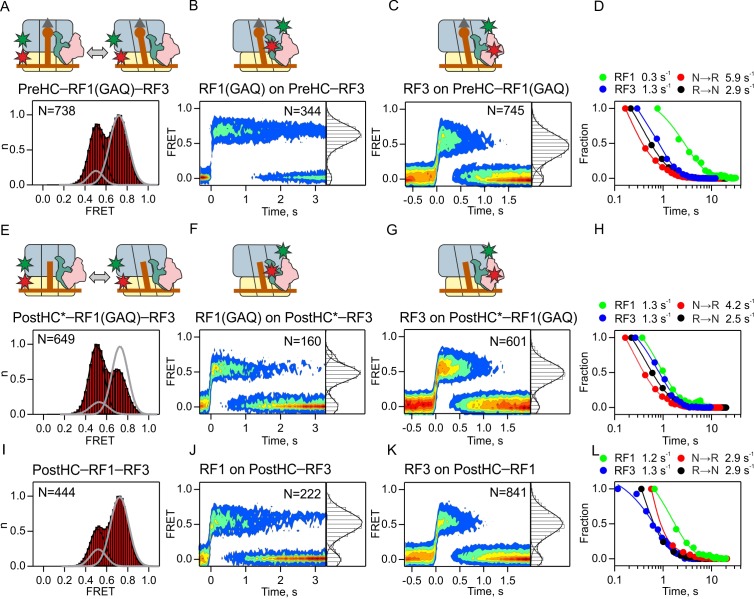
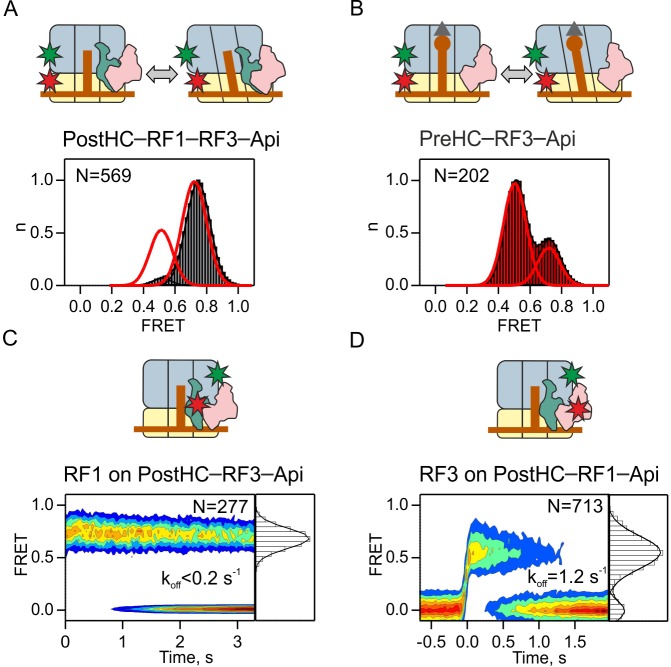
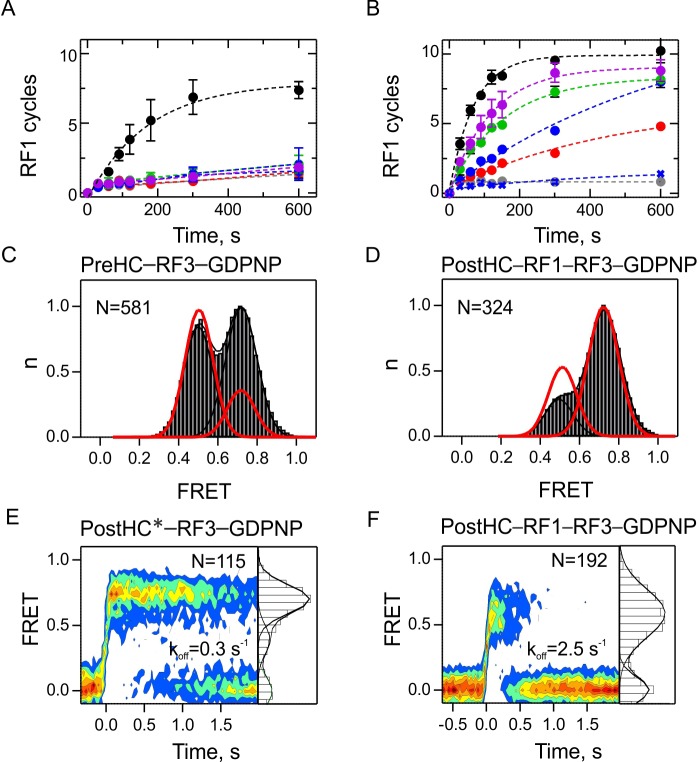
Release factors RF1 and RF2 promote hydrolysis of peptidyl-tRNA during translation termination. The GTPase RF3 promotes recycling of RF1 and RF2. Using single molecule FRET and biochemical assays, we show that ribosome termination complexes that carry two factors, RF1-RF3 or RF2-RF3, are dynamic and fluctuate between non-rotated and rotated states, whereas each factor alone has its distinct signature on ribosome dynamics and conformation. Dissociation of RF1 depends on peptide release and the presence of RF3, whereas RF2 can dissociate spontaneously. RF3 binds in the GTP-bound state and can rapidly dissociate without GTP hydrolysis from termination complex carrying RF1. In the absence of RF1, RF3 is stalled on ribosomes if GTP hydrolysis is blocked. Our data suggest how the assembly of the ribosome-RF1-RF3-GTP complex, peptide release, and ribosome fluctuations promote termination of protein synthesis and recycling of the release factors.
释放因子 RF1 和 RF2 促进翻译终止时肽酰-tRNA 的水解。GTP 酶 RF3 促进 RF1 和 RF2 的循环利用。使用单分子 FRET 和生化测定,我们表明携带两种因子 RF1-RF3 或 RF2-RF3 的核糖体终止复合物是动态的,在非旋转和旋转状态之间波动,而每种因子单独对核糖体动力学和构象具有其独特的特征。RF1 的解离取决于肽的释放和 RF3 的存在,而 RF2 可以自发解离。RF3 以结合 GTP 的状态结合,并可以在没有 GTP 水解的情况下从携带 RF1 的终止复合物中快速解离。如果 GTP 水解被阻断,在没有 RF1 的情况下,RF3 如果 GTP 水解被阻断,RF3 会在核糖体上停滞。我们的数据表明核糖体-RF1-RF3-GTP 复合物的组装、肽的释放以及核糖体的波动如何促进蛋白质合成的终止和释放因子的循环利用。