Department of Obstetrics and Gynecology, Sheba Medical Center, Tel-Hashomer, Israel.
Sackler School of Medicine, Tel Aviv University, Tel Aviv, Israel.
PLoS One. 2018 Jun 11;13(6):e0198949. doi: 10.1371/journal.pone.0198949. eCollection 2018.
Bed rest or activity restriction is a common obstetrical practice, despite a paucity of data to support its efficacy. The aim of this study was to determine whether physical activity, as assessed by a smart band activity tracker, is associated with preterm birth in pregnant women at high risk for preterm delivery.
This was a pilot prospective cohort study including pregnant women at high risk for preterm delivery between 24 and 32 weeks-of-gestation. Physical activity level was assessed by smart band activity. Patients with sonographic short cervical length (≤ 20 mm) were asked to wear the smart band activity tracker continuously for at least one week, including one weekend. Both physicians and patients were blinded to the data stored in the smart band activity tracker. No specific recommendations were given to participants as to the level or intensity of physical activity. The primary outcome was the rate of preterm birth (< 37 weeks-of-gestation). Secondary outcomes included the rate of delivery before 34 weeks of gestation and neonatal outcome. Parametric and nonparametric statistics were used for analysis.
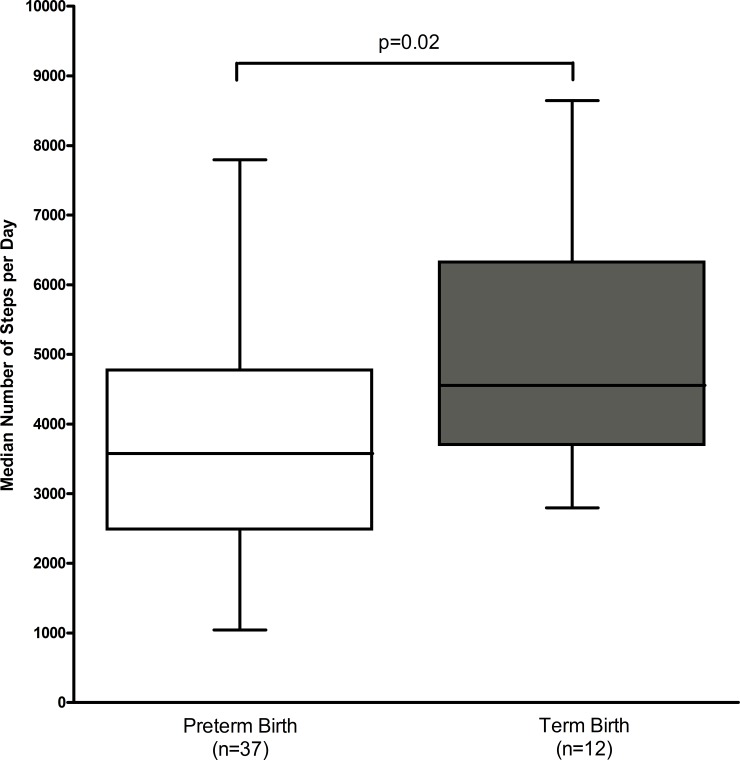
Study population included 49 pregnant women: 37 women (75.7%) delivered preterm and 12 (24.5%) delivered at or after 37 weeks-of-gestation. The median steps per day was significantly lower in patients who delivered preterm (3576, IQR: 2478-4775 vs. 4554, IQR: 3632-6337, p = 0.02). Regression analysis revealed that the median number of steps per day was independently inversely associated with preterm birth, after adjustment for maternal age, body mass index, gestational age at recruitment, cervical length, cervical dilatation and plurality.
This pilot study represents the first quantitative assessment of the association between physical activity and preterm birth. The results of this pilot study do not support the efficacy of decreased physical activity in the prevention of preterm birth in patients with sonographic short cervical length.
卧床休息或活动限制是一种常见的产科实践,尽管缺乏数据支持其疗效。本研究旨在确定通过智能手环活动追踪器评估的身体活动是否与有早产风险的孕妇的早产有关。
这是一项前瞻性队列研究,纳入了妊娠 24 至 32 周有早产风险的孕妇。身体活动水平通过智能手环活动进行评估。有超声宫颈短(≤20mm)的患者被要求至少连续佩戴智能手环活动追踪器一周,包括一个周末。医生和患者均对智能手环活动追踪器中存储的数据不知情。没有向参与者提供关于身体活动水平或强度的具体建议。主要结局是早产率(<37 孕周)。次要结局包括 34 孕周前的分娩率和新生儿结局。采用参数和非参数统计进行分析。
研究人群包括 49 名孕妇:37 名(75.7%)早产,12 名(24.5%)在 37 孕周及以上分娩。早产患者的每日步数中位数明显较低(3576,IQR:2478-4775 与 4554,IQR:3632-6337,p=0.02)。回归分析显示,在调整了母亲年龄、体重指数、招募时的孕周、宫颈长度、宫颈扩张和多胎后,每日步数中位数与早产独立负相关。
这项初步研究代表了首次对身体活动与早产之间的关联进行定量评估。这项初步研究的结果不支持超声宫颈短的患者减少身体活动对预防早产的疗效。