National Field Station of Freshwater Ecosystem of Liangzi Lake, College of Life Sciences, Wuhan University, Wuhan, 430072, PR China.
Key Laboratory of Plant Resources Conservation and Sustainable Utilization, South China Botanical Garden, Chinese Academy of Sciences, Guangzhou, 510650, PR China.
Sci Rep. 2018 Jun 11;8(1):8813. doi: 10.1038/s41598-018-27279-3.
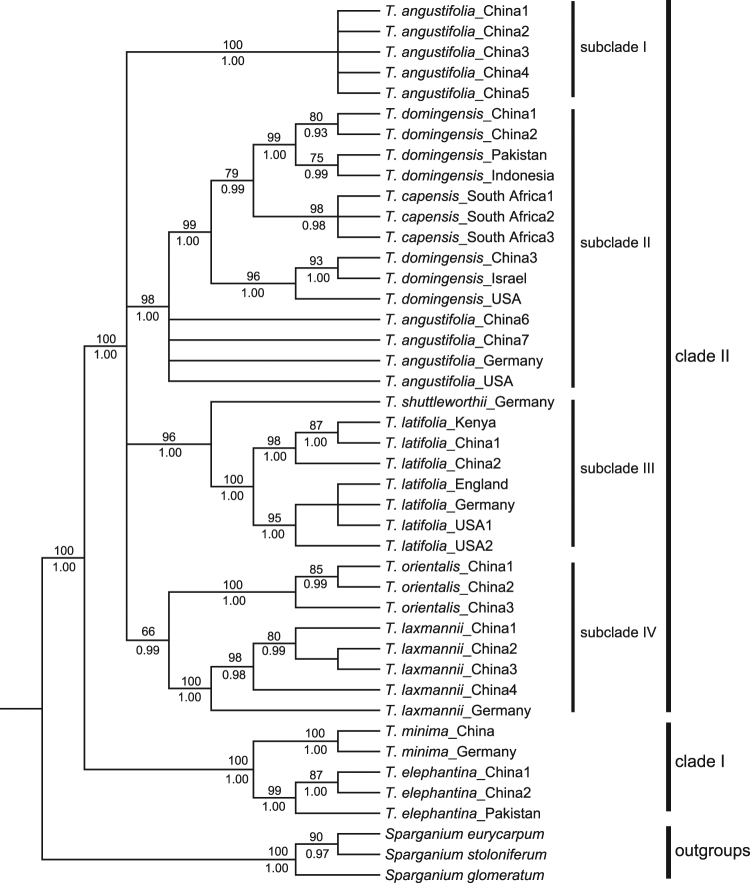
Typha is a cosmopolitan aquatic plant genus that includes species with widespread distributions. It is a relatively ancient genus with an abundant fossil record dating back to the Paleogene. However, the details of its biogeographic history have remained unclear until now. In this study, we present a revised molecular phylogeny using sequences of seven chloroplast DNA markers from nine species sampled from various regions in order to infer the biogeographic history of the genus. Two clades were recovered with robust support. Typha minima and T. elephantina comprised one clade, and the other clade included the remaining seven species, which represented a polytomy of four robustly supported subclades. Two widespread species, T. angustifolia and T. domingensis, were revealed to be paraphyletic, indicating the need for taxonomic revision. Divergence time estimation suggested that Typha had a mid-Eocene crown origin, and its diversification occurred in the Middle and Late Miocene. Ancestral area reconstruction showed that Typha possibly originated from eastern Eurasia. Both dispersal via the Beringian Land Bridge and recent transoceanic dispersal may have influenced the intercontinental distribution of Typha species.
香蒲是一个世界性的水生植物属,包含分布广泛的物种。它是一个相对古老的属,有丰富的化石记录,可追溯到古近纪。然而,其生物地理历史的细节至今仍不清楚。在这项研究中,我们使用来自不同地区的 9 个种的 7 个叶绿体 DNA 标记的序列,提出了一个修正的分子系统发育,以推断该属的生物地理历史。两个分支得到了强有力的支持。小香蒲和象鼻草香蒲构成一个分支,而其他七个种则构成另一个分支,代表四个强有力支持的亚分支的多系群。两个广泛分布的种,狭叶香蒲和多穗香蒲,被揭示为并系的,表明需要进行分类修订。分化时间估计表明,香蒲的起源于中始新世,其多样化发生在中晚中新世。祖先区域重建表明,香蒲可能起源于东亚。通过白令陆桥的扩散和最近的跨洋扩散都可能影响了香蒲属物种的洲际分布。