Davarzani Nasser, Sanders-van Wijk Sandra, Maeder Micha T, Rickenbacher Peter, Smirnov Evgueni, Karel Joël, Suter Thomas, de Boer Rudolf A, Block Dirk, Rolny Vinzent, Zaugg Christian, Pfisterer Matthias E, Peeters Ralf, Brunner-La Rocca Hans-Peter
1Department of Data Science and Knowledge Engineering, Maastricht University, St. Servaasklooster 39, P.O. Box 616, 6200 MD Maastricht, the Netherlands.
2Department of Cardiology, Maastricht University Medical Center, Maastricht, the Netherlands.
EPMA J. 2018 May 13;9(2):161-173. doi: 10.1007/s13167-018-0137-7. eCollection 2018 Jun.
It is uncertain whether repeated measurements of a multi-target biomarker panel may help to personalize medical heart failure (HF) therapy to improve outcome in chronic HF.
This analysis included 499 patients from the Trial of Intensified versus standard Medical therapy in Elderly patients with Congestive Heart Failure (TIME-CHF), aged ≥ 60 years, LVEF ≤ 45%, and NYHA ≥ II, who had repeated clinical visits within 19 months follow-up. The interaction between repeated measurements of biomarkers and treatment effects of loop diuretics, spironolactone, β-blockers, and renin-angiotensin system (RAS) inhibitors on risk of HF hospitalization or death was investigated in a hypothesis-generating analysis. Generalized estimating equation (GEE) models were used to account for the correlation between recurrences of events in a patient.
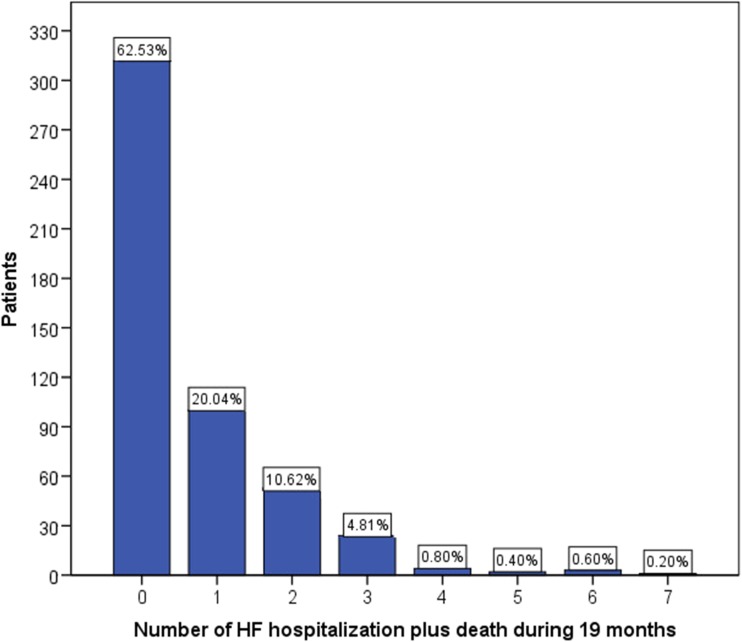
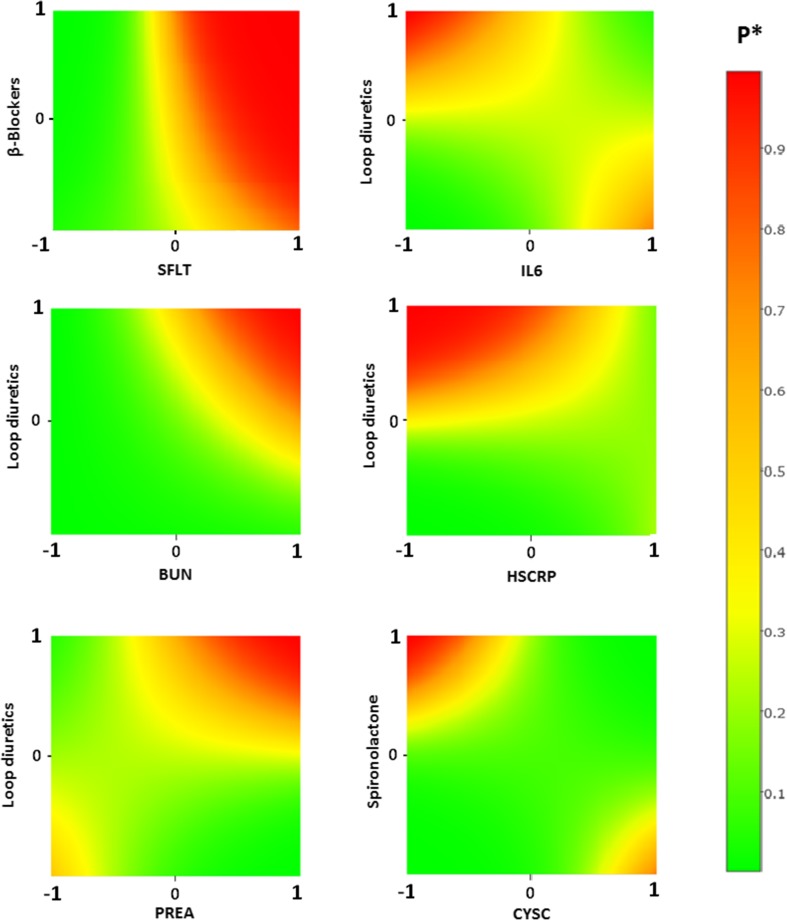
One hundred patients (20%) had just one event (HF hospitalization or death) and 87 (17.4%) had at least two events. Loop diuretic up-titration had a beneficial effect for patients with high interleukin-6 (IL6) or high high-sensitivity C-reactive protein (hsCRP) (interaction, = 0.013 and = 0.001), whereas the opposite was the case with low hsCRP (interaction, = 0.013). Higher dosage of loop diuretics was associated with poor outcome in patients with high blood urea nitrogen (BUN) or prealbumin (interaction, = 0.006 and = 0.001), but not in those with low levels of these biomarkers. Spironolactone up-titration was associated with lower risk of HF hospitalization or death in patients with high cystatin C (CysC) (interaction, = 0.021). β-Blockers up-titration might have a beneficial effect in patients with low soluble fms-like tyrosine kinase-1 (sFlt) (interaction, = 0.021). No treatment biomarker interactions were found for RAS inhibition.
The data of this post hoc analysis suggest that decision-making using repeated biomarker measurements may be very promising in bringing treatment of heart failure to a new level in the context of predictive, preventive, and personalized medicine. Clearly, prospective testing is needed before this novel concept can be adopted.
isrctn.org, identifier: ISRCTN43596477.
多靶点生物标志物组合的重复测量是否有助于使心力衰竭(HF)的医学治疗个体化,以改善慢性HF的预后尚不确定。
本分析纳入了499例来自老年充血性心力衰竭强化治疗与标准药物治疗试验(TIME-CHF)的患者,年龄≥60岁,左心室射血分数(LVEF)≤45%,纽约心脏协会(NYHA)分级≥Ⅱ级,在19个月的随访期内有多次临床就诊。在一项假设生成分析中,研究了生物标志物的重复测量与袢利尿剂、螺内酯、β受体阻滞剂和肾素-血管紧张素系统(RAS)抑制剂对HF住院或死亡风险的治疗效果之间的相互作用。使用广义估计方程(GEE)模型来考虑患者事件复发之间的相关性。
100例患者(20%)仅发生1次事件(HF住院或死亡),87例患者(17.4%)至少发生2次事件。袢利尿剂剂量增加对白细胞介素-6(IL6)高或高敏C反应蛋白(hsCRP)高的患者有有益作用(相互作用,P = 0.013和P = 0.001),而hsCRP低的患者情况则相反(相互作用,P = 0.013)。袢利尿剂剂量增加与血尿素氮(BUN)高或前白蛋白高的患者预后不良相关(相互作用,P = 0.006和P = 0.001),但与这些生物标志物水平低的患者无关。螺内酯剂量增加与胱抑素C(CysC)高的患者HF住院或死亡风险降低相关(相互作用,P = 0.021)。β受体阻滞剂剂量增加可能对可溶性fms样酪氨酸激酶-1(sFlt)低的患者有有益作用(相互作用,P = 0.021)。未发现RAS抑制的治疗生物标志物相互作用。
这项事后分析的数据表明,在预测、预防和个性化医学的背景下,使用重复的生物标志物测量进行决策可能非常有前景,能将心力衰竭的治疗提升到一个新水平。显然,在采用这一新概念之前需要进行前瞻性测试。
isrctn.org,标识符:ISRCTN43596477。