Human Environments Analysis Laboratory, University of Western Ontario, London, ON, Canada.
Department of Geography, Western University, London, ON, Canada.
PLoS One. 2018 Jun 13;13(6):e0198470. doi: 10.1371/journal.pone.0198470. eCollection 2018.
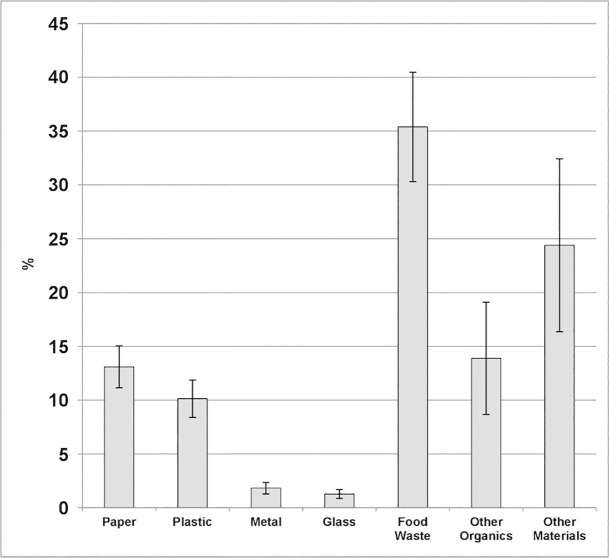
There is little consensus on the amount of worldwide food waste generation because many current estimates are indirect and link back to the same limited primary datasets, with much of the data originating from fieldwork undertaken in the 1970s and 1980s. Direct measurement of waste streams, through waste composition studies, can be used to develop accurate estimates of food waste disposal. In Ontario, Canada, municipalities that undertake household waste composition studies all use a common direct measurement methodology that includes a broad range of waste categories, including food waste. The purpose of this research was to estimate the quantity of food waste disposed, in the garbage stream, by households in southern Ontario, Canada, and determine if this common methodology could be expanded and serve as the basis of a standardized and rigorous household food waste measurement methodology. Household waste composition study data (2012-2015), including a single "food waste" category, were gathered from 9 Ontario municipalities, aggregated and analyzed to develop estimates of food waste in the garbage stream. On average, households disposed 2.40 kg/week of food waste in the garbage, which comprised 35.4% of this waste stream. This does not include any food waste otherwise disposed (e.g., sink) or recycled (e.g., composted). Urban households disposed significantly greater amounts of food waste compared to rural households in the spring (p = 0.01) and summer (p = 0.02). Households with access to a green bin program disposed significantly less food waste than those with no access to a green bin program in the spring (p = 0.03) and summer (p<0.01). The common methodology used to develop these estimates shows promise as the basis of a household food waste measurement methodology. This future methodology would include dividing food waste into avoidable and unavoidable food waste categories, as well as adding subcategories (e.g., avoidable fruits and vegetables).
由于许多当前的估计都是间接的,并与同样有限的原始数据集相关联,其中大部分数据源自于 20 世纪 70 年代和 80 年代的实地调查,因此全球食物浪费产生量的共识很少。通过废物成分研究直接测量废物流,可以用来准确估计食物废物处理量。在加拿大安大略省,进行家庭废物成分研究的市政府都使用一种共同的直接测量方法,其中包括广泛的废物类别,包括食物废物。本研究的目的是估计加拿大安大略省南部家庭在垃圾中处理的食物废物量,并确定这种共同的方法是否可以扩展并作为标准化和严格的家庭食物废物测量方法的基础。从 9 个安大略省政府收集了家庭废物成分研究数据(2012-2015 年),包括单一的“食物废物”类别,将其汇总并进行分析,以开发垃圾中食物废物的估算值。平均而言,家庭每周在垃圾中处理 2.40 公斤的食物废物,占该废物流的 35.4%。这不包括任何其他处理(例如,水槽)或回收(例如,堆肥)的食物废物。与农村家庭相比,城市家庭在春季(p = 0.01)和夏季(p = 0.02)中处理的食物废物量明显更多。在春季(p = 0.03)和夏季(p<0.01),有绿色垃圾桶计划的家庭比没有绿色垃圾桶计划的家庭处理的食物废物明显少。用于开发这些估算值的共同方法具有成为家庭食物废物测量方法基础的潜力。这种未来的方法将包括将食物废物分为可避免和不可避免的食物废物类别,并添加子类别(例如,可避免的水果和蔬菜)。