Chen Xiongbiao, Fang Pihua, Liu Zheng, He Jia, Tang Min, Liu Jun, Lu Bin, Zhang Shu
Department of Cardiac Arrhythmia - State Key Laboratory of Cardiovascular Disease - Fuwai Hospital - National Center for Cardiovascular Diseases - Chinese Academy of Medical Sciences and Peking Union Medical College, Beijing - China.
Department of Radiology - State Key Laboratory of Cardiovascular Disease - Fuwai Hospital - National Center for Cardiovascular Disease - Chinese Academy of Medical Sciences and Peking Union Medical College, Beijing - China.
Arq Bras Cardiol. 2018 May;110(5):440-448. doi: 10.5935/abc.20180071.
The influence of pulmonary vein (PV) anatomy on cryo kinetics during cryoballoon (CB) ablation is unclear.
To investigate the relationship between PV anatomy and cryo kinetics during CB ablation for atrial fibrillation (AF).
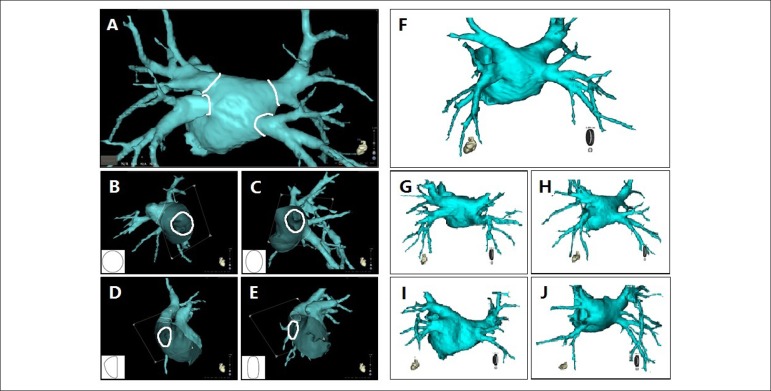
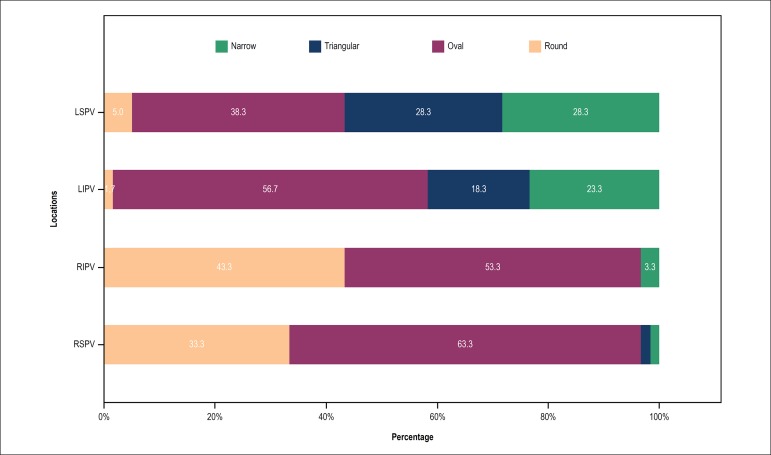
Sixty consecutive patients were enrolled. PV anatomy, including ostial diameters (long, short and corrected), ratio between short and long diameters, ostium shape (round, oval, triangular, and narrow), and drainage pattern (typical, with common trunk, common antrum, ostial branch and supernumerary PV) were evaluated on multi-detector computed tomography (MDCT) images pre-procedure. Cryo kinetics parameters [balloon freeze time from 0 to -30ºC (BFT), balloon nadir temperature (BNT) and balloon warming time from -30 to +15ºC (BWT)] were recorded during procedure. All p values are two-sided, with values of p < 0.05 considered to be statistically significant.
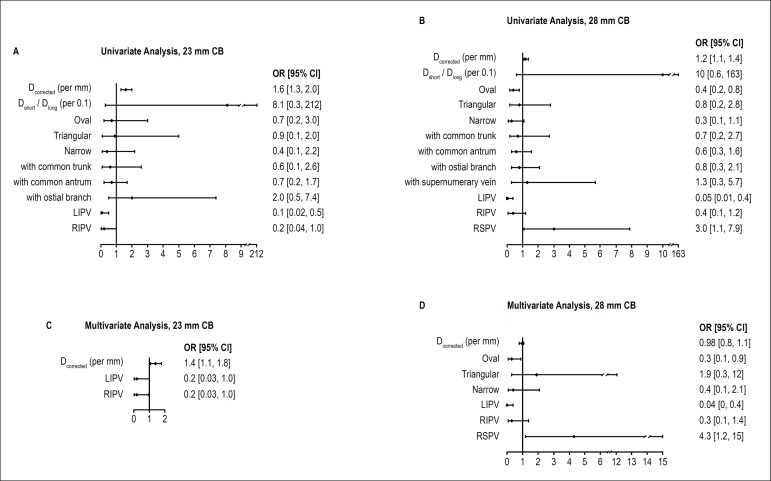
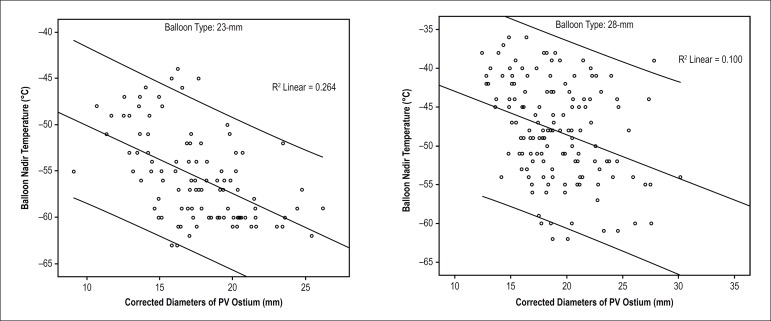
606 times of freezing cycle were accomplished. Moderate negative correlation was documented between BNT and corrected PV diameter (r = -0.51, p < 0.001) when using 23-mm CBs, and mild negative correlation (r = - 0.32, p = 0.001) was found when using 28-mm CBs. Multivariate logistic regression analysis revealed that PV corrected ostial diameter (OR, 1.4; p = 0.004) predicted a BNT < -51ºC when using 23-mm CBs, while PV ostium oval shape (OR, 0.3; p = 0.033) and PV locations (left inferior PV: OR, 0.04; p = 0.005; right superior PV: OR, 4.3; p = 0.025) predicted BNT < -51ºC when using 28-mm CBs.
MDCT can provide PV anatomy accurate evaluation prior CB ablation. PV anatomy is associated with cryo kinetics during ablation.
肺静脉(PV)解剖结构对冷冻球囊(CB)消融过程中冷冻动力学的影响尚不清楚。
探讨心房颤动(AF)患者CB消融过程中PV解剖结构与冷冻动力学之间的关系。
连续纳入60例患者。术前在多排螺旋计算机断层扫描(MDCT)图像上评估PV解剖结构,包括开口直径(长径、短径和校正直径)、短径与长径之比、开口形状(圆形、椭圆形、三角形和狭窄形)以及引流模式(典型、有共同干、共同窦、开口分支和额外PV)。术中记录冷冻动力学参数[球囊从0至-30℃的冷冻时间(BFT)、球囊最低温度(BNT)和球囊从-30至+15℃的复温时间(BWT)]。所有p值为双侧,p<0.05被认为具有统计学意义。
共完成606次冷冻周期。使用23-mm CB时,BNT与校正后的PV直径之间呈中度负相关(r = -0.51,p < 0.001),使用28-mm CB时呈轻度负相关(r = - 0.32,p = 0.001)。多因素逻辑回归分析显示,使用23-mm CB时,PV校正开口直径(OR,1.4;p = 0.004)预测BNT < -51℃,而使用28-mm CB时,PV开口椭圆形(OR,0.3;p = 0.033)和PV位置(左下PV:OR,0.04;p = 0.005;右上PV:OR,4.3;p = 0.025)预测BNT < -51℃。
MDCT可在CB消融术前提供准确的PV解剖结构评估。PV解剖结构与消融过程中的冷冻动力学相关。