Key Laboratory of Advanced Electrical Engineering and Energy Technology, Tianjin Polytechnic University, Tianjin 300000, China.
School of Instrument Science and Opto-Electronics Engineering, Hefei University of Technology, Hefei 230000, China.
Sensors (Basel). 2018 Jun 13;18(6):1921. doi: 10.3390/s18061921.
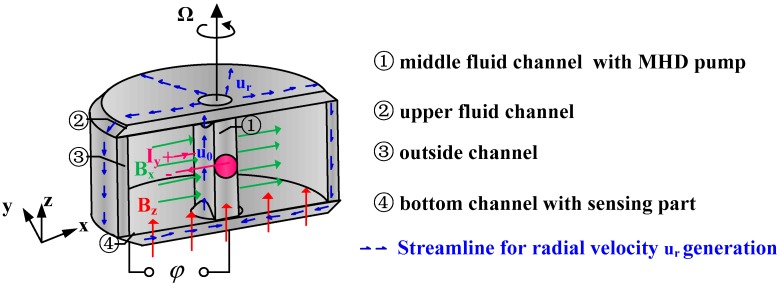
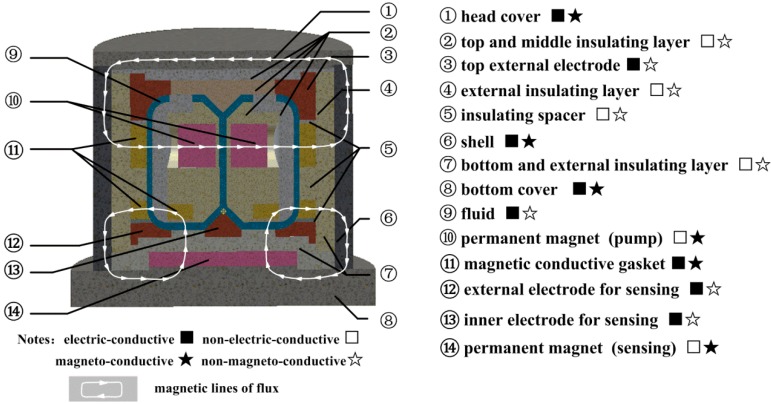
The magnetohydrodynamic (MHD) angular rate sensor (ARS) with low noise level in ultra-wide bandwidth is developed in lasing and imaging applications, especially the line-of-sight (LOS) system. A modified MHD ARS combined with the Coriolis effect was studied in this paper to expand the sensor’s bandwidth at low frequency (<1 Hz), which is essential for precision LOS pointing and wide-bandwidth LOS jitter suppression. The model and the simulation method were constructed and a comprehensive solving method based on the magnetic and electric interaction methods was proposed. The numerical results on the Coriolis effect and the frequency response of the modified MHD ARS were detailed. In addition, according to the experimental results of the designed sensor consistent with the simulation results, an error analysis of model errors was discussed. Our study provides an error analysis method of MHD ARS combined with the Coriolis effect and offers a framework for future studies to minimize the error.
在激光和成像应用中,特别是在视线 (LOS) 系统中,开发了具有超低噪声水平的超宽带宽磁流体动力学 (MHD) 角速度传感器 (ARS)。本文研究了一种结合科里奥利效应的改进型 MHD ARS,以扩展传感器在低频 (<1 Hz) 下的带宽,这对于精密 LOS 指向和宽带 LOS 抖动抑制至关重要。构建了模型和仿真方法,并提出了一种基于磁电相互作用方法的综合求解方法。详细介绍了科里奥利效应和改进型 MHD ARS 频率响应的数值结果。此外,根据与模拟结果一致的设计传感器的实验结果,讨论了模型误差的误差分析。我们的研究提供了一种结合科里奥利效应的 MHD ARS 的误差分析方法,并为未来的研究提供了一个最小化误差的框架。