Westendorp Willeke F, Vermeij Jan-Dirk, Hilkens Nina A, Brouwer Matthijs C, Algra Ale, van der Worp H Bart, Dippel Diederik Wj, van de Beek Diederik, Nederkoorn Pual J
1Department of Neurology, Academic Medical Center, University of Amsterdam, Amsterdam Neuroscience, Amsterdam, Netherlands.
2Department of Neurology & Neurosurgery and Julius Center, University Medical Center Utrecht, Utrecht University, Utrecht, Netherlands.
Eur Stroke J. 2018 Jun;3(2):136-144. doi: 10.1177/2396987318764519. Epub 2018 Mar 8.
Patients with acute stroke are at high risk for infection. These infections are associated with unfavourable outcome after stroke. A prediction rule can identify the patients at the highest risk for strategies to prevent infection. We aim to develop a prediction rule for post-stroke pneumonia and other infections in patients with acute stroke.
We used data from the Preventive Antibiotics in Stroke Study, a multicentre randomised trial comparing preventive ceftriaxone vs. standard stroke care in patients with acute stroke. Possible predictors for post-stroke pneumonia or infection were selected from the literature. Backward elimination logistic regression analysis was used to construct prediction rules for pneumonia or infection. Internal validation was performed and a risk chart was constructed. We adjusted for preventive antibiotic use.
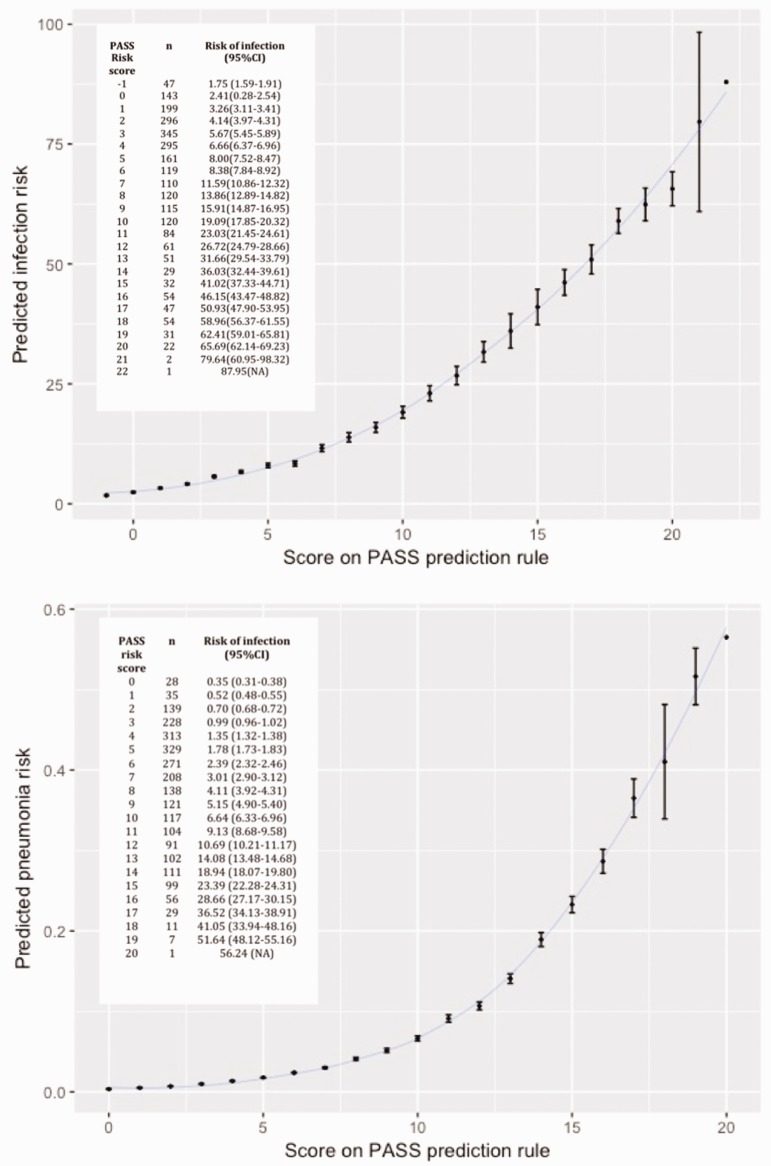
Pneumonia was diagnosed in 159 of the 2538 included patients, and infection in 348. Pneumonia was predicted by higher age, male sex, pre-stroke disability, medical history of chronic obstructive pulmonary disease, more severe stroke, dysphagia and intracerebral haemorrhage (rather than ischaemic stroke). Infections were predicted by higher age, male sex, history of diabetes, chronic obstructive pulmonary disease, more severe stroke, dysphagia, use of bladder catheter, preventive antibiotic use and intracerebral haemorrhage. With the prediction rule developed, risks for pneumonia ranged from 0.4% to 56.2% and from 1.8% to 88.0% for infection. Discrimination of the score was good (C-statistic, 0.84; 95% CI: 0.81-0.87 and 0.82; 95% CI: 0.79-0.84 for pneumonia and infection).
The Preventive Antibiotics in Stroke Study pneumonia and infection rule identify patients at the highest risk for post-stroke pneumonia or infection and may be used for future studies and novel therapies, after confirmation in an external population.
急性中风患者感染风险很高。这些感染与中风后不良预后相关。一个预测规则可以识别出感染风险最高的患者,以便采取预防感染的策略。我们旨在制定一个针对急性中风患者中风后肺炎及其他感染的预测规则。
我们使用了中风预防性抗生素研究的数据,这是一项多中心随机试验,比较了急性中风患者预防性使用头孢曲松与标准中风护理的效果。从文献中选取了中风后肺炎或感染的可能预测因素。采用向后逐步消除逻辑回归分析构建肺炎或感染的预测规则。进行了内部验证并构建了风险图表。我们对预防性抗生素的使用进行了校正。
在纳入的2538例患者中,159例被诊断为肺炎,348例发生感染。年龄较大、男性、中风前残疾、慢性阻塞性肺疾病病史、中风更严重、吞咽困难和脑出血(而非缺血性中风)可预测肺炎。年龄较大、男性、糖尿病史、慢性阻塞性肺疾病、中风更严重、吞咽困难、使用膀胱导管、预防性抗生素使用和脑出血可预测感染。根据制定的预测规则,肺炎风险范围为0.4%至56.2%,感染风险范围为1.8%至88.0%。该评分的区分度良好(肺炎和感染的C统计量分别为0.84;95%可信区间:0.81 - 0.87和0.82;95%可信区间:0.79 - 0.84)。
中风预防性抗生素研究中的肺炎和感染规则可识别出中风后肺炎或感染风险最高的患者,在外部人群中得到证实后,可用于未来的研究和新疗法。