Department of Cardiac Surgery, Fujian Medical University Union Hospital, Fuzhou, Fujian 350001, P.R. China.
Mol Med Rep. 2018 Aug;18(2):1433-1438. doi: 10.3892/mmr.2018.9120. Epub 2018 Jun 1.
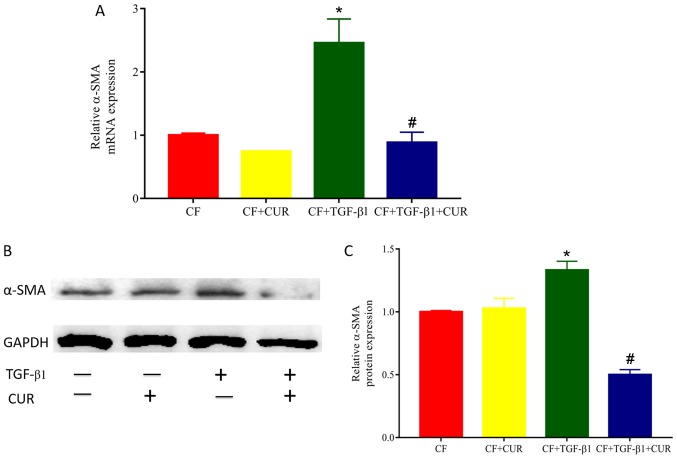
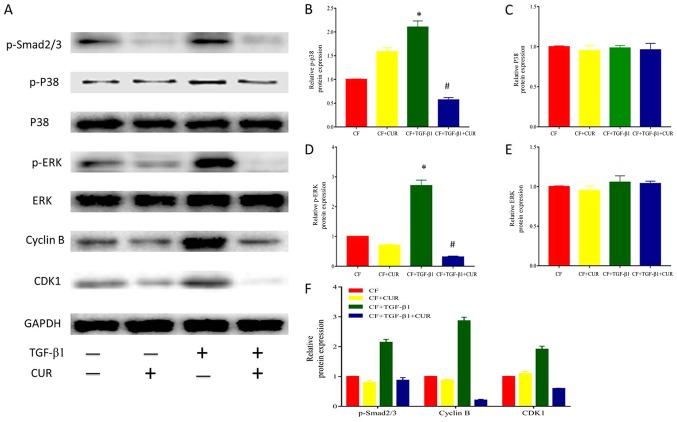
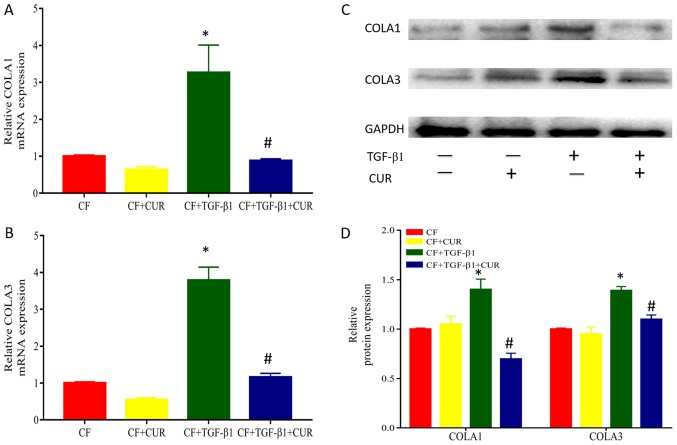
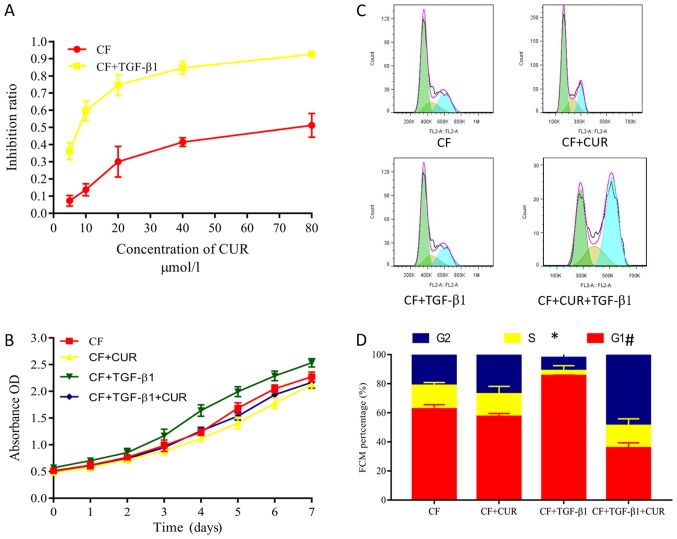
Cardiac fibrosis is a deleterious effect of many cardiovascular diseases. Previous studies have shown that curcumin has exhibited protective effects on cardiovascular diseases. The aim of the present study was to evaluate the effects of curcumin on the activity of human cardiac fibroblasts (CFs) and to elucidate the underlying mechanisms involved. Human CFs were incubated with or without curcumin (20 µmol/l) and transforming growth factor β1 (TGF‑β1; 10 ng/ml), and the expression of α‑smooth muscle actin (α‑SMA), collagen type Iα (COLA)‑1 and COLA3 was evaluated using reverse transcription‑quantitative polymerase chain reaction and western blot analysis. Cell proliferation was evaluated by Cell Counting Kit‑8 analysis, and phases of the cell cycle were studied by flow cytometry. Western blot analysis was performed to evaluate the expression of cyclin‑dependent kinase 1 (CDK1), Cyclin B, phosphorylation (p)‑mothers against decapentaplegic homolog 2/3 (p‑smad2/3), p‑P38, and p‑extracellular regulated protein kinases (ERK). Curcumin significantly reduced mRNA and protein levels of α‑SMA, COLA1, and COLA3 in CFs stimulated with TGF‑β1. However, in the absence of TGF‑β1, curcumin did not have any effects on CFs, suggesting that curcumin inhibited TGF‑β1‑mediated CF activities, including differentiation and collagen deposition. Additionally, curcumin inhibited the proliferation of TGF‑β1‑treated CFs, and promoted G2/M phase cell cycle arrest. Curcumin reduced cell cycle protein expression by inhibiting smad2/3, p38 mitogen‑activated protein kinase, and ERK phosphorylation in TGF‑β1‑treated CFs. Thus, these results indicated that curcumin may be a potential anti‑fibrotic drug to treat cardiac fibrosis.
心肌纤维化是许多心血管疾病的有害影响。先前的研究表明姜黄素对心血管疾病表现出保护作用。本研究旨在评估姜黄素对人心脏成纤维细胞(CFs)活性的影响,并阐明所涉及的潜在机制。将人 CFs 与姜黄素(20 μmol/L)和转化生长因子β1(TGF-β1;10 ng/ml)孵育,并通过逆转录-定量聚合酶链反应和 Western blot 分析评估α-平滑肌肌动蛋白(α-SMA)、I 型胶原(COLA)-1 和 COLA3 的表达。通过细胞计数试剂盒-8 分析评估细胞增殖,通过流式细胞术研究细胞周期各阶段。通过 Western blot 分析评估周期蛋白依赖性激酶 1(CDK1)、细胞周期蛋白 B、磷酸化(p)-母亲抗颅足畸形蛋白 2/3(p-smad2/3)、p-P38 和 p-细胞外调节蛋白激酶(ERK)的表达。姜黄素显著降低了 TGF-β1 刺激的 CFs 中α-SMA、COLA1 和 COLA3 的 mRNA 和蛋白水平。然而,在没有 TGF-β1 的情况下,姜黄素对 CFs 没有任何影响,表明姜黄素抑制了 TGF-β1 介导的 CF 活性,包括分化和胶原沉积。此外,姜黄素抑制 TGF-β1 处理的 CFs 的增殖,并促进 G2/M 期细胞周期停滞。姜黄素通过抑制 TGF-β1 处理的 CFs 中的 smad2/3、p38 丝裂原激活蛋白激酶和 ERK 磷酸化来减少细胞周期蛋白的表达。因此,这些结果表明姜黄素可能是治疗心肌纤维化的一种潜在的抗纤维化药物。