Ha Dongmun, Lee JeeYeon, Kim Dajeong, Oh In-Sun, Lee Eui-Kyung, Shin Ju-Young
School of Pharmacy, Sungkyunkwan University, Suwon, South Korea.
Medicine (Baltimore). 2018 Jun;97(24):e11070. doi: 10.1097/MD.0000000000011070.
Epidemiological evidence regarding healthcare utilization and medical expenditure of patients with psoriasis in Korea is needed. To analyze the differences in healthcare utilization and financial burdens between patients with and without psoriasis and compare these patterns according to the disease severity.
We conducted a descriptive cross-sectional study using a sample of the National Health Insurance database between January 1, 2012 and December 31, 2013. We included patients diagnosed with psoriasis and those with nonpsoriasis skin diseases, matched for age, sex, income, and geographical region. The patients with psoriasis were further divided into mild and moderate-to-severe psoriasis groups. Each patient was followed up for 1 year to estimate their healthcare utilization and medical expenditure since their initial diagnosis. Healthcare utilization was defined as the sum of outpatient visits and inpatient stays per person. We conducted McNemar test or Bowker test of symmetry to compare the baseline characteristics and used the Wilcoxon matched-pair signed-rank test to compare the healthcare utilization and direct costs with a 5% significance level.
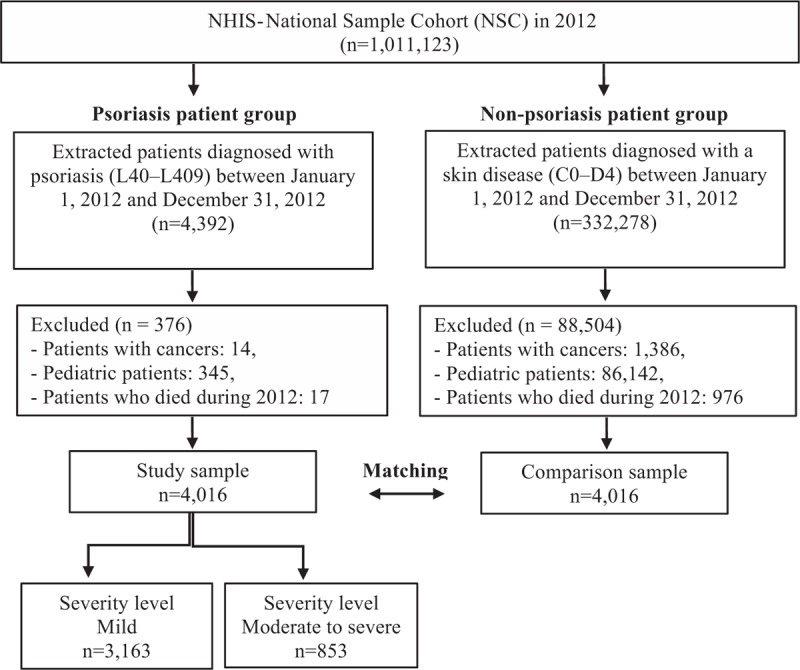
Our study subjects were 4016 patients with psoriasis and equally matched 4016 patients with nonpsoriasis skin diseases. Compared with patients without psoriasis, those with psoriasis had more days of healthcare service use (5.26 vs 4.19, P < .001) and higher medical expenditures within 1 year per person (209,320 vs 117,968 won, P < .001). Patients with moderate-to-severe psoriasis had more days of healthcare service use (12.71 vs 3.25, P < .001) and higher medical expenditures within 1 year per person (611,688 vs 107,445 won, P < .001) than those with mild psoriasis.
Patients with psoriasis had higher burdens of healthcare utilization than those without psoriasis, and patients with moderate-to-severe psoriasis had the greatest burdens.
韩国需要有关银屑病患者医疗服务利用情况和医疗支出的流行病学证据。分析银屑病患者与非银屑病患者在医疗服务利用和经济负担方面的差异,并根据疾病严重程度比较这些模式。
我们使用2012年1月1日至2013年12月31日期间的国民健康保险数据库样本进行了一项描述性横断面研究。我们纳入了诊断为银屑病的患者和患有非银屑病皮肤病的患者,并根据年龄、性别、收入和地理区域进行匹配。银屑病患者进一步分为轻度和中度至重度银屑病组。每位患者随访1年,以估计自初次诊断以来的医疗服务利用情况和医疗支出。医疗服务利用定义为每人门诊就诊次数和住院天数之和。我们进行了McNemar检验或Bowker对称性检验以比较基线特征,并使用Wilcoxon配对符号秩检验以在5%显著性水平下比较医疗服务利用和直接成本。
我们的研究对象为4016例银屑病患者和4016例匹配的非银屑病皮肤病患者。与非银屑病患者相比,银屑病患者的医疗服务使用天数更多(5.26天对4.19天,P<0.001),且每人1年内的医疗支出更高(209,320韩元对117,968韩元,P<0.001)。中度至重度银屑病患者的医疗服务使用天数更多(12.71天对3.25天,P<0.001),且每人1年内的医疗支出更高(611,688韩元对107,445韩元,P<0.001),高于轻度银屑病患者。
银屑病患者的医疗服务利用负担高于非银屑病患者,中度至重度银屑病患者的负担最大。