An Sang Joon, Seo Mi Sook, Choi Soo Il, Lim Tae-Ha, Shin So Jin, Kang Keum Nae, Kim Young Uk
Department of Neurology Department of Anesthesiology and Pain Medicine, Catholic Kwandong University of Korea College of Medicine, International ST. Mary's Hospital, Incheon Department of Anesthesiology and Pain Medicine, Eulji General Hospital, Eulji University College of Medicine Department of Anesthesiology and Pain Medicine, National Police Hospital, Seoul, Republic of Korea.
Medicine (Baltimore). 2018 Jun;97(24):e11090. doi: 10.1097/MD.0000000000011090.
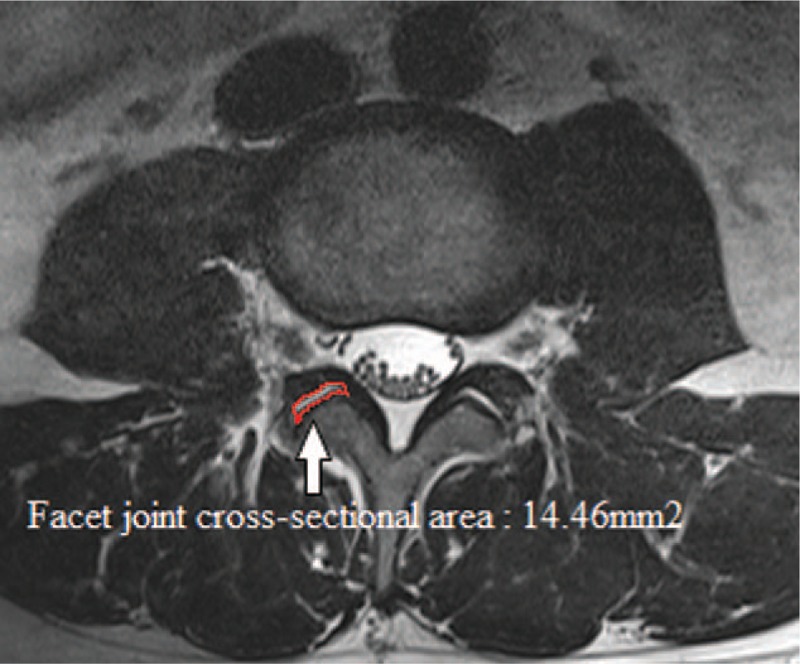
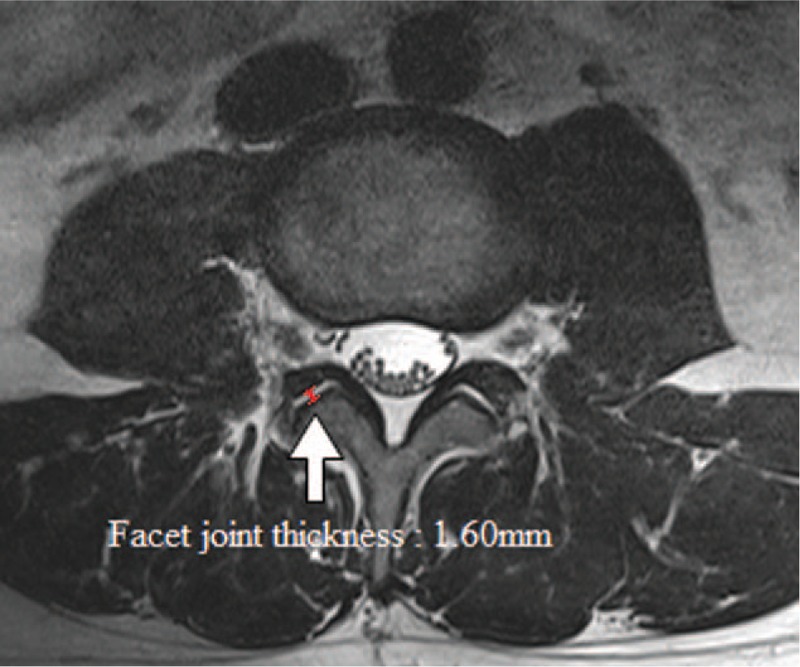
One of the major causes of lumbar spinal canal stenosis (LSCS) has been considered facet joint hypertrophy (FJH). However, a previous study asserted that "FJH" is a misnomer because common facet joints are no smaller than degenerative facet joints; however, this hypothesis has not been effectively demonstrated. Therefore, in order to verify that FJH is a misnomer in patients with LSCS, we devised new morphological parameters that we called facet joint thickness (FJT) and facet joint cross-sectional area (FJA).We collected FJT and FJA data from 114 patients with LSCS. A total of 86 control subjects underwent lumbar magnetic resonance imaging (MRI) as part of routine medical examinations, and axial T2-weighted MRI images were obtained from all participants. We measured FJT by drawing a line along the facet area and then measuring the narrowest point at L4-L5. We measured FJA as the whole cross-sectional area of the facet joint at the stenotic L4-L5 level.The average FJT was 1.60 ± 0.36 mm in the control group and 1.11 ± 0.32 mm in the LSCS group. The average FJA was 14.46 ± 5.17 mm in the control group and 9.31 ± 3.47 mm in the LSCS group. Patients with LSCS had significantly lower FJTs (P < .001) and FJAs (P < .001).FJH, a misnomer, should be renamed facet joint area narrowing. Using this terminology would eliminate confusion in descriptions of the facet joint.
腰椎管狭窄症(LSCS)的主要病因之一一直被认为是小关节肥大(FJH)。然而,先前的一项研究断言,“FJH”是一个误称,因为正常小关节并不比退变小关节小;然而,这一假设尚未得到有效证实。因此,为了验证FJH在LSCS患者中是一个误称,我们设计了新的形态学参数,即小关节厚度(FJT)和小关节截面积(FJA)。我们收集了114例LSCS患者的FJT和FJA数据。共有86名对照受试者作为常规体检的一部分接受了腰椎磁共振成像(MRI)检查,并从所有参与者中获取了轴向T2加权MRI图像。我们通过沿着小关节区域画一条线,然后测量L4-L5处最窄点来测量FJT。我们将FJA测量为狭窄的L4-L5水平处小关节的整个截面积。对照组的平均FJT为1.60±0.36mm,LSCS组为1.11±0.32mm。对照组的平均FJA为14.46±5.17mm,LSCS组为9.31±3.47mm。LSCS患者的FJT(P<0.001)和FJA(P<0.001)显著更低。FJH这个误称应重新命名为小关节面积缩小。使用这个术语将消除小关节描述中的混淆。