Xia Dandan, Wang Huiyu, Wang Runjie, Liu Chaoying, Xu Junying
Department of Oncology, Wuxi People's Hospital, Wuxi, P.R. China.
Medicine (Baltimore). 2018 Jun;97(24):e11115. doi: 10.1097/MD.0000000000011115.
Endocrine therapy plays an important role in the treatment of patients with hormone receptor-positive breast cancer. Renal metastasis of breast cancer is rare in clinical practice.
We present here a 54-year-old woman with breast cancer after first line chemotherapy and second line endocrinotherapy (i.e., toremifene & exemestane) failure.
The patient was rarely diagnosed breast cancer metastasis to the kidney and a positive hormone status (ER and PR) but was negative for human epidermal factor receptor 2 (HER2).
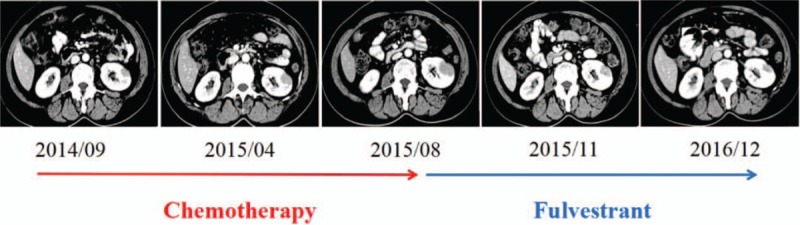
The patient was treated with a high dose of fulvestrant (SERD; 500 mg) by intramuscular injection once per month.
The patient's condition significantly improved as measured by a decrease in the renal and pulmonary masses; symptoms including dry cough and blood phlegm also improved.
Endocrinotherapy with high-dose fulvestrant may provide benefits for patients with HR+/HER2- advanced breast cancer with renal metastasis after SERMs failure.
内分泌治疗在激素受体阳性乳腺癌患者的治疗中发挥着重要作用。乳腺癌肾转移在临床实践中较为罕见。
我们在此介绍一位54岁女性,其在一线化疗和二线内分泌治疗(即托瑞米芬和依西美坦)失败后患有乳腺癌。
该患者很少被诊断为乳腺癌肾转移且激素状态为阳性(雌激素受体和孕激素受体),但人表皮生长因子受体2(HER2)为阴性。
该患者每月接受一次高剂量氟维司群(选择性雌激素受体下调剂;500毫克)肌肉注射治疗。
通过肾脏和肺部肿块缩小来衡量,患者病情显著改善;干咳和血痰等症状也有所改善。
对于SERMs治疗失败后发生肾转移的HR+/HER2-晚期乳腺癌患者,高剂量氟维司群内分泌治疗可能有益。