Ma Xinxin, Su Wen, Chen Haibo
Department of Neurology, Beijing Hospital, National Center of Gerontology, Beijing, P.R. China.
Medicine (Baltimore). 2018 Jun;97(24):e11127. doi: 10.1097/MD.0000000000011127.
Reversible splenial lesion syndrome (RESLES) is a reversible condition with an excellent prognosis in most patients. The clinical features include altered states of consciousness, delirium, headache, and seizures, but no callosal disconnection syndromes have been described in RESLES.
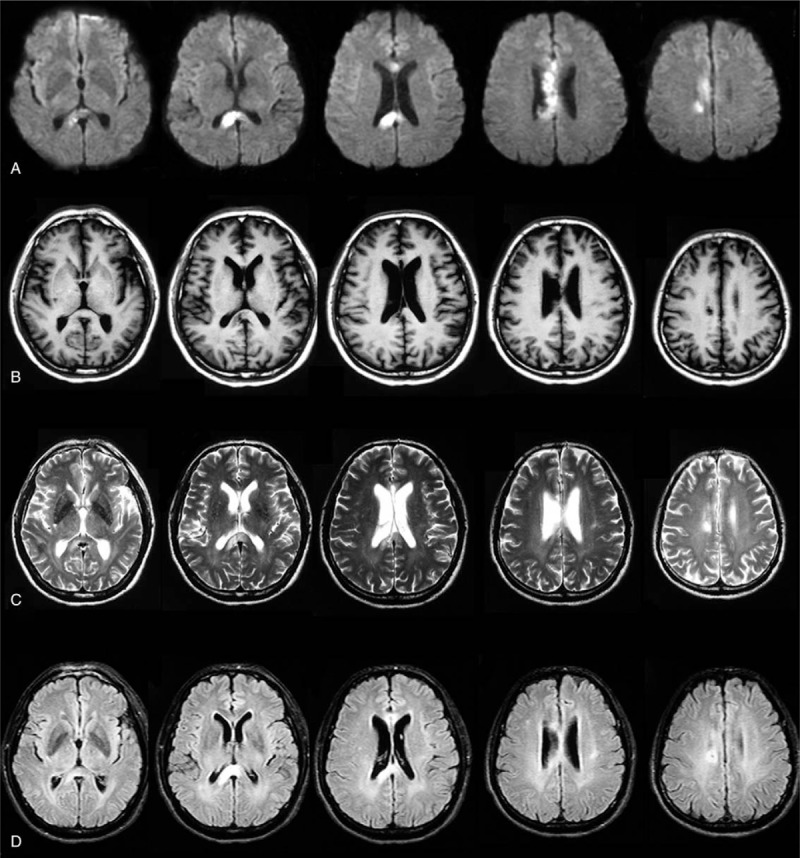
We presented a 57-year-old patient with alien hand syndrome, autotopagnosia, gait disorders, and left ideomotor apraxia after blood transfusion. The brain magnetic resonance imaging (MRI) showed a few regions with high signal intensity in the genu, body, and splenium of the right corpus callosum on diffusion weighted images. Cerebrovascular examination was unremarkable.
He was diagnosed with RESLES and callosal disconnection syndrome.
The patient received symptomatic and supportive treatment in our hospital.
He recovered to baseline on following up of 6 months and abnormalities on brain MRI completely disappeared.
Neurologists should be aware of the symptoms of callosal disconnection syndrome in RESLES. In addition, caution should be taken when transfusing blood products in patients with gastrointestinal bleeding.
可逆性胼胝体压部病变综合征(RESLES)是一种可逆性疾病,大多数患者预后良好。其临床特征包括意识状态改变、谵妄、头痛和癫痫发作,但RESLES中尚未描述有胼胝体离断综合征。
我们报告了一名57岁患者,输血后出现异己手综合征、自体部位失认症、步态障碍和左侧观念运动性失用症。脑磁共振成像(MRI)在扩散加权图像上显示右侧胼胝体膝部、体部和压部有几个高信号区域。脑血管检查无异常。
他被诊断为RESLES和胼胝体离断综合征。
患者在我院接受了对症及支持治疗。
随访6个月时他恢复至基线水平,脑MRI异常完全消失。
神经科医生应了解RESLES中胼胝体离断综合征的症状。此外,对有胃肠道出血的患者输血时应谨慎。