Epidemiology and Public Health Research Unit, Population Health Department, Luxembourg Institute of Health, Strassen, Luxembourg.
Competence Center for Methodology and Statistics, Luxembourg Institute of Health, Strassen, Luxembourg.
PLoS One. 2018 Jun 14;13(6):e0197021. doi: 10.1371/journal.pone.0197021. eCollection 2018.
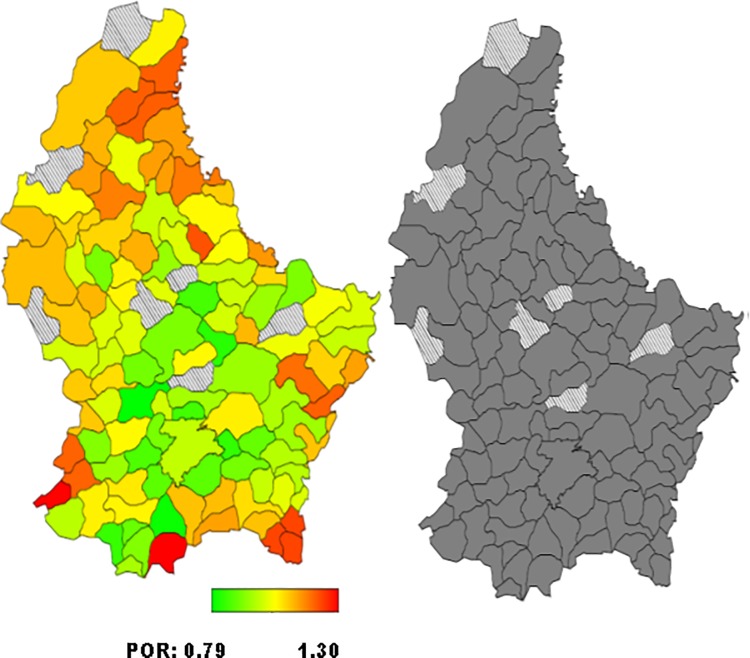
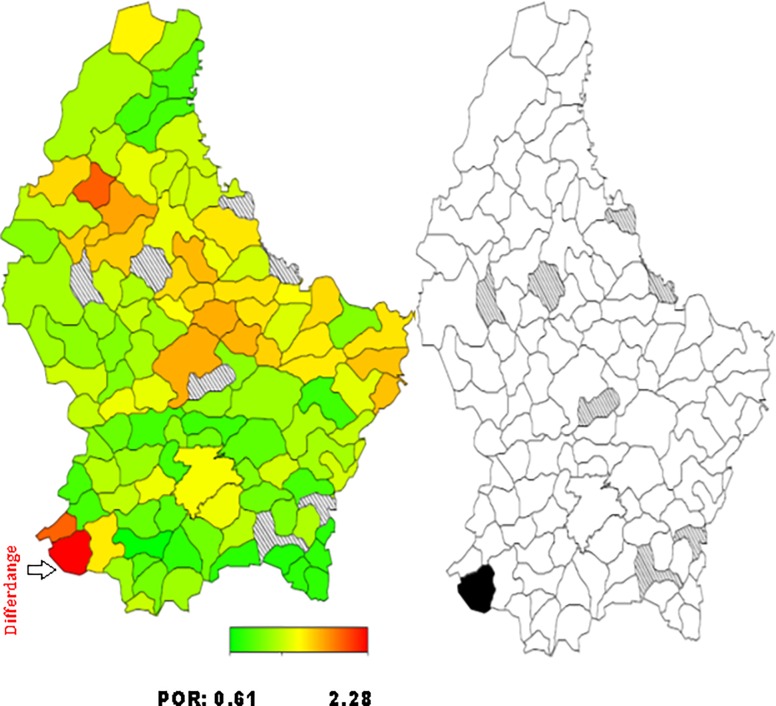
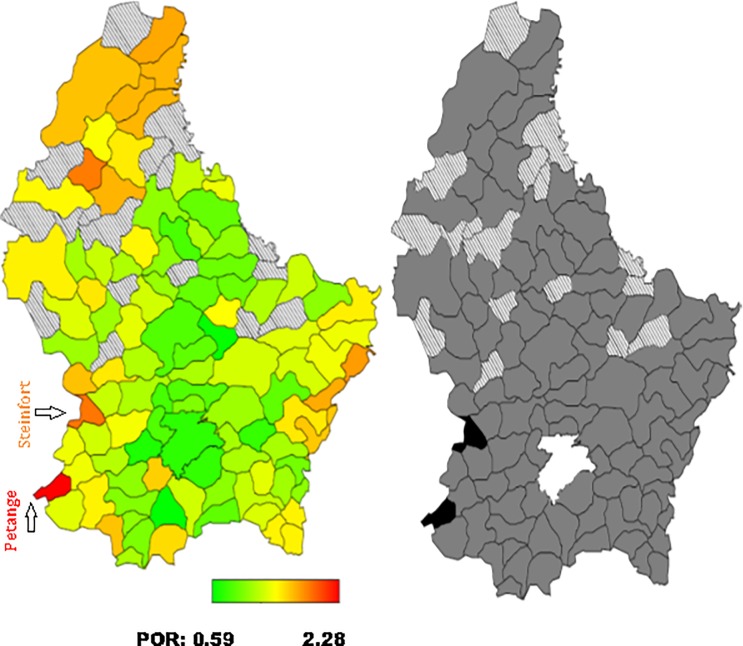
The analyses of geographic variations in the prevalence of major chronic conditions, such as overweight and obesity, are an important public health tool to identify "hot spots" and inform allocation of funding for policy and health promotion campaigns, yet rarely performed. Here we aimed at exploring, for the first time in Luxembourg, potential geographic patterns in overweight/obesity prevalence in the country, adjusted for several demographic, socioeconomic, behavioural and health status characteristics. Data came from 720 men and 764 women, 25-64 years old, who participated in the European Health Examination Survey in Luxembourg (2013-2015). To investigate the geographical variation, geo-additive semi-parametric mixed model and Bayesian modelisations based on Markov Chain Monte Carlo techniques for inference were performed. Large disparities in the prevalence of overweight and obesity were found between municipalities, with the highest rates of obesity found in 3 municipalities located in the South-West of the country. Bayesian approach also underlined a nonlinear effect of age on overweight and obesity in both genders (significant in men) and highlighted the following risk factors: 1. country of birth for overweight in men born in a non-European country (Posterior Odds Ratio (POR): 3.24 [1.61-8.69]) and women born in Portugal (POR: 2.44 [1.25-4.43]), 2. low educational level (secondary or below) for overweight (POR: 1.66 (1.06-2.72)] and obesity (POR:2.09 [1.05-3.65]) in men, 3. single marital status for obesity in women (POR: 2.20 [1.24-3.91]), 4.fair (men: POR: 3.19 [1.58-6.79], women: POR: 2.24 [1.33-3.73]) to very bad health perception (men: POR: 15.01 [2.16-98.09]) for obesity, 5. sleeping more than 6 hours for obesity in unemployed men (POR: 3.66 [2.02-8.03]). Protective factors highlighted were: 1. single marital status against overweight (POR: [0.60 (0.38-0.96)]) and obesity (POR: 0.39 [0.16-0.84]) in men, 2. the fact to be widowed against overweight in women (POR: [0.30 (0.07-0.86)], as well as a non European country of birth (POR: 0.49 [0.19-0.98]), tertiary level of education (POR: 0.34 [0.18-0.64]), moderate alcohol consumption (POR: 0.54 [0.36-0.90]) and aerobic physical activity practice (POR: 0.44 [0.27-0.77]) against obesity in women. A double burden of environmental exposure due to historic mining and industrial activities and past economic vulnaribility in the South-West of the country may have participated to the higher prevalence of obesity found in this region. Other demographic, socioeconomic, behavioural and health status covariates could have been involved as well.
本研究旨在首次探索卢森堡人群超重/肥胖流行率的潜在地理模式,并调整了几个人口统计学、社会经济、行为和健康状况特征。数据来自 720 名 25-64 岁的男性和 764 名女性,他们参加了卢森堡 2013-2015 年的欧洲健康检查调查。为了研究地理变异,我们进行了地理添加剂半参数混合模型和基于马尔可夫链蒙特卡罗技术的贝叶斯模型化分析。研究发现,各直辖市之间的超重和肥胖流行率存在很大差异,该国西南部的 3 个直辖市肥胖率最高。贝叶斯方法还强调了年龄对两性超重和肥胖的非线性影响(在男性中显著),并强调了以下风险因素:1. 男性中来自非欧洲国家的出生国(葡萄牙出生的女性)与超重有关(后验优势比(POR):3.24[1.61-8.69])和 2.44[1.25-4.43]),2. 低教育水平(中学或以下)与超重有关(POR:1.66[1.06-2.72])和肥胖(POR:2.09[1.05-3.65]),3. 未婚状态与肥胖有关(POR:2.20[1.24-3.91]),4. 一般(男性:POR:3.19[1.58-6.79],女性:POR:2.24[1.33-3.73])至非常差的健康状况(男性:POR:15.01[2.16-98.09])与肥胖有关,5. 失业男性睡眠超过 6 小时与肥胖有关(POR:3.66[2.02-8.03])。突出的保护因素包括:1. 单身状态与超重有关(POR:[0.60(0.38-0.96)])和肥胖(POR:0.39[0.16-0.84])在男性中,2. 丧偶与女性超重有关(POR:[0.30(0.07-0.86)]),以及非欧洲出生国(POR:0.49[0.19-0.98])、高等教育水平(POR:0.34[0.18-0.64])、适度饮酒(POR:0.54[0.36-0.90])和有氧运动(POR:0.44[0.27-0.77])与女性肥胖有关。该国西南部历史采矿业和工业活动造成的环境暴露的双重负担以及过去的经济脆弱性可能导致了该地区肥胖率的升高。其他人口统计学、社会经济、行为和健康状况的协变量也可能参与其中。