Centre de Recherche Public de la Santé, Centre d'Etudes en Santé, 1A rue Thomas Edison, Strassen, L-1445, Grand-Duchy of Luxembourg.
BMC Public Health. 2012 Oct 11;12:864. doi: 10.1186/1471-2458-12-864.
No previous study has examined the prevalence of cardiovascular risk factors and explored the influence of immigration status and acculturation on overweight/obesity among the Portuguese immigrants to Luxembourg. Our objectives were to (1) compare the prevalence of cardiovascular risk factors between native Luxembourgers and Portuguese immigrants, (2) examine the relationship between immigrant generation status, proportion of life spent in Luxembourg and language proficiency or preference (as proxy variables of acculturation) and overweight/obesity among Portuguese immigrants, and (3) elucidate the role of underlying socioeconomic, behavioral and dietary factors in overweight/obesity differences among the two populations.
Recent national cross-sectional data from ORISCAV-LUX survey 2007-2008, composed of 843 subjects were analyzed. Overweight/obesity was defined as body mass index (BMI) >25 kg/m(2). Acculturation score was measured by using immigrant generation status, proportion of life spent in Luxembourg, and language proficiency or preference. Univariable and multivariable logistic regression analyses were performed to examine the association between acculturation markers and overweight/obesity. Further, a series of successive models were fitted to explore the separated and added impact of potential mediators (socioeconomic status, physical activity, dietary factors) on overweight/obesity among Luxembourgers and Portuguese immigrants.
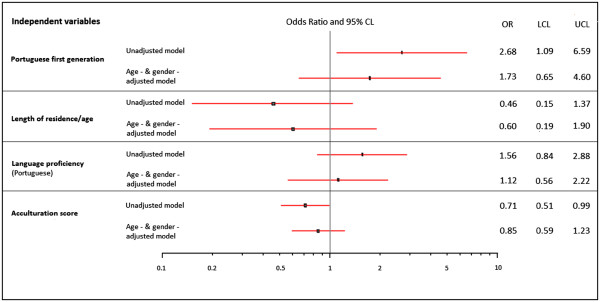
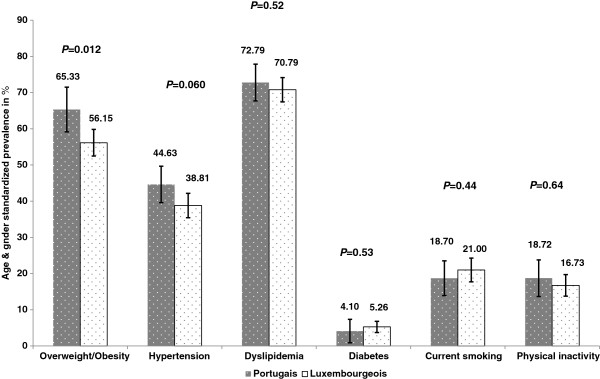
Compared to Luxembourgers, Portuguese immigrants of first and second generation were younger and currently employed. About 68% of first generation Portuguese had only primary school, and about 44% were living below poverty threshold. Although the cardiovascular risk factors were comparable, Portuguese immigrants were more frequently overweight and obese than Luxembourgers, even after age and gender standardization to the European population. Overweight/obesity was significantly higher among Portuguese of first generation compared to second generation (P=0.028). Although we observed a tendency of lower risk with higher acculturation, none of the acculturation markers, both individually and taken together as a score, was statistically significant after controlling for age and gender. Compared to Luxembourgers, odds of overweight/obesity were significantly higher among Portuguese immigrants, in unadjusted model 1 (P=0.043), in age and gender-adjusted model 2 (P<0.0001), in socioeconomic status adjusted model 3 (P= 0.01), in physical activity adjusted model 4 (P=0.007). However, this difference was attenuated and statistically disappeared after controlling for dietary factors (P=0.09).
These findings address a lack of heterogeneity between Portuguese immigrants and Luxembourgers regarding hypertension, hyperlipidemia, diabetes mellitus, physical inactivity, and current cigarette smoking. However, Portuguese immigrants to Luxembourg were more likely to be overweight/obese than Luxembourgers participants. This risk may be explained by different dietary practice. An in-depth comparative assessment of dietary habits of Luxembourgers and Portuguese immigrants is warranted.
此前尚无研究调查心血管危险因素的流行情况,也未探究移民身份和文化适应对卢森堡葡萄牙移民超重/肥胖的影响。我们的目标是:(1)比较本地卢森堡人与葡萄牙移民的心血管危险因素流行情况,(2)研究移民代际地位、在卢森堡生活的时间比例以及语言熟练程度或偏好(作为文化适应的替代变量)与葡萄牙移民超重/肥胖的关系,以及(3)阐明潜在的社会经济、行为和饮食因素在两组人群超重/肥胖差异中的作用。
对最近的 2007-2008 年 ORISCAV-LUX 调查的全国性横断面数据进行了分析,共纳入 843 名受试者。超重/肥胖定义为体质指数(BMI)>25kg/m2。采用移民代际地位、在卢森堡生活的时间比例以及语言熟练程度或偏好来衡量文化适应程度。使用单变量和多变量逻辑回归分析来检验文化适应指标与超重/肥胖之间的关系。此外,还拟合了一系列连续模型,以探讨潜在的中介因素(社会经济地位、身体活动、饮食因素)对卢森堡人和葡萄牙移民超重/肥胖的单独和附加影响。
与卢森堡人相比,第一代和第二代葡萄牙移民更年轻,且目前正在工作。第一代葡萄牙人中约有 68%仅接受过小学教育,约有 44%生活在贫困线以下。尽管心血管危险因素相似,但葡萄牙移民的超重和肥胖发生率明显高于卢森堡人,即使在按欧洲人口年龄和性别进行标准化后也是如此。与第二代葡萄牙移民相比,第一代葡萄牙移民的超重/肥胖发生率更高(P=0.028)。尽管我们观察到文化适应程度越高,风险越低的趋势,但在控制年龄和性别后,没有任何一个文化适应指标(单独或作为一个分数)具有统计学意义。与卢森堡人相比,葡萄牙移民在未调整模型 1 中,超重/肥胖的比值比(OR)显著更高(P=0.043);在调整年龄和性别后的模型 2 中,OR 显著更高(P<0.0001);在调整社会经济地位后的模型 3 中,OR 显著更高(P=0.01);在调整身体活动后的模型 4 中,OR 显著更高(P=0.007)。然而,在控制饮食因素后,这种差异减弱且具有统计学意义(P=0.09)。
这些发现表明,在高血压、高血脂、糖尿病、身体活动不足和当前吸烟方面,葡萄牙移民与卢森堡人之间存在异质性。然而,与卢森堡人相比,卢森堡的葡萄牙移民更有可能超重/肥胖。这种风险可能与不同的饮食行为有关。有必要对卢森堡人和葡萄牙移民的饮食习惯进行深入的比较评估。