Arthritis and Musculoskeletal Medicine, School of Medicine, Medical Sciences and Nutrition, University of Aberdeen, Aberdeen, United Kingdom.
MRC Unit for Lifelong Health and Ageing at UCL, London, United Kingdom.
PLoS One. 2018 Jun 14;13(6):e0197570. doi: 10.1371/journal.pone.0197570. eCollection 2018.
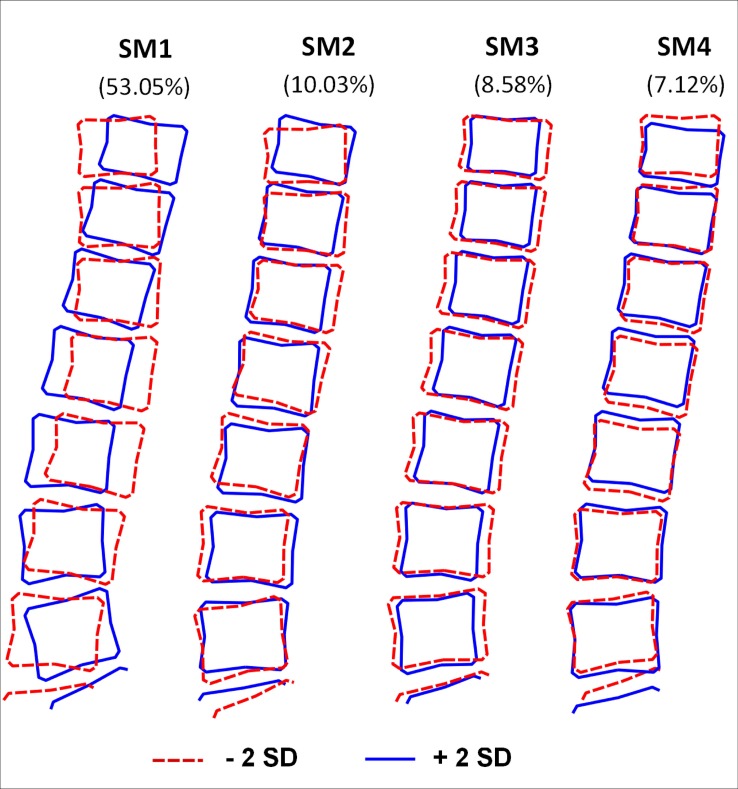
This study investigated associations between measures of adiposity from age 36 and spine shape at 60-64 years. Thoracolumbar spine shape was characterised using statistical shape modelling on lateral dual-energy x-ray absorptiometry images of the spine from 1529 participants of the MRC National Survey of Health and Development, acquired at age 60-64. Associations of spine shape modes with: 1) contemporaneous measures of total and central adiposity (body mass index (BMI), waist circumference (WC)) and body composition (android:gynoid fat mass ratio and lean and fat mass indices, calculated as whole body (excluding the head) lean or fat mass (kg) divided by height2 (m)2); 2) changes in total and central adiposity between age 36 and 60-64 and 3) age at onset of overweight, were tested using linear regression models. Four modes described 79% of the total variance in spine shape. In men, greater lean mass index was associated with a larger lordosis whereas greater fat mass index was associated with straighter spines. Greater current BMI was associated with a more uneven curvature in men and with larger anterior-posterior (a-p) vertebral diameters in both sexes. Greater WC and fat mass index were also associated with a-p diameter in both sexes. There was no clear evidence that gains in BMI and WC during earlier stages of adulthood were associated with spine shape but younger onset of overweight was associated with a more uneven spine and greater a-p diameter. In conclusion, sagittal spine shapes had different associations with total and central adiposity; earlier onset of overweight and prior measures of WC were particularly important.
本研究调查了 36 岁时的肥胖指标与 60-64 岁时脊柱形状之间的关系。在 1529 名 MRC 国民健康与发展调查参与者的脊柱侧位双能 X 射线吸收仪图像上,使用统计形状建模对胸腰椎形状进行了特征描述,这些参与者在 60-64 岁时接受了检查。脊柱形状模式与以下方面的相关性采用线性回归模型进行了检验:1)与总脂肪和中央脂肪(体重指数(BMI)、腰围(WC))和身体成分(男性型:女性型脂肪质量比以及瘦体重和脂肪质量指数有关,通过全身(不包括头部)瘦体重或脂肪质量(kg)除以身高的平方(m2)计算得出)的同期测量值;2)36 岁至 60-64 岁期间总脂肪和中央脂肪的变化;3)超重开始的年龄。四种模式描述了脊柱形状总方差的 79%。在男性中,较大的瘦体重指数与较大的脊柱前凸有关,而较大的脂肪质量指数与更直的脊柱有关。当前 BMI 越大,男性脊柱的曲率越不均匀,两性的前后(a-p)椎体直径越大。更大的 WC 和脂肪质量指数也与两性的 a-p 直径有关。没有明确的证据表明,成年早期 BMI 和 WC 的增加与脊柱形状有关,但超重开始的年龄越小,脊柱越不均匀,a-p 直径越大。总之,矢状位脊柱形状与总脂肪和中央脂肪有不同的相关性;超重开始年龄越早,WC 测量值越早,就越重要。