Department of Global Health, Boston University School of Public Health, Boston, Massachusetts, United States of America.
Emory Global Health Institute at Emory University, Atlanta, GA, United States of America.
PLoS One. 2018 Jun 14;13(6):e0198176. doi: 10.1371/journal.pone.0198176. eCollection 2018.
Identifying and understanding traditional perceptions that influence newborn care practices and care-seeking behavior are crucial to developing sustainable interventions to improve neonatal health. The Zambia Chlorhexidine Application Trial (ZamCAT), a large-scale cluster randomized trial, assessed the impact of 4% chlorhexidine on neonatal mortality and omphalitis in Southern Province, Zambia. The main purpose of this post-ZamCAT qualitative study was to understand the impact of newborn care health messages on care-seeking behavior for neonates and the acceptability, knowledge, and attitudes towards chlorhexidine cord care among community members and health workers in Southern Province.
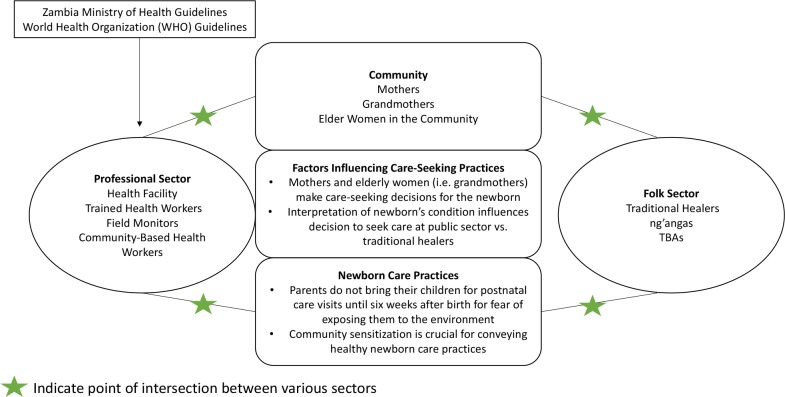
METHODS & FINDINGS: Five focus group discussions and twenty-six in-depth interviews were conducted with mothers and health workers from ten health centers (5 rural and 5 peri-urban/urban). Community perceptions and local realities were identified as fundamental to care-seeking decisions and influenced individual participation in particular health-seeking behaviors. ZamCAT field monitors (data collectors) disseminated health messages at the time of recruitment at the health center and during subsequent home visits. Mothers noted that ZamCAT field monitors were effective in providing lessons and education on newborn care practices and participating mothers were able to share these messages with others in their communities. Although the study found no effect of chlorhexidine cord washes on neonatal mortality, community members had positive views towards chlorhexidine as they perceived that it reduced umbilical cord infections and was a beneficial alternative to traditional cord applications.
The acceptability of health initiatives, such as chlorhexidine cord application, in community settings, is dependent on community education, understanding, and engagement. Community-based approaches, such as using community-based cadres of health workers to strengthen referrals, are an acceptable and potentially effective strategy to improve care-seeking behaviors and practices.
识别和理解影响新生儿护理实践和寻求护理行为的传统观念,对于制定可持续的干预措施以改善新生儿健康至关重要。赞比亚洗必泰应用试验(ZamCAT)是一项大规模的整群随机试验,评估了 4%洗必泰对赞比亚南部省新生儿死亡率和脐炎的影响。这项 ZamCAT 后定性研究的主要目的是了解新生儿护理健康信息对寻求新生儿护理行为的影响,以及社区成员和卫生工作者对氯己定脐带护理的接受程度、知识和态度。
在南部省的 10 个卫生中心(5 个农村和 5 个城郊/城市),对母亲和卫生工作者进行了 5 次焦点小组讨论和 26 次深入访谈。社区观念和当地现实被认为是寻求护理决策的基础,并影响了个人对特定卫生寻求行为的参与。ZamCAT 现场监测员(数据收集员)在卫生中心招募时以及随后的家访中传播健康信息。母亲们注意到,ZamCAT 现场监测员在提供新生儿护理实践课程和教育方面非常有效,参与的母亲能够将这些信息与社区中的其他人分享。尽管研究发现洗必泰脐带冲洗对新生儿死亡率没有影响,但社区成员对洗必泰持积极态度,因为他们认为洗必泰可以减少脐带感染,是传统脐带应用的有益替代物。
在社区环境中,接受卫生倡议,如氯己定脐带护理,取决于社区教育、理解和参与。以社区为基础的方法,如利用社区卫生工作者作为骨干来加强转介,是一种可以接受的、潜在有效的策略,可以改善寻求护理行为和实践。