Department of Internal Medicine, University of Michigan Hospitals, Ann Arbor, Michigan, United States of America.
Department of Global Health, Boston University School of Public Health, Boston, Massachusetts, United States of America.
PLoS Med. 2021 May 5;18(5):e1003610. doi: 10.1371/journal.pmed.1003610. eCollection 2021 May.
Neonatal infection, a leading cause of neonatal death in low- and middle-income countries, is often caused by pathogens acquired during childbirth. Clean delivery kits (CDKs) have shown efficacy in reducing infection-related perinatal and neonatal mortality. However, there remain gaps in our current knowledge, including the effect of individual components, the timeline of protection, and the benefit of CDKs in home and facility deliveries.
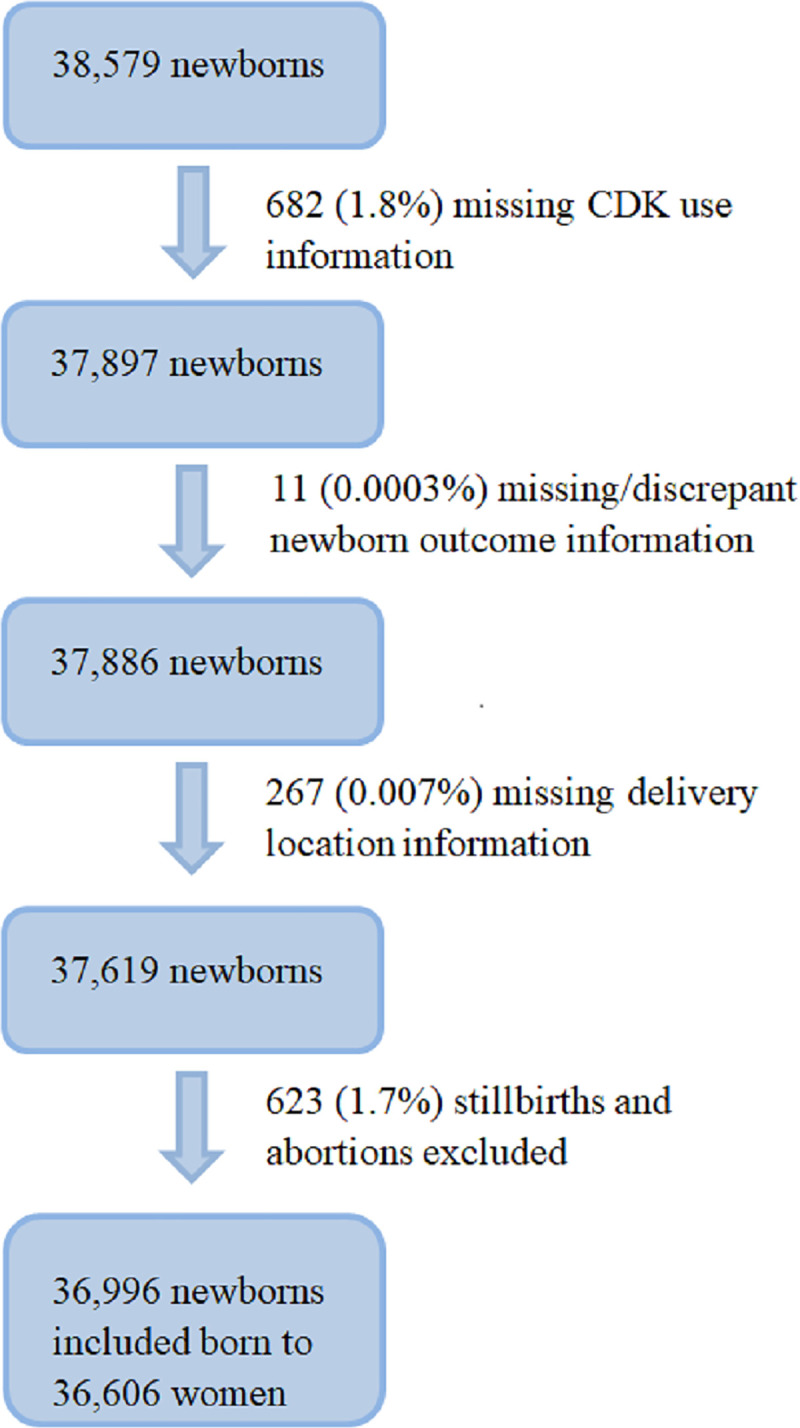
A post hoc secondary analysis was performed using nonrandomized data from the Zambia Chlorhexidine Application Trial (ZamCAT), a community-based, cluster-randomized controlled trial of chlorhexidine umbilical cord care in Southern Province of Zambia from February 2011 to January 2013. CDKs, containing soap, gloves, cord clamps, plastic sheet, razor blade, matches, and candle, were provided to all pregnant women. Field monitors made a home-based visit to each participant 4 days postpartum, during which CDK use and newborn outcomes were ascertained. Logistic regression was used to study the association between different CDK components and neonatal mortality rate (NMR). Of 38,579 deliveries recorded during the study, 36,996 newborns were analyzed after excluding stillbirths and those with missing information. Gloves, cord clamps, and plastic sheets were the most frequently used CDK item combination in both home and facility deliveries. Each of the 7 CDK components was associated with lower NMR in users versus nonusers. Adjusted logistic regression showed that use of gloves (odds ratio [OR] 0.33, 95% CI 0.24-0.46), cord clamp (OR 0.51, 95% CI 0.38-0.68), plastic sheet (OR 0.46, 95% CI 0.34-0.63), and razor blade (OR 0.69, 95% CI 0.53-0.89) were associated with lower risk of newborn mortality. Use of gloves and cord clamp were associated with reduced risk of immediate newborn death (<24 hours). Reduction in risk of early newborn death (1-6 days) was associated with use of gloves, cord clamps, plastic sheets, and razor blades. In examining perinatal mortality (stillbirth plus neonatal death in the first 7 days of life), similar patterns were observed. There was no significant reduction in risk of late newborn mortality (7-28 days) with CDK use. Study limitations included potential recall bias of CDK use and inability to establish causality, as this was a secondary observational study.
CDK use was associated with reductions in early newborn mortality at both home and facility deliveries, especially when certain kit components were used. While causality could not be established in this nonrandomized secondary analysis, given these beneficial associations, scaling up the use of CDKs in rural areas of sub-Saharan Africa may improve neonatal outcomes.
Name of trial: Zambia Chlorhexidine Application Trial (ZamCAT) Name of registry: Clinicaltrials.gov Trial number: NCT01241318.
新生儿感染是中低收入国家新生儿死亡的主要原因,通常由分娩期间获得的病原体引起。清洁分娩套件(CDK)已被证明能有效降低与感染相关的围产期和新生儿死亡率。然而,我们目前的知识仍存在一些空白,包括各个组成部分的效果、保护时间以及 CDK 在家庭和医疗机构分娩中的益处。
这是对赞比亚洗必泰脐带护理应用试验(ZamCAT)的一项非随机数据进行的事后二次分析,该试验是在赞比亚南部省进行的一项基于社区的、群组随机对照试验,于 2011 年 2 月至 2013 年 1 月期间对氯己定脐带护理进行了评估。为所有孕妇提供了包含肥皂、手套、脐带夹、塑料片、剃刀刀片、火柴和蜡烛的 CDK。现场监测员在产后 4 天对每位参与者进行了一次家访,在此期间确定了 CDK 的使用情况和新生儿结局。使用逻辑回归研究了不同 CDK 组成部分与新生儿死亡率(NMR)之间的关联。在研究期间记录的 38579 次分娩中,排除了死产儿和信息缺失儿后,对 36996 名新生儿进行了分析。手套、脐带夹和塑料片是家庭和医疗机构分娩中最常用的 CDK 项目组合。与非使用者相比,CDK 的 7 个组成部分中的每一个都与较低的 NMR 相关。调整后的逻辑回归显示,使用手套(比值比 [OR] 0.33,95%置信区间 [CI] 0.24-0.46)、脐带夹(OR 0.51,95% CI 0.38-0.68)、塑料片(OR 0.46,95% CI 0.34-0.63)和剃刀刀片(OR 0.69,95% CI 0.53-0.89)与新生儿死亡风险降低相关。使用手套和脐带夹与新生儿立即死亡(<24 小时)风险降低相关。使用手套、脐带夹、塑料片和剃刀刀片与降低早期新生儿死亡(1-6 天)风险相关。在检查围产期死亡率(出生后 7 天内的死产儿加新生儿死亡)时,也观察到了类似的模式。CDK 使用并未显著降低新生儿晚期死亡(7-28 天)的风险。研究的局限性包括对 CDK 使用的潜在回忆偏差和无法确定因果关系,因为这是一项二次观察性研究。
在家庭和医疗机构分娩中,CDK 的使用与早期新生儿死亡率的降低有关,尤其是当使用某些套件组件时。虽然在这项非随机二次分析中无法确定因果关系,但鉴于这些有益的关联,在撒哈拉以南非洲的农村地区扩大 CDK 的使用可能会改善新生儿结局。
试验名称:赞比亚洗必泰应用试验(ZamCAT) 试验注册名称:Clinicaltrials.gov 试验编号:NCT01241318。
