National Research Centre for the Working Environment, Lersø Parkallé 105, 2100, Copenhagen, Denmark.
Centre for Musculoskeletal Research, Department of Occupational and Public Health Sciences, University of Gävle, Kungsbäcksvägen 47, 801 76, Gävle, Sweden.
Int J Behav Nutr Phys Act. 2018 Jun 15;15(1):53. doi: 10.1186/s12966-018-0685-1.
Data on time spent in physical activity, sedentary behavior and sleep during a day is compositional in nature, i.e. they add up to a constant value. Compositional data have fundamentally different properties from unconstrained data in real space, and require other analytical procedures, referred to as compositional data analysis (CoDA). Most physical activity and sedentary behavior studies, however, still apply analytical procedures adapted to data in real space, which can lead to misleading results. The present study describes a comparison of time spent sedentary and in physical activity between age groups and sexes, and investigates the extent to which results obtained by CoDA differ from those obtained using standard analytical procedures.
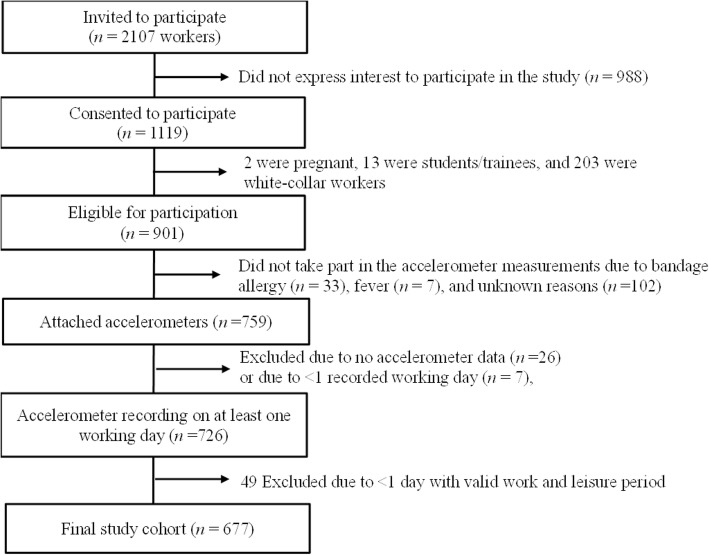
Time spent sedentary, standing, and in physical activity (walking/running/stair climbing/cycling) during work and leisure was determined for 1-4 days among 677 blue-collar workers using accelerometry. Differences between sexes and age groups were tested using MANOVA, using both a standard and a CoDA approach based on isometric log-ratio transformed data.
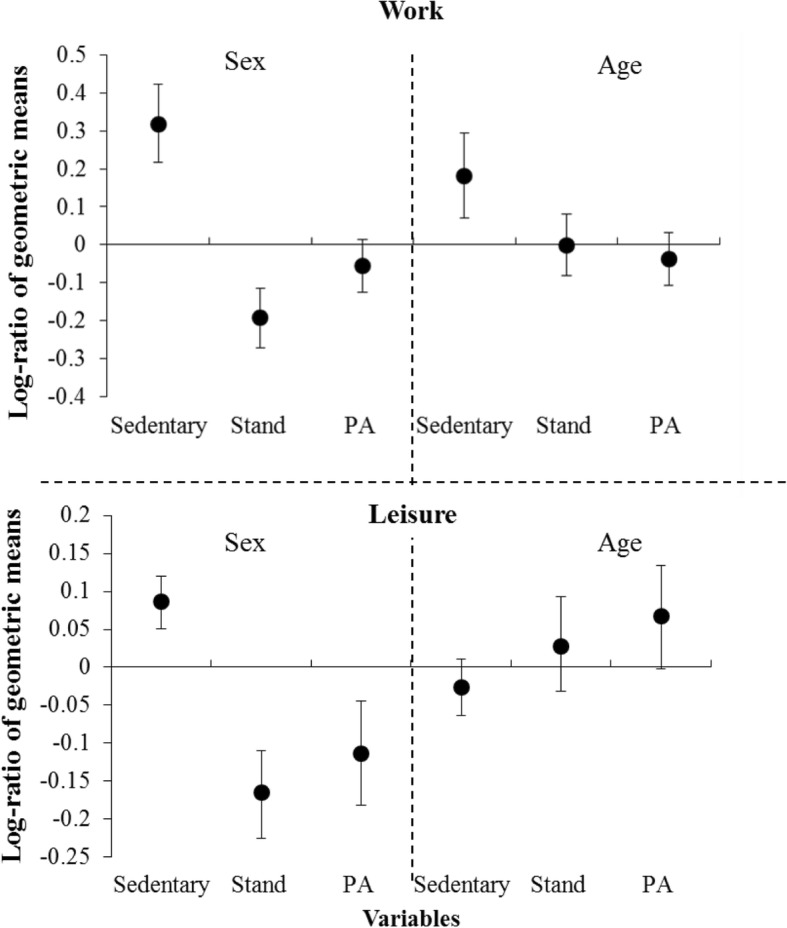
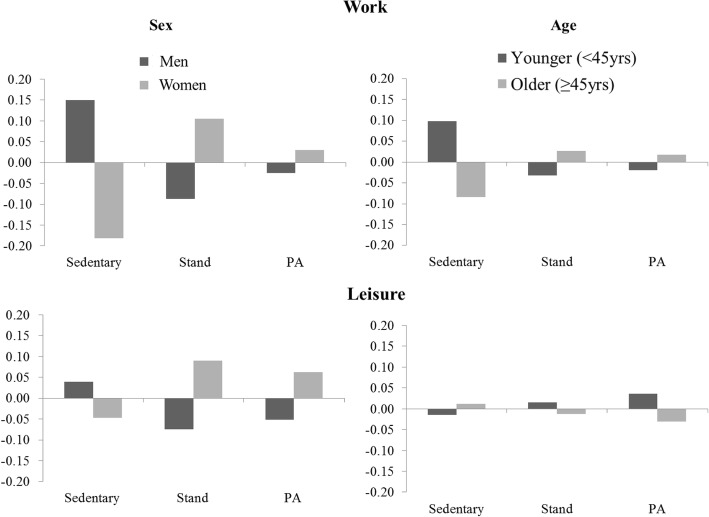
When determining differences between sexes for different activities time at work, the effect size using standard analysis (η = 0.045, p < 0.001) was 15% smaller than that obtained with CoDA (η = 0.052, p < 0.001), although both approaches suggested a statistically significant difference. When determining corresponding differences between age groups, CoDA resulted in a 60% larger, and significant, effect size (η = 0.012, p = 0.02) than that obtained with the standard approach (η = 0.008, p = 0.07). During leisure, results based on standard (age; η = 0.007, p = 0.09; sex; η = 0.052, p < 0.001) and CoDA (age; η = 0.007, p = 0.09; sex; η = 0.051, p < 0.001) analyses were similar.
Results and, hence, inferences concerning age and sex-based differences in time spent sedentary and in physical activity at work differed between CoDA and standard analysis. We encourage researchers to use CoDA in similar studies, to adequately account for the compositional nature of data on physical activity and sedentary behavior.
一天中进行身体活动、久坐行为和睡眠所花费的时间数据本质上是组合性的,即它们加起来是一个常数。组合数据与真实空间中的无约束数据具有根本不同的性质,需要使用其他分析程序,称为组合数据分析(CoDA)。然而,大多数身体活动和久坐行为研究仍然使用适用于真实空间数据的分析程序,这可能会导致误导性的结果。本研究描述了比较不同年龄组和性别之间久坐和身体活动时间的差异,并研究了 CoDA 获得的结果与使用标准分析程序获得的结果之间的差异程度。
使用加速度计在 677 名蓝领工人中连续 1-4 天记录工作和休闲时间的久坐、站立和身体活动(步行/跑步/爬楼梯/骑自行车)时间。使用 MANOVA 测试性别和年龄组之间的差异,使用基于等比对数转换数据的标准和 CoDA 方法。
当确定不同活动时间的性别差异时,使用标准分析(η=0.045,p<0.001)的效应大小比 CoDA 小 15%(η=0.052,p<0.001),尽管两种方法都表明存在统计学上的显著差异。当确定相应的年龄组差异时,CoDA 得到的效应大小大 60%(η=0.012,p=0.02),比标准方法(η=0.008,p=0.07)更显著。在休闲时间,基于标准(年龄;η=0.007,p=0.09;性别;η=0.052,p<0.001)和 CoDA(年龄;η=0.007,p=0.09;性别;η=0.051,p<0.001)分析的结果相似。
CoDA 和标准分析之间的工作时间久坐和身体活动时间的年龄和性别差异的结果和推论不同。我们鼓励研究人员在类似的研究中使用 CoDA,以充分考虑身体活动和久坐行为数据的组合性质。