Department of Epidemiology, Gillings School of Public Health, University of North Carolina, Chapel Hill, USA.
Center for Environmental Health and Susceptibility, University of North Carolina, Chapel Hill, USA.
Sci Rep. 2018 Jun 14;8(1):9137. doi: 10.1038/s41598-018-27505-y.
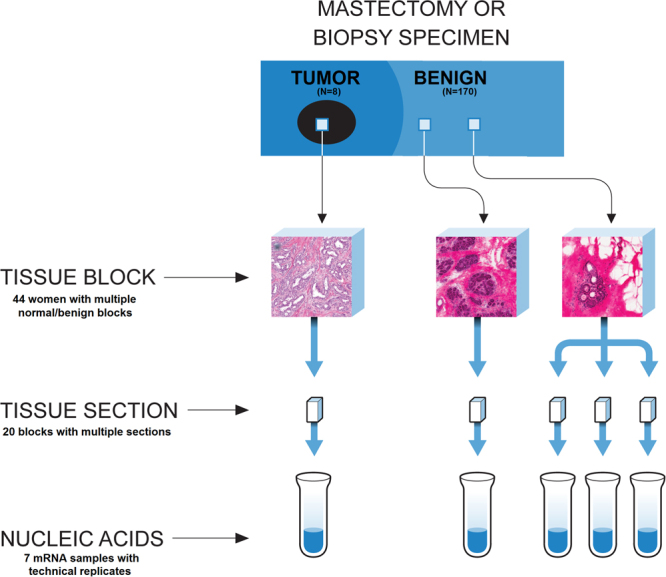
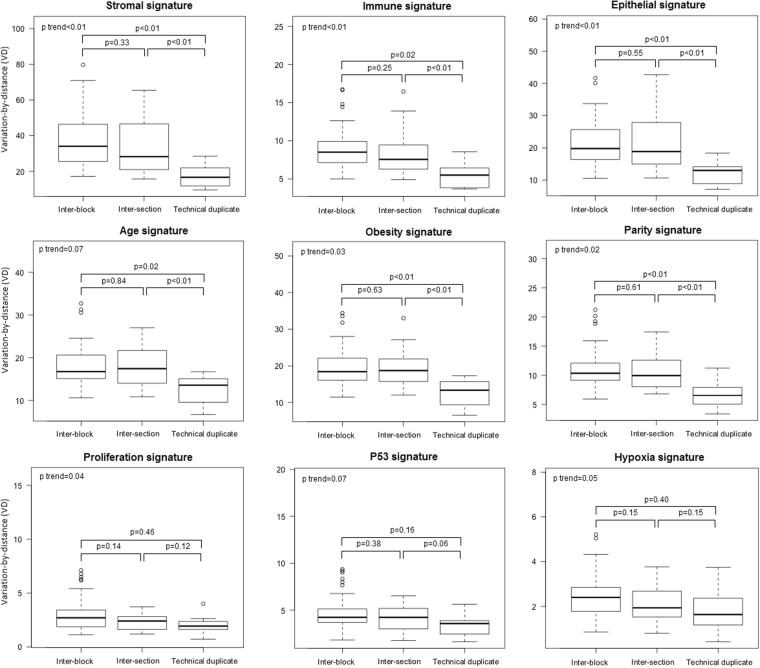
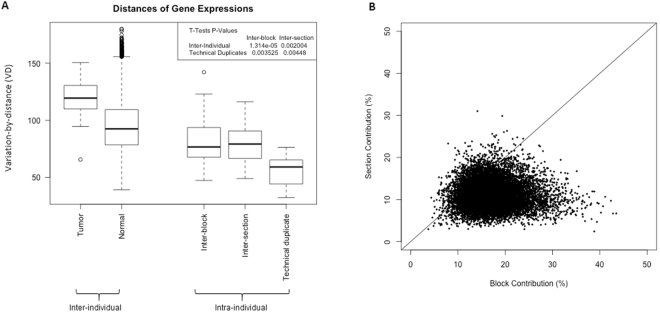
Several studies have sought to identify novel transcriptional biomarkers in normal breast or breast microenvironment to predict tumor risk and prognosis. However, systematic efforts to evaluate intra-individual variability of gene expression within normal breast have not been reported. This study analyzed the microarray gene expression data of 288 samples from 170 women in the Normal Breast Study (NBS), wherein multiple histologically normal breast samples were collected from different block regions and different sections at a given region. Intra-individual differences in global gene expression and selected gene expression signatures were quantified and evaluated in association with other patient-level factors. We found that intra-individual reliability was relatively high in global gene expression, but differed by signatures, with composition-related signatures (i.e., stroma) having higher intra-individual variability and tumorigenesis-related signatures (i.e., proliferation) having lower intra-individual variability. Histological stroma composition was the only factor significantly associated with heterogeneous breast tissue (defined as > median intra-individual variation; high nuclear density, odds ratio [OR] = 3.42, 95% confidence interval [CI] = 1.15-10.15; low area, OR = 0.29, 95% CI = 0.10-0.86). Other factors suggestively influencing the variability included age, BMI, and adipose nuclear density. Our results underscore the importance of considering intra-individual variability in tissue-based biomarker development, and have important implications for normal breast research.
一些研究试图鉴定新的正常乳腺或乳腺微环境中的转录生物标志物,以预测肿瘤风险和预后。然而,尚未有系统性研究评估正常乳腺内基因表达的个体内变异性。本研究分析了来自正常乳腺研究(NBS)中的 170 名女性 288 个样本的微阵列基因表达数据,其中多个组织学上正常的乳腺样本取自不同的组织块区域和给定区域的不同切片。量化并评估了个体内的总体基因表达和选定的基因表达特征与其他患者水平因素的关联。我们发现,个体内的总体基因表达的可靠性相对较高,但特征不同,组成相关的特征(即基质)具有更高的个体内变异性,而与肿瘤发生相关的特征(即增殖)具有较低的个体内变异性。组织学基质组成是唯一与异质性乳腺组织显著相关的因素(定义为个体内变异性>中位数;高核密度,比值比[OR] = 3.42,95%置信区间[CI] = 1.15-10.15;低面积,OR = 0.29,95% CI = 0.10-0.86)。其他因素提示可能影响变异性的包括年龄、BMI 和脂肪细胞核密度。我们的结果强调了在基于组织的生物标志物开发中考虑个体内变异性的重要性,这对正常乳腺研究具有重要意义。