Division of Hematology and Oncology, Department of Medicine, Massachusetts General Hospital Cancer Center and Harvard Medical School, Boston, Massachusetts.
Department of Psychiatry, Massachusetts General Hospital and Harvard Medical School, Boston, Massachusetts.
Cancer. 2018 Aug;124(16):3445-3453. doi: 10.1002/cncr.31576. Epub 2018 Jun 15.
Patients with cancer experience many stressors placing them at risk for posttraumatic stress disorder (PTSD) symptoms, yet little is known about factors associated with PTSD symptoms in this population. This study explored relationships among patients' PTSD symptoms, physical and psychological symptom burden, and risk for hospital readmissions.
We prospectively enrolled patients with cancer admitted for an unplanned hospitalization from August 2015-April 2017. Upon admission, we assessed patients' PTSD symptoms (Primary Care PTSD Screen), as well as physical (Edmonton Symptom Assessment System [ESAS]) and psychological (Patient Health Questionnaire 4 [PHQ-4]) symptoms. We examined associations between PTSD symptoms and patients' physical and psychological symptom burden using linear regression. We evaluated relationships between PTSD symptoms and unplanned hospital readmissions within 90-days using Cox regression.
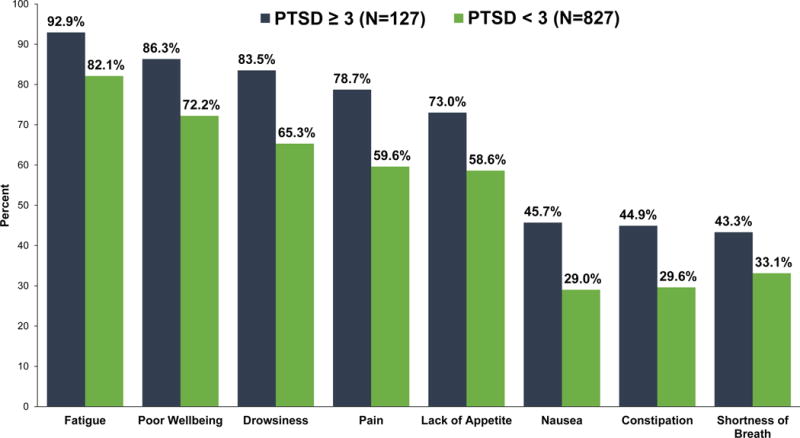
We enrolled 954 of 1,087 (87.8%) patients approached, and 127 (13.3%) screened positive for PTSD symptoms. The 90-day hospital readmission rate was 38.9%. Younger age, female sex, greater comorbidities, and genitourinary cancer type were associated with higher PTSD scores. Patients' PTSD symptoms were associated with physical symptoms (ESAS physical: B = 3.41; P < .001), the total symptom burden (ESAS total: B = 5.97; P < .001), depression (PHQ-4 depression: B = 0.67; P < .001), and anxiety symptoms (PHQ-4 anxiety: B = 0.71; P < .001). Patients' PTSD symptoms were associated with a lower risk of hospital readmissions (hazard ratio, 0.81; P = .001).
A high proportion of hospitalized patients with cancer experience PTSD symptoms, which are associated with a greater physical and psychological symptom burden and a lower risk of hospital readmissions. Interventions to address patients' PTSD symptoms are needed and should account for their physical and psychological symptom burden. Cancer 2018. © 2018 American Cancer Society.
癌症患者面临许多压力源,使他们有患创伤后应激障碍(PTSD)的风险,但对于这一人群中与 PTSD 症状相关的因素知之甚少。本研究探讨了患者 PTSD 症状、身体和心理症状负担以及再次住院风险之间的关系。
我们前瞻性地招募了 2015 年 8 月至 2017 年 4 月期间因非计划性住院而入院的癌症患者。入院时,我们评估了患者的 PTSD 症状(初级保健 PTSD 筛查),以及身体症状(埃德蒙顿症状评估系统[ESAS])和心理症状(患者健康问卷 4 [PHQ-4])。我们使用线性回归来检查 PTSD 症状与患者身体和心理症状负担之间的关系。我们使用 Cox 回归评估 PTSD 症状与 90 天内非计划性住院再入院之间的关系。
我们对 954 名(87.8%)提出的患者中的 1087 名进行了评估,其中 127 名(13.3%)筛查出 PTSD 症状阳性。90 天内的医院再入院率为 38.9%。年龄较小、女性、合并症较多和泌尿生殖系统癌症类型与更高的 PTSD 评分相关。患者的 PTSD 症状与身体症状(ESAS 身体:B = 3.41;P < .001)、总症状负担(ESAS 总:B = 5.97;P < .001)、抑郁(PHQ-4 抑郁:B = 0.67;P < .001)和焦虑症状(PHQ-4 焦虑:B = 0.71;P < .001)相关。患者的 PTSD 症状与较低的医院再入院风险相关(风险比,0.81;P = .001)。
相当比例的住院癌症患者经历 PTSD 症状,这些症状与更大的身体和心理症状负担以及较低的医院再入院风险相关。需要针对患者的 PTSD 症状进行干预,并且应该考虑到他们的身体和心理症状负担。癌症 2018。© 2018 美国癌症协会。